
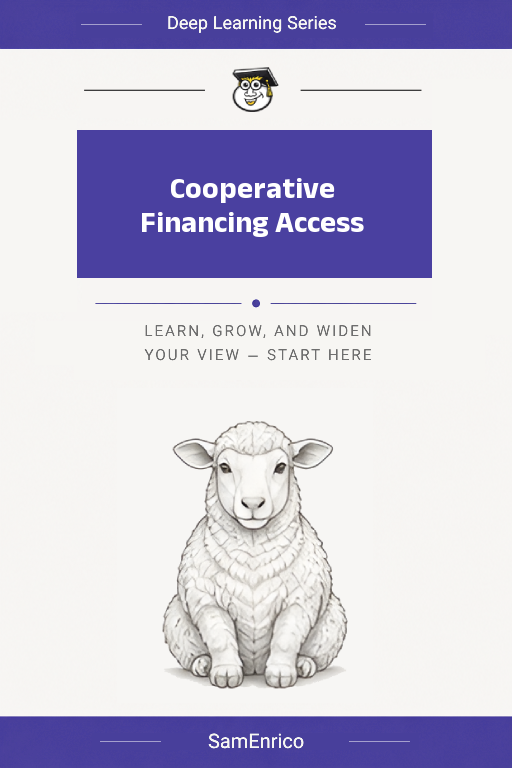
Non-FictionBusiness BriefCooperative Finance
Cooperative Financing Access
Secure loans from cooperative banks, development f
Secure loans from cooperative banks, development finance institutions, and impact investors for co-op enterprises.
Formats
About this book
Free sample
Chapter 1: The Great Lockbox--The first time Maria Santos sat across from a loan officer at her local cooperative bank, she brought three years of audited financials, a member register with 1,200 names, and a business plan that projected a 15 percent return on assets within 24 months. She left two hours later with nothing but a polite rejection letter and a new vocabulary word: "unbankable."Maria was the elected board president of the Palawan Coconut Producers Cooperative, a fifty-year-old enterprise that aggregated the harvest of 1,200 smallholder farmers on a Philippine island known for its biodiverse rainforests and chronic poverty. The cooperative had never missed a member patronage payment in its history. It had weathered typhoons, price collapses, and a global pandemic without laying off a single employee. It owned a small processing facility that turned raw coconuts into virgin oil, and it had secured a purchase agreement with a Manila-based exporter that wanted triple the current volume.All Maria needed was two million dollars to expand the processing line.The loan officer at the cooperative bank was sympathetic.
He was, after all, employed by an institution founded on the same Raiffeisen principles that had given rise to Maria's cooperative a century earlier. But his hands were tied by a regulation that had nothing to do with Maria's profitability or her cooperative's track record. The bank's internal risk model required physical collateral that could be seized and sold in a liquidation event. Maria's cooperative had plenty of assets—the processing facility, the land it sat on, the equipment inside, the member contributions held in reserve—but all of it was legally "locked." Under Philippine cooperative law, as under cooperative law in most countries, those assets could not be distributed to members and, crucially, could not be easily seized by creditors. The lock was designed to protect the cooperative's mission from being dismantled by opportunists.
But to the bank's risk model, a locked asset was no asset at all.Maria walked out onto the street and asked herself a question that cooperative leaders around the world ask every day: How can an enterprise that is profitable…
This is the end of the free sample. Get the eBook to keep going. Buy now
Contents
- Chapter 1
- Chapter 2
- Chapter 3
- Chapter 4
- Chapter 5
- Chapter 6
- Chapter 7
- Chapter 8
- Chapter 9
- Chapter 10
- Chapter 11
- Chapter 12
Details
- Author
- Francisco Aurora
- Publisher
- SamEnrico
- Language
- English
- Genre
- Non-Fiction, Business Brief, Cooperative Finance
- Released
- 2026-05-29
- Pages (approx.)
- 154
- Available as
- eBook, Audiobook

Read better in the ZLOADR app
Your eBooks on your phone or tablet. Sign in with your SamEnrico account and start reading.
More by Francisco Aurora
 Testosterone and Cholesterol BalanceFrancisco Aurora$11.99
 Kigali Data Privacy Compliance GuideFrancisco Aurora$11.99
 Elaboration Study Strategies GuideFrancisco Aurora$11.99
 Body Scan for EndometriosisFrancisco Aurora$11.99
 Information Overload Filtering SystemFrancisco Aurora$11.99
 Whispers of the Celestial Cartographer: Mapping the Heavens Before TimeFrancisco Aurora$11.99
 The Last Dance of the Sultan: The Untold Story of Adnan Kahveci's Rise and FallFrancisco Aurora$11.99
 Golden Retriever BreedingFrancisco Aurora$11.99
 Hobart Study And PR GuideFrancisco Aurora$12.99
 Understanding Charcot–Marie–tooth Type 1 Aplasia Cutis CongenitaFrancisco Aurora$17.99
 How to Become a Bull-chain OperatorFrancisco Aurora$11.99
You may also like
 Hong Kong Handover 1997Dunn Johnnie$11.99
 Zumba For Postnatal Recovery CourseNeal Christian$11.99
 Zumba for BeginnersLadner Nikia$11.99
 YouTube Comment Mining GuideHumes Pandora$12.99
 Worry Box MeditationCarlin Rudy$11.99
 Workplace Stress MeditationNguyen Lynn$11.99
 Workplace Stress and Sleep RepairHawley Ivory$11.99
 Workplace Perfectionism CureDelaney Jeffry$11.99
 Workplace Injustice Anger GuideWallen Isabelle$11.99
 Work Addiction and Burnout LinkGreenwood Ester$11.99
 Women in Yoga and WellnessBeattie Galina$11.99
 Women in Stand Up ComedyChun Evangeline$11.99