
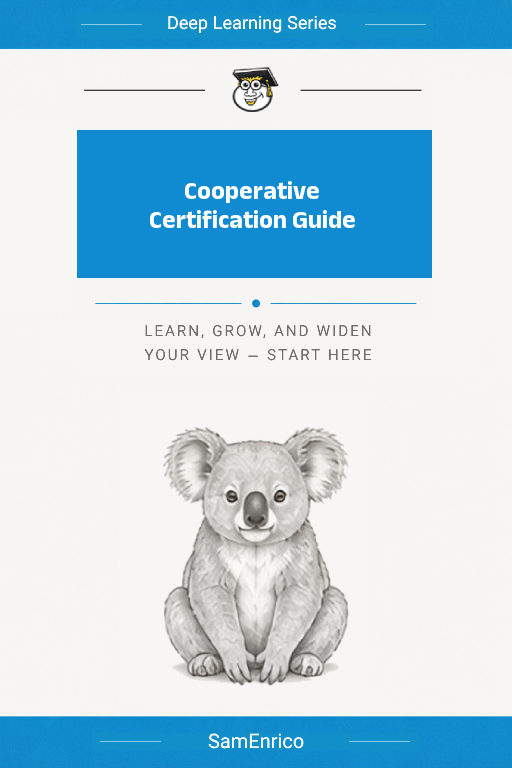
Non-FictionBusiness BriefAlternative Structures
Cooperative Certification Guide eBook
Get Fairtrade, Organic, and Rainforest Alliance ce
Get Fairtrade, Organic, and Rainforest Alliance certification for cooperatives. Premium prices and market access.
Formats
Free sample
Chapter 1: The Stacking Imperative...–- Maria sat at the wooden table that served as her desk, surrounded by three separate audit reports from three different certification bodies. As the general manager of a 1,200-member coffee cooperative in the highlands of northern Nicaragua, she had spent the past six months preparing for back-to-back inspections. The Fairtrade auditor came in February, the Organic certifier in March, and the Rainforest Alliance team just last week. Each had requested essentially the same documents: member lists, input records, training logs, grievance reports. Each had asked the same questions about traceability, child labor, and water management.
And each had issued findings that, while slightly different in wording, pointed to the same underlying gaps in her cooperative's internal systems.Maria’s story is not unusual. In fact, it is the norm. Across the global South, thousands of cooperative managers spend hundreds of hours each year duplicating efforts for multiple certifications, not because they lack competence, but because the certification system itself has evolved in silos. Fairtrade developed its standards to address social justice and trade equity. Organic standards emerged from the environmental movement’s focus on input prohibition and soil health.
Rainforest Alliance built its program around ecosystem services and biodiversity conservation. Each serves a legitimate and valuable purpose. But for the cooperative that wants to access premium prices from buyers who demand all three, the result is a fragmented, exhausting, and expensive process.This book exists because that fragmentation is no longer necessary. And this first chapter exists to convince you of one central truth: strategically stacking multiple certifications is not merely an option for ambitious cooperatives—it is rapidly becoming the minimum requirement for market access in the 21st-century global supply chain.The landscape has shifted beneath our feet. Between 2024 and 2026, three regulatory shocks have transformed what buyers demand from their suppliers.
The European Union Deforestation Regulation (EUDR) now requires that any agricultural commodity entering the EU market must be accompanied by proof that it was not produced on land deforested after December 31, 2020. The Corporate Sustainability Due Diligence Directive (CSDDD) mandates that large companies identify, prevent, and remediate human rights and environmental harms throughout their supply chains. And consumer-facing brands, facing legal liability under these new rules, have responded by demanding that their suppliers hold not one, but multiple certifications as a proxy for due diligence.The single-certification cooperative is no longer competitive. The cooperative that holds all three—Fairtrade, Organic, and Rainforest Alliance—is not only competitive but positioned to command premium prices that far exceed the sum of individual certification premiums. This chapter explains why.The Myth of the Single Certification Let us begin by naming a persistent myth: the belief that one certification is sufficient to open all doors.
This myth persists for understandable reasons. Twenty years ago, a cooperative could achieve Fairtrade certification and immediately access European buyers willing to pay the Minimum Price plus the Premium. Ten years ago, Organic certification alone was enough to command double the conventional market price for coffee, cocoa, or tea. Even five years ago, Rainforest Alliance certification was viewed as a nice-to-have differentiator for environmentally conscious brands.Those days are over.The myth survives because certification bodies themselves have historically positioned their standards as comprehensive solutions. Fairtrade’s marketing emphasizes social justice and economic empowerment.
Organic certifiers highlight health and environmental purity. Rainforest Alliance promotes its holistic approach to farm management. Each is telling a partial truth. But no single certification covers all of the risks that buyers now face under EUDR and CSDDD.Consider the following scenario, which is drawn from an actual case study of a Colombian coffee cooperative that learned this lesson the hard way. The cooperative held Organic certification and believed that was sufficient to satisfy its German buyer.
When the buyer requested proof of deforestation-free supply chains under EUDR, the cooperative was unable to provide it. Organic certification does not require geolocation of plots or historical deforestation analysis. The cooperative lost the contract. Meanwhile, a neighboring cooperative that held both Organic and Rainforest Alliance certification—the latter requiring GPS mapping of every member plot—was able to produce the necessary documentation within days. They gained the contract at a premium price.The lesson is brutal but clear: each certification covers a specific risk domain, and buyers now need proof across all domains simultaneously.The Comparative Standards Matrix To understand why stacking is necessary, we must first understand what each certification uniquely offers and where each falls short.
The table below, which will be referenced throughout this book, provides a side-by-side comparison of the three major certification schemes.Fairtrade International Fairtrade’s core strength is its social and economic architecture. The Fairtrade Minimum Price provides a safety net when commodity markets collapse, ensuring that farmers never sell below the cost of sustainable production. The Fairtrade Premium, an additional sum paid on top of the purchase price, is democratically managed by a joint body of cooperative members and workers. This Premium has financed schools, health clinics, clean water systems, and processing infrastructure for thousands of cooperatives worldwide.Fairtrade also pioneered requirements for democratic decision-making, gender equity (minimum 30 percent women in leadership positions), and the prohibition of child labor and forced labor. The Fairtrade system includes a robust certification and traceability mechanism through its Transaction Certificates.However, Fairtrade has significant gaps.
It does not require organic input management. Synthetic pesticides and fertilizers are permitted under Fairtrade standards as long as they are used safely. Fairtrade does not require geolocation of plots or deforestation analysis. And while Fairtrade requires environmental risk assessment, its environmental standards are less prescriptive than those of Rainforest Alliance or Organic.Organic Certification (EU Regulation 2018/848)Organic certification’s core strength is its prohibition of synthetic inputs. No synthetic pesticides, no synthetic fertilizers, no genetically modified organisms.
This creates a product that appeals to health-conscious consumers and commands premium prices in the European and North American markets. Organic certification also requires buffer zones between organic and conventional plots, crop rotation, soil conservation practices, and detailed input records.The weakness of Organic certification is its narrow focus. Organic standards say almost nothing about social conditions. Child labor is not explicitly addressed. Democratic governance is not required.
Wages and working conditions are not audited. Organic certification also does not require geolocation or deforestation analysis beyond basic record-keeping. A cooperative could be fully Organic certified and still have endemic child labor or supply chains linked to recent deforestation—and the Organic certifier would never know.Rainforest Alliance (2020 Certification Program)Rainforest Alliance’s core strength is its ecosystem-based approach. The 2020 Certification Program introduced the “Smart Meter” system, which scores cooperatives on a scale of 0 to 100 across multiple indicators including water management, biodiversity conservation, soil health, and climate resilience. Certification requires maintaining a minimum score rather than achieving perfection overnight, which encourages continuous improvement.Rainforest Alliance requires geolocation of every member plot using GPS coordinates, which has become unexpectedly valuable for EUDR compliance.
It also requires wastewater management protocols for wet mills, biodiversity buffers, and agroforestry practices. Unlike Fairtrade, Rainforest Alliance includes social standards such as non-discrimination, freedom of association, and prohibition of child labor, but these are less detailed than Fairtrade’s requirements.The weakness of…
This is the end of the free sample. Get the eBook to keep going. Buy now
About this book
Details
- Author
- Thomsen Leatha
- Publisher
- SamEnrico
- Language
- English
- Genre
- Non-Fiction, Business Brief, Alternative Structures
- Released
- 2026-05-30
- Pages (approx.)
- 158
- Available as
- eBook, Audiobook

Read better in the ZLOADR app
Your eBooks on your phone or tablet. Sign in with your SamEnrico account and start reading.
More by Thomsen Leatha
 The Environment Design WorkbookThomsen Leatha$11.99
 Internal Comms PlaybookThomsen Leatha$11.99
 Hidden Lactose SourcesThomsen Leatha$11.99
 Anger for ArtistsThomsen Leatha$11.99
 Workaholism in NonprofitsThomsen Leatha$11.99
 The Last Whisper of the Beothuk: A Vanished People’s Untold StoryThomsen Leatha$11.99
 Parent Caregiver Micro BreaksThomsen Leatha$12.99
 Understanding Spongiform EncephalopathyThomsen Leatha$17.99
 How to Become a Lead-caster HelperThomsen Leatha$11.99
 Australorp Chicken BreedingThomsen Leatha$11.99
You may also like
 Hong Kong Handover 1997Dunn Johnnie$11.99
 Zumba For Postnatal Recovery CourseNeal Christian$11.99
 Zumba for BeginnersLadner Nikia$11.99
 YouTube Comment Mining GuideHumes Pandora$12.99
 Worry Box MeditationCarlin Rudy$11.99
 Workplace Stress MeditationNguyen Lynn$11.99
 Workplace Stress and Sleep RepairHawley Ivory$11.99
 Workplace Perfectionism CureDelaney Jeffry$11.99
 Workplace Injustice Anger GuideWallen Isabelle$11.99
 Work Addiction and Burnout LinkGreenwood Ester$11.99
 Women in Yoga and WellnessBeattie Galina$11.99
 Women in Stand Up ComedyChun Evangeline$11.99