
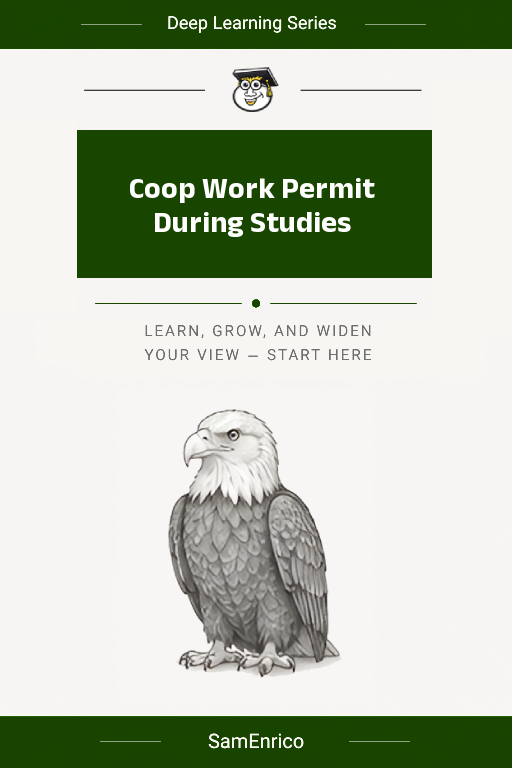
Coop Work Permit During Studies eBook
Add a co-op work permit to your study permit for m
Add a co-op work permit to your study permit for mandatory internships, ensuring work terms count toward CRS points.
Formats
Free sample
Chapter 1: The 50-Point Myth--–- Sarah had done everything right. A diligent computer engineering student from India, she had secured a coveted 16-month co-op position at a prominent Canadian fintech company in downtown Toronto. She worked 40 hours per week, paid taxes, contributed to CPP and EI, and even received a glowing performance review. When she graduated and created her Express Entry profile, she confidently listed those 1,340 co-op hours under "Canadian Work Experience." She calculated her CRS score expecting to see an additional 50 points for one year of skilled Canadian work. Instead, her score sat exactly where it would have been if she had never worked a single day.
She received a Procedural Fairness Letter months later accusing her of misrepresentation. Her $15,000 in immigration fees and her 16 months of hard work had contributed exactly zero points to her ranking. This book exists to ensure this does not happen to you.The Most Dangerous Assumption in Canadian Student Immigration The single most costly misunderstanding among international students in Canada is the belief that any paid work performed while holding a valid study permit and a co-op work permit automatically counts toward the Comprehensive Ranking System (CRS) points under the Canadian Experience Class (CEC). This assumption appears logical. You worked.
You were paid. You were in Canada. Why would those hours not count?The answer lies in a specific, often-overlooked clause in the Immigration and Refugee Protection Regulations. Work performed while you are a full-time student, regardless of the type of permit you hold, is explicitly excluded from consideration as "Canadian work experience" for the purpose of CEC ranking points. This includes on-campus work, off-campus work under the 20-hour rule, and co-op work under a dedicated co-op work permit.
The exclusion is absolute and unforgiving.This chapter will demolish this dangerous assumption, introduce the critical distinction between CEC ranking points and Federal Skilled Worker Program (FSWP) eligibility, and establish the foundational principle that will guide this entire book: a co-op work permit is not a direct points-generating tool for your Express Entry ranking. Instead, it is a strategic asset for skill development, employer networking, and securing a post-graduation job offer that can indirectly lead to CRS points through entirely different mechanisms.The Student Loophole: What IRCC Actually Says Let us examine the exact language from Immigration, Refugees and Citizenship Canada (IRCC) operational manuals. Under the Canadian Experience Class, work experience acquired while you were a full-time student does not count toward the minimum requirements, regardless of whether you held a valid work permit. The policy rationale is straightforward: the CEC is designed to reward post-graduation integration into the Canadian labor market, not learning experiences that are part of your academic program.This is what immigration professionals call the "Student Loophole," though it is not a loophole at all. It is a deliberate exclusion.
IRCC considers any work performed while you hold full-time student status as fundamentally different from work performed after you have graduated and entered the labor market as a permanent resident applicant. The logic is that student workers have different protections, different expectations, and different relationships with employers than permanent workers.To make this concrete, consider two identical software developers. Developer A completes a 12-month co-op term at Shopify during her studies, working 40 hours per week. Developer B graduates, then works 12 months at Shopify on a Post-Graduation Work Permit (PGWP). Both perform identical duties.
Both are paid the same salary. Developer B receives 40 CRS points for one year of Canadian work experience. Developer A receives zero. The work itself is identical. The only difference is the timing relative to graduation.This is the brutal reality that no university orientation session and no co-op office advisor will explain to you.
Most academic advisors are experts in education, not immigration law. They will celebrate your co-op placement without understanding the CRS implications. This book fills that gap.The Critical Distinction: CEC Ranking vs. FSWP Eligibility To understand what co-op work can and cannot do for your immigration journey, you must internalize a fundamental distinction that the original version of this book initially confused. Let us state it clearly and permanently, as this resolved inconsistency forms the backbone of every subsequent chapter.Distinction One – CEC Ranking Points: Under the Canadian Experience Class, which is one of three federal economic immigration programs managed through Express Entry, you receive CRS points for Canadian work experience.
These points range from 40 points for one year of experience to 80 points for five or more years. Work performed while you were a full-time student, including co-op work, contributes zero points to this calculation. This rule is absolute and applies regardless of the quality, duration, or compensation of your co-op position.Distinction Two – FSWP Eligibility: Under the Federal Skilled Worker Program, which is a separate economic immigration program also managed through Express Entry, you must first qualify for the program by scoring at least 67 points on a six-factor grid. This grid includes points for work experience. Unlike the CEC, the FSWP does allow you to count work performed while you were a student, including co-op work, toward its minimum work experience requirement of one continuous year of skilled work.
However, meeting FSWP eligibility does not automatically give you CRS ranking points. It only allows you to enter the Express Entry pool under that program.This distinction creates a paradoxical situation that confuses even experienced immigration consultants. Your 12-month co-op term can make you eligible for the FSWP (good), but it cannot give you any CRS ranking points under the CEC (not good). If you are eligible for both programs, your CRS score will be calculated without those co-op hours. If you are only eligible for the FSWP because you lack Canadian experience after graduation, you enter the pool with a lower score.The following table, which will be referenced throughout this book, summarizes this distinction clearly:Type of Work Counts for CEC Ranking Points?Counts for FSWP Eligibility (67-point grid)?Co-op work during full-time studies NOYES (if paid and skilled)Off-campus work during full-time studies (20-hour limit)NOYES (if paid and skilled)On-campus work during full-time studies NOYES (if paid and skilled)Post-graduation work on PGWPYESYESThis table resolves the inconsistency that plagued earlier versions of this book.
Chapter 1 does not claim that co-op work counts for nothing. It claims that co-op work counts for zero CEC ranking points. Chapter 6 will explore how to use co-op work for FSWP eligibility. Chapter 11 will apply this to a 16-month co-op case study. No subsequent chapter will contradict this foundational rule.The Bridge to Chapter 7: 50 Points from Job Offers, Not from Work History Before readers proceed, another potential confusion must be addressed.
Chapter 7 of this book discusses how a return job offer secured through a co-op term can generate +50 CRS points under the "Arranged Employment" category. This is not a contradiction of Chapter 1. The two mechanisms are entirely separate.Chapter 1 addresses direct work experience points. You receive these points simply for having worked a certain number of years in Canada. Co-op work gives you zero of these points.Chapter 7 addresses arranged employment points.
You receive these points if you have a valid job offer from a Canadian employer for at least one year after you…
This is the end of the free sample. Get the eBook to keep going. Buy now
About this book
Details
- Author
- Tavares Garland
- Publisher
- SamEnrico
- Language
- English
- Genre
- Non-Fiction, Student's Shortcut
- Released
- 2026-05-30
- Pages (approx.)
- 154
- Available as
- eBook, Audiobook

Read better in the ZLOADR app
Your eBooks on your phone or tablet. Sign in with your SamEnrico account and start reading.
More by Tavares Garland
 Dream Incubation for Creative BlocksTavares Garland$11.99
 Morning Routine for HR ProsTavares Garland$11.99
 Open Book Exam Strategy GuideTavares Garland$11.99
 Masked Improv GameTavares Garland$11.99
 Lake Placid Calming ScriptTavares Garland$11.99
 Postpartum Sleep MeditationTavares Garland$11.99
 Tress MacNeille Animation QueenTavares Garland$11.99
 Early Menopause Causes And CareTavares Garland$11.99
 The Last Breath: The Untold Story of the First Lung TransplantTavares Garland$11.99
 Baba Yaga's Bone House: The Witch Who Ate the WorldTavares Garland$11.99
 How to Produce Vehicle Fuel System CleanersTavares Garland$11.99
 Vegan Certification ExportTavares Garland$12.99
You may also like
 Hong Kong Handover 1997Dunn Johnnie$11.99
 Zumba For Postnatal Recovery CourseNeal Christian$11.99
 Zumba for BeginnersLadner Nikia$11.99
 YouTube Comment Mining GuideHumes Pandora$12.99
 Worry Box MeditationCarlin Rudy$11.99
 Workplace Stress MeditationNguyen Lynn$11.99
 Workplace Stress and Sleep RepairHawley Ivory$11.99
 Workplace Perfectionism CureDelaney Jeffry$11.99
 Workplace Injustice Anger GuideWallen Isabelle$11.99
 Work Addiction and Burnout LinkGreenwood Ester$11.99
 Women in Yoga and WellnessBeattie Galina$11.99
 Women in Stand Up ComedyChun Evangeline$11.99