
Non-FictionAI OperatorStartup Legal
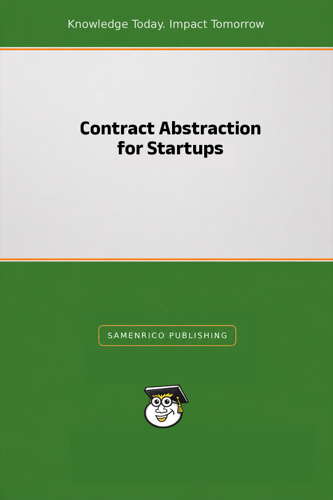
Contract Abstraction for Startups eBook
Implement lean AI contract review for early-stage
Implement lean AI contract review for early-stage companies with limited legal budgets.
Formats
Free sample
Chapter 1: The $47,000 Email--–- The email arrived on a Tuesday. Maya Chen, founder of a sixteen-person B2B Saa S startup called Relay, had been awake since 4:00 AM troubleshooting a database migration. She skimmed the subject line—“Relay LLC Vendor Agreement Renewal”—and filed it in a folder called “Legal/Contracts.” She told herself she would read it later. Later never came.Ninety days after that email, Relay’s bank account was charged $47,000 for software licenses that exactly zero employees were using. The contract had renewed automatically.
The 60-day cancellation window had closed forty-seven days earlier. Maya had missed it by almost seven weeks.She called the vendor. They were polite but firm. “Per Section 8.2 of your agreement,” the account manager said, “automatic renewal is triggered unless written notice is provided within the specified window. We received no such notice.” Maya opened the PDF.
There it was, buried on page twenty-three: “This Agreement shall automatically renew for successive one-year terms unless either party provides written notice of non-renewal at least sixty (60) days prior to the end of the then-current term.”She had signed that contract eighteen months ago. She had read the first three pages, checked the pricing, and clicked “Sign.” The $47,000 was non-refundable.That story is true. The names have been changed, but the company exists. The founder still flinches when she tells it.Here is another one.A hardware startup called Stretto had hired a freelance firmware developer to write the code that would make their device actually work. The contract was a template from a popular document generation service.
It included a standard “work for hire” clause. The founder, a former mechanical engineer, assumed that meant the company owned the code. Eighteen months later, after raising $2 million in seed funding, the startup tried to license the firmware to a manufacturer. The developer surfaced. He had kept a copy of the contract.
He pointed to a clause the founder had never read: “All intellectual property rights in any deliverables shall remain with Contractor unless expressly assigned in writing.”The contract did not contain an express assignment of IP. The “work for hire” clause meant nothing under US law because the developer was an independent contractor, not an employee. The developer demanded $500,000 for a retroactive assignment. The startup paid. They had no choice.
The firmware was their only asset.These are not horror stories about predatory vendors or bad-faith contractors. They are horror stories about contracts—specifically, about what happens when founders do not read them, or read them badly, or rely on assumptions instead of extraction.The Billable Hour Trap If you are a founder, you already know the problem. Legal review is slow, expensive, and psychologically draining. A junior associate at a mid-sized law firm bills between $250 and $400 per hour. A standard Master Services Agreement, the kind you need for every enterprise customer, takes four to six hours to review properly.
That is $1,200 to $2,400 per contract. If your startup is closing ten customer contracts per month, that is $12,000 to $24,000 in legal fees. For a seed-stage company, that is not an expense. It is a crisis.So most founders do what Maya did. They skim.
They sign. They hope.The legal industry has a name for this. They call it the “billable hour trap.” Here is how it works: lawyers are incentivized to spend more time, not less. Thoroughness is rewarded. Efficiency is penalized.
A partner who tells a junior associate “this contract only needs two hours of review” is leaving money on the table. The system was designed for Fortune 500 companies with dedicated legal departments, not for startups trying to find product-market fit with six months of runway.But there is another trap, and it is the one that hurts more.The Trap of Assumed Comprehension When Maya signed that $47,000 auto-renewal, she was not being lazy. She was being human. Research on contract reading comprehension is sobering. A 2019 study published in the Journal of Empirical Legal Studies found that when experienced business professionals were given a standard commercial contract and asked to identify “material risks,” they missed an average of 37 percent of the clauses that would later trigger financial liability.
When the same professionals were given a time constraint (under one hour), the miss rate climbed to 58 percent.Think about that. More than half of the clauses that could cost you money—you will not see them.The problem is not intelligence or effort. The problem is volume and structure. Contracts are written in a language that nobody speaks. “Indemnification,” “force majeure,” “severability,” “subrogation”—these words exist nowhere outside of legal documents.
They are designed to be precise, which is good for litigation and terrible for reading. Every sentence is a hedge against a future lawsuit. Every clause is a trap door that might open or might not.Your brain, confronted with a thirty-page MSA, does one of two things. It either glazes over (the “I’ll read it later” response) or it falsely reassures itself (the “this looks standard” response). Both responses cost you money.A Different Way This book exists because a third response is now possible.
Large language models—the technology behind Chat GPT, Claude, and Llama—are not lawyers. They do not understand the law. They cannot give you advice. But they can do something that humans cannot do reliably or affordably: they can read a fifty-page contract in thirty seconds and extract exactly the five to ten clauses that actually matter to your business.This is not artificial intelligence as Hollywood imagines it. There is no robot lawyer arguing before a judge.
There is a pattern-matching engine that has been trained on millions of legal documents and can spot a limitation of liability clause with 94 percent accuracy. That is not perfect. It is better than human skimming, which operates at somewhere around 60 percent accuracy under time pressure. And it costs less than five cents per page.Here is the core argument of this book, stated plainly:You do not need to read contracts. You need to abstract them.Abstraction, borrowed from software engineering, means hiding complex implementation details behind a simple interface.
When you use a banking app, you do not see the code that moves money between servers. You see a button that says “Transfer.” Legal abstraction works the same way. A fifty-page NDA contains dozens of clauses, but a founder needs to know three things: (1) How long does confidentiality last? (2) What information is excluded? (3) What happens if there is a leak?
The AI’s job is to hide the legalese and answer those three questions.This book teaches you how to build that abstraction layer for your startup. It assumes no legal training and no programming experience. It assumes you have a laptop, an internet connection, and a willingness to spend twenty dollars per month on a Chat GPT subscription. It assumes you are tired of paying lawyers for work that a machine can do better, faster, and cheaper.But let us be precise about what this book does and does not claim.What This Book Is Not This book is not a replacement for lawyers.That statement matters, so I will repeat it. This book is not a replacement for lawyers.…
This is the end of the free sample. Get the eBook to keep going. Buy now
About this book
Details
- Author
- Goldstein Felica
- Publisher
- SamEnrico
- Language
- English
- Genre
- Non-Fiction, AI Operator, Startup Legal
- Released
- 2026-06-10
- Pages (approx.)
- 133
- Available as
- eBook, Audiobook

Read better in the ZLOADR app
Your eBooks on your phone or tablet. Sign in with your SamEnrico account and start reading.
More by Goldstein Felica
 Long Term Care Basics HandbookGoldstein Felica$11.99
 Counting Breaths for ConcentrationGoldstein Felica$11.99
 China FCPA Enforcement TrackerGoldstein Felica$11.99
 Manic Episode ListeningGoldstein Felica$11.99
 Imposter Group Therapy GuideGoldstein Felica$11.99
 Stay at Home Parent TimeGoldstein Felica$11.99
 Kenya KenyattaGoldstein Felica$11.99
 Cacao Ceremony Leadership GuideGoldstein Felica$11.99
 The Unbreakable Run: The 1966 Boston Marathon's Miracle MileGoldstein Felica$11.99
 The Siege of Hattin: Saladin's Triumph Over the CrusadersGoldstein Felica$11.99
 Echoes of the Deep: The Mysterious Song of the Humpback WhaleGoldstein Felica$11.99
 The Dancer's Guide to CsárdásGoldstein Felica$11.99
You may also like
 Hong Kong Handover 1997Dunn Johnnie$11.99
 Zumba For Postnatal Recovery CourseNeal Christian$11.99
 Zumba for BeginnersLadner Nikia$11.99
 YouTube Comment Mining GuideHumes Pandora$12.99
 Worry Box MeditationCarlin Rudy$11.99
 Workplace Stress MeditationNguyen Lynn$11.99
 Workplace Stress and Sleep RepairHawley Ivory$11.99
 Workplace Perfectionism CureDelaney Jeffry$11.99
 Workplace Injustice Anger GuideWallen Isabelle$11.99
 Work Addiction and Burnout LinkGreenwood Ester$11.99
 Women in Yoga and WellnessBeattie Galina$11.99
 Women in Stand Up ComedyChun Evangeline$11.99