
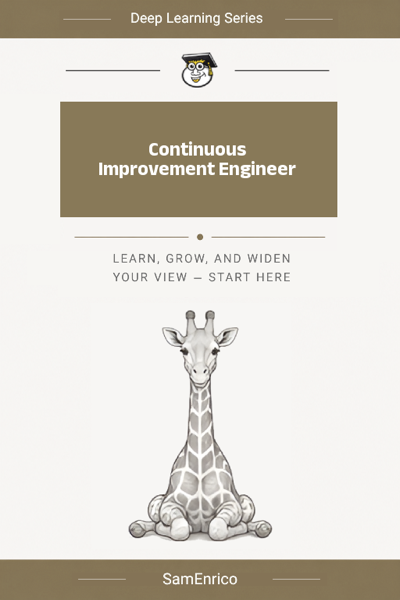
Non-FictionInformativeEducational
Continuous Improvement Engineer eBook
A Coursebook on Continuous Improvement Engineer
A Coursebook on Continuous Improvement Engineer
Formats
Free sample
Chapter 1: The Unfinished Engineer--The first time Priya ran a Kaizen event, she did everything right.She had her Green Belt. She had her stopwatch. She had her DMAIC template printed in triplicate. She showed up at 6:00 AM on a Monday, coffee in hand, ready to transform a failing assembly line that had missed delivery targets for eleven consecutive weeks.By Wednesday afternoon, the plant manager had stopped attending. By Thursday, two operators had asked to be reassigned.
And by Friday’s final presentation, the team had produced exactly three actionable improvements—none of which survived the weekend.Priya did everything right by the textbook. And the textbook failed her.She had been trained to be a problem-solver. But no one told her that problem-solving is only twenty percent of the job. The other eighty percent is something most CI courses never mention: designing systems where problems cannot survive, coaching humans through the terror of change, and learning to see waste that has become invisible to everyone else.This book is for the Priyas of the world. It is for the industrial engineers who suspect their Black Belt was mostly vocabulary.
It is for the quality managers who have a wall of control charts and a floor full of recurring defects. And it is for the operations leaders who have tried Lean, tried Six Sigma, tried Kaizen—and still cannot figure out why the gains never stick.The title of this book is Continuous Improvement Engineer. But the real title, the one that should have been on the cover, is The Unfinished Engineer.Because the best CI engineers are never finished. Not finished learning. Not finished seeing.
Not finished redesigning the systems they thought they fixed last quarter. And most importantly, they are not finished becoming the kind of engineer who does not solve problems—but rather, builds the conditions where problems solve themselves.The Lie You Were Told Let us name the lie immediately.The lie is this: continuous improvement is a toolkit. Learn the tools. Apply the tools. Get the results.This lie is perpetuated by belt mills that certify Green Belts in five days, by software companies that sell Kanban boards as if the board itself creates flow, and by consultants who need you to believe that failure is a knowledge problem—because if failure were a culture problem, they would have to stay longer and charge more.Here is the truth no one tells you in training: you already know enough tools.
The problem is not that you lack another Pareto chart template. The problem is that your organization has learned to resist change without even knowing it is resisting.Every organization develops antibodies. These antibodies are not malicious. They are not plotted in boardrooms. They emerge naturally, like scar tissue, from years of failed initiatives, broken promises, and leaders who declared “Lean transformation” and then asked for next quarter’s numbers unchanged.When you walk onto a factory floor or into an office with a stopwatch and a plan, you are not walking into a neutral space.
You are walking into a living system that has evolved defenses. Operators have seen six Sigma events come and go. Supervisors have been told “this time is different” four times. Plant managers have ROI spreadsheets from three consultants who all promised 30% productivity gains that never materialized.The CI engineer who succeeds is not the one with the most tools. It is the one who understands the antibodies and works with them, not against them.Three Roles, One Engineer Let us redefine what this job actually is.Traditional process engineering asks: how should this work?
The engineer designs a future state, specifies equipment, writes procedures, and hands the package to operations with a bow.Continuous Improvement Engineering asks a different question: how does this system want to work, and what is stopping it?This question requires three distinct roles that must live in the same person. Most CI engineers are good at one of these. The great ones master all three.Role One: The Analyst The analyst lives in data. Not big data—small, useful, messy, real-time data. The analyst knows how to distinguish a run chart from a control chart and, more importantly, knows when each is a waste of time.The analyst does not love statistics.
The analyst loves answers, and statistics are simply the most honest way to get them when the problem is complex and the stakes are high.But here is the secret about the analyst role: it is the least important of the three. Most CI problems are not data problems. They are visibility problems, incentive problems, or fear problems. The analyst can calculate a Cpk of 0.6 all day long, but if no one believes the number—or worse, if everyone believes it and has learned to live with it—the analysis changes nothing.The analyst’s job is to make the invisible visible. Not to build a shrine to the invisible.Role Two: The Facilitator The facilitator runs the room.
Whether it is a five-day Kaizen event or a thirty-minute root cause discussion, the facilitator ensures that the best ideas surface—not the loudest opinions, not the highest titles.Facilitation is the most counterintuitive skill for an engineer to learn. Engineers are trained to solve problems. Facilitators are trained to not solve problems. They ask questions. They draw out the quiet operator who has seen the defect pattern for two years but was never asked.
They protect the team from the plant manager who wants to skip analysis and jump to solutions.The facilitator knows that the best countermeasure will fail if the team does not own it. So the facilitator tolerates a slightly worse solution that the team believes in, because that solution will be improved next week, and the week after, while the “perfect” solution imposed from above will be abandoned by Monday.Role Three: The Architect The architect thinks in systems. Not just process flows—incentive systems, communication systems, visual management systems, handoff systems, escalation systems.The architect asks: what is the simplest rule change that would make the right behavior automatic? When defects appear, the novice buys a gauge. The expert creates a poka-yoke.
The architect realizes that the real problem is that no one was measured on quality, so she changes the weekly scorecard first, then designs the poka-yoke as the second step.The architect also knows when to stop designing. The most elegant Kanban system in the world is inferior to a two-bin system that operators actually use. The architect prioritizes adoption over elegance every time.Most CI engineers never develop the architect role. They stay as analysts or facilitators. That is fine.
But the ones who change industries—who go from fixing lines to fixing systems—are architects.The Three Pillars of Continuous Improvement Every decision you make as a CI engineer will be tested against three pillars. When a pillar is missing, improvement becomes impossible.Pillar One: Respect for People This is not a soft sentiment. It is a hard operational constraint.Respect for people means: the person who does the job knows the most about the job. Your job as a CI engineer is not to tell them what…
This is the end of the free sample. Get the eBook to keep going. Buy now
About this book
Details
- Author
- Batista Sunny
- Publisher
- SamEnrico
- Language
- English
- Genre
- Non-Fiction, Informative, Educational
- Released
- 2026-05-04
- Pages (approx.)
- 142
- Available as
- eBook, Audiobook

Read better in the ZLOADR app
Your eBooks on your phone or tablet. Sign in with your SamEnrico account and start reading.
More by Batista Sunny
 Buffett's Failed Ben BridgeBatista Sunny$11.99
 The Beginner's Meditation HandbookBatista Sunny$11.99
 Meeting Name Recall GuideBatista Sunny$11.99
 IGF1 and Aging ConnectionBatista Sunny$11.99
 The Poison Ring of 19th-Century Paris: The Deadly Legacy of the Papavoine FamilyBatista Sunny$11.99
 How to Produce Boys' ClothingBatista Sunny$11.99
 Ghana Mobile Money and Cash-on-Delivery StrategiesBatista Sunny$12.99
 How to Start a Professional Employer Organization BusinessBatista Sunny$11.99
You may also like
 Hong Kong Handover 1997Dunn Johnnie$11.99
 Zumba For Postnatal Recovery CourseNeal Christian$11.99
 Zumba for BeginnersLadner Nikia$11.99
 YouTube Comment Mining GuideHumes Pandora$12.99
 Worry Box MeditationCarlin Rudy$11.99
 Workplace Stress MeditationNguyen Lynn$11.99
 Workplace Stress and Sleep RepairHawley Ivory$11.99
 Workplace Perfectionism CureDelaney Jeffry$11.99
 Workplace Injustice Anger GuideWallen Isabelle$11.99
 Work Addiction and Burnout LinkGreenwood Ester$11.99
 Women in Yoga and WellnessBeattie Galina$11.99
 Women in Stand Up ComedyChun Evangeline$11.99