
Non-FictionBusiness BriefLong Term Care
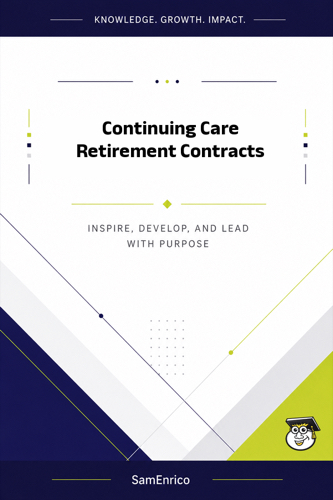
Continuing Care Retirement Contracts eBook
Evaluates entrance fees, monthly costs, and refund
Evaluates entrance fees, monthly costs, and refundability options.
Formats
Free sample
Chapter 1: The Million-Dollar Handshake--Margaret and David Sullivan had done everything right. For forty-seven years, they had saved diligently, maxed out their IRAs, paid off their suburban Chicago home, and built a nest egg of $1.2 million. David, a retired engineer, had run the numbers dozens of times. Margaret, a former schoolteacher, had visited nine different retirement communities. When they walked into The Pines of Glenview—a gleaming Life Plan Community with a saltwater pool, a woodworking shop, and a dining room that rivaled any restaurant in the North Shore—they thought they had found heaven.The sales director, a warm woman named Carol with perfectly coiffed silver hair, greeted them with glasses of champagne.
"You've worked your whole lives for this moment," Carol said, gesturing toward a model apartment with granite countertops and a private balcony overlooking a koi pond. "At The Pines, we take care of everything. Your lawn, your meals, your healthcare. You'll never worry again."Margaret cried. David squeezed her hand.
They signed the contract that afternoon.Eighteen months later, David was dead from a sudden heart attack. Margaret, grieving and alone, received a letter from The Pines. The subject line read: "Notice of Monthly Fee Adjustment and Refund Determination." The letter informed her that her monthly fee was increasing by 22 percent—not the 3 percent she had been promised verbally. Furthermore, the $380,000 entrance fee she and David had paid? Non-refundable, the contract stated.
Page 47, subsection C, paragraph 4. The money was gone.Margaret had not read page 47. Neither had David. Neither will you, unless you understand what you are about to learn.This book exists because the Sullivan family's story is not an anomaly. It is not a cautionary tale about a single bad actor.
It is the inevitable result of a legal and financial system that allows Continuing Care Retirement Communities (CCRCs)—also known as Life Plan Communities—to write contracts that transfer enormous financial risk from the provider to the resident, often without the resident ever understanding the transaction.What You Are Actually Buying Let us begin with a fundamental question that most prospective residents never ask, or ask too late: What am I actually purchasing when I pay an entrance fee and sign a CCRC contract?If you are like most people, you assume you are buying something akin to a condominium combined with an insurance policy. You pay a large upfront sum (the entrance fee) and then monthly fees in exchange for a place to live, amenities, and guaranteed healthcare for the rest of your life. This assumption is partially correct, but the parts that are incorrect can bankrupt you.A CCRC is not real estate in the traditional sense. In the vast majority of non-profit CCRCs—which dominate the industry—you do not hold title to your unit. You do not build equity.
You cannot sell your unit on the open market. What you are purchasing is a lifetime right to occupy a specific apartment or cottage, coupled with priority access to a continuum of healthcare services: independent living, assisted living, memory care, and skilled nursing. That is it. You are a tenant with a very expensive lease and a healthcare rider, not an owner.This distinction matters because your home—the single largest asset most retirees own—is often sold to fund the entrance fee. When you sell your house and write a check for $400,000 to a CCRC, you are not investing in real estate.
You are prepaying for future services, some of which you may never receive. If you leave or die, the disposition of that $400,000 is governed entirely by the refundability clause of your contract. That clause can give you back 90 percent, 50 percent, nothing, or something in between. Or it can give you back nothing for years while the CCRC waits to resell your unit.The second misconception is about the monthly fee. Most residents believe their monthly fee covers their apartment and meals, with a small uplift for healthcare access.
In reality, the monthly fee is a complex amalgam of operating costs, capital reserves, healthcare premiums (in some contract types), and profit margins. Understanding what is inside that number—and how it can change over time—is the difference between a predictable retirement and a financial death spiral.The third misconception is about the contract itself. Carol, the sales director at The Pines, gave the Sullivans a beautiful brochure with photographs of smiling residents playing bridge and swimming laps. The brochure promised "peace of mind," "care for life," and "predictable costs." The contract, which ran 87 pages, promised something quite different. It promised that the CCRC could raise fees with 60 days' notice, could change the terms of healthcare access, and could retain the entire entrance fee if the resident died within five years.
The Sullivans, like most people, never compared the brochure to the contract. They assumed the brochure was a summary. It was not. It was marketing. The contract was the truth.The Financial Triangle That Determines Your Future This book introduces a conceptual framework that you will use to evaluate every CCRC contract you encounter.
I call it the Financial Triangle. It has three vertices:Vertex One: The Entrance Fee. This is the upfront payment, typically ranging from $100,000 to over $1 million. It can be fully refundable, partially refundable, declining, or non-refundable. It can be amortized over time or returned in a lump sum.
It is the single largest check you will write in your retirement, and its terms determine everything that follows.Vertex Two: The Monthly Fee. This is the recurring payment, typically ranging from $3,000 to $8,000 per month for a single resident, and $4,500 to $12,000 for a couple. It can be fixed, indexed to inflation, or variable based on care needs. It can increase by 2 percent annually or 20 percent. It can include meals, utilities, housekeeping, and healthcare access—or it can exclude essential services that you will pay for separately.Vertex Three: Refundability Terms.
This is the set of rules governing what money—if any—returns to you or your estate when you leave or die. Refundability can be conditioned on resale, paid from operating reserves, structured as a declining percentage over time, or entirely absent. It is the least understood and most dangerous variable in the entire contract.Here is the crucial insight that the Sullivans missed, that most financial advisors miss, and that this book will drill into your thinking: You cannot evaluate any one vertex without considering the other two. A low entrance fee is meaningless if monthly fees are high and unpredictable. A generous refundability clause is meaningless if the refund is conditioned on resale and the CCRC goes bankrupt.
A low monthly fee is meaningless if the entrance fee is non-refundable and you die after two years.The Financial Triangle forces you to think holistically. Every contract represents a trade-off among these three vertices. Your job is to understand the trade-offs well enough to choose the combination that matches your specific health, longevity, and legacy goals.Why This Book Exists: The Information Gap There are approximately 2,000 CCRCs in the United States, housing roughly one million seniors. The industry generates over $80 billion in annual revenue. And yet, there is no standardized contract.
There is no federal oversight body. There is no required disclosure form comparable to the mortgage industry's Good Faith Estimate…
This is the end of the free sample. Get the eBook to keep going. Buy now
About this book
Details
- Author
- Titus Jeannine
- Publisher
- SamEnrico
- Language
- English
- Genre
- Non-Fiction, Business Brief, Long Term Care
- Released
- 2026-06-06
- Pages (approx.)
- 150
- Available as
- eBook, Audiobook

Read better in the ZLOADR app
Your eBooks on your phone or tablet. Sign in with your SamEnrico account and start reading.
More by Titus Jeannine
 Divorce for LGBTQTitus Jeannine$11.99
 Night Before Speech ProtocolTitus Jeannine$11.99
 The Teen Self Compassion GuideTitus Jeannine$11.99
 Nok Terracotta Visual TalesTitus Jeannine$11.99
 The Montreal Heist: The 1976 Brinks Truck Ambush That Shocked CanadaTitus Jeannine$11.99
 Understanding Polysyndactyly Orofacial AnomaliesTitus Jeannine$17.99
 Celery-top Pine HarvestingTitus Jeannine$11.99
 Travel Spending on Local ExperiencesTitus Jeannine$12.99
 HARO Link Building StrategyTitus Jeannine$12.99
 A Beginners Guide to English draughts (Volume 1)Titus Jeannine$11.99
You may also like
 Hong Kong Handover 1997Dunn Johnnie$11.99
 Zumba For Postnatal Recovery CourseNeal Christian$11.99
 Zumba for BeginnersLadner Nikia$11.99
 YouTube Comment Mining GuideHumes Pandora$12.99
 Worry Box MeditationCarlin Rudy$11.99
 Workplace Stress MeditationNguyen Lynn$11.99
 Workplace Stress and Sleep RepairHawley Ivory$11.99
 Workplace Perfectionism CureDelaney Jeffry$11.99
 Workplace Injustice Anger GuideWallen Isabelle$11.99
 Work Addiction and Burnout LinkGreenwood Ester$11.99
 Women in Yoga and WellnessBeattie Galina$11.99
 Women in Stand Up ComedyChun Evangeline$11.99