
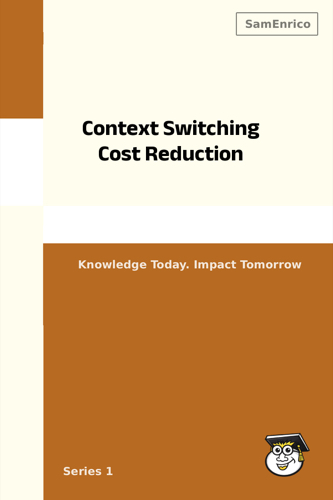
Non-FictionBusiness BriefCognitive Load
Context Switching Cost Reduction eBook
Batch similar tasks to minimize mental overhead.
Batch similar tasks to minimize mental overhead.
Formats
Free sample
Chapter 1: The 23-Minute Curse--You have been lied to about multitasking.Not exaggerations. Not white lies. Actual, measurable, peer-reviewed lies.The lie sounds like this: "I am good at multitasking." Or its close cousin: "I need to multitask to get everything done." Or the most dangerous version: "I can just check this really quick—it will only take a second."That last one is the killer. Because that "quick check" does not cost a second. It costs 23 minutes.
Every single time.Let that land.Every time you switch your attention from what you are doing to something else—email, Slack, a text message, a coworker tapping your shoulder, a sudden thought about tomorrow's meeting—you do not lose the five seconds it takes to glance away. You lose an average of 23 minutes of focused cognitive output.Not sometimes. Not if you are tired. Always. The research is unforgiving.This chapter is called The 23-Minute Curse because that number is the single most important metric in this entire book.
If you forget every statistic, every tool, every technique that follows, remember this: one quick check costs twenty-three minutes. And you do dozens of these checks every day.By the end of this chapter, you will understand exactly why your brain punishes you for switching—and why batching similar tasks is not a productivity trick but a neurological necessity.The Day I Measured My Own Switching Before we dive into the science, let me tell you about Sarah. Sarah is a marketing director at a mid-sized tech company. She is smart, driven, and chronically overwhelmed. When I met her, she described her workday as "a blender set to puree."Here is what Sarah's average morning looked like:8:30 AM: Arrive, check email.
Read three messages. Decide to reply later.8:34 AM: Open Slack. Fourteen unread channels. Scan quickly. See a question from her boss.8:37 AM: Start drafting response to boss.
Get interrupted by a calendar notification for a 9 AM meeting.8:39 AM: Switch to preparing for the meeting. Open the agenda doc.8:41 AM: Phone buzzes. Text from her child's school. Replies.8:43 AM: Back to the meeting agenda. Cannot remember what she read.
Starts over.8:47 AM: Meeting starts. Spends first five minutes mentally still in Slack.9:52 AM: Meeting ends. Checks email again. Sees a message from a client.9:55 AM: Opens client email. Needs a report.
Switches to the reporting dashboard.9:58 AM: Slack notification. Her boss replied to her half-finished draft from 8:37.10:01 AM: Back to the report. Forgets what data she needed. Re-reads client email.10:05 AM: Phone again. This time a notification from Instagram.10:06 AM: "Just one quick scroll." Five minutes later, she is watching a video about homemade sourdough.By 10:30 AM, Sarah had completed exactly one thing: she attended a meeting.
She had started five other tasks and finished none. She felt exhausted, anxious, and behind—and she had been working for only two hours.I asked Sarah to track her task switches for three days using the method you will learn in Chapter 2. The result: she averaged 87 context switches per day. At 23 minutes of recovery per switch, that meant she was losing over 33 hours of cognitive focus every week.Sarah did not have a time management problem. She had a switching problem.You probably do too.The Neuroscience of a Single Switch To understand why a "quick check" costs 23 minutes, you need to understand how your brain manages attention.
This is not psychology or self-help. This is cognitive neuroscience, and the findings are remarkably consistent.Your brain's attention system is governed primarily by the prefrontal cortex—the region right behind your forehead. This is the executive control center. It decides what to focus on, what to ignore, and when to shift.Here is the catch: the prefrontal cortex has limited capacity. Severely limited.
Think of it as a whiteboard with room for only two or three sticky notes at a time. Everything else has to be stored somewhere else or lost.When you are focused on a single task—say, writing a report—your prefrontal cortex holds the rules, goals, and context for that task. It is like a computer running one program: efficient, fast, and fully allocated.When you switch to another task—say, checking email—your brain must perform a series of expensive operations:Step 1: Inhibition. Your brain must actively suppress the rules and goals of the report-writing task. This is not automatic.
It requires energy, like applying the brakes on a moving car.Step 2: Activation. Your brain must retrieve and load the rules and goals of the email task. This is also not automatic. It requires searching through memory and reactivating dormant neural patterns.Step 3: Orientation. Your brain must reorient your attention to the new task's environment, tools, and context.
Where are you in the email? Who sent it? What needs a response?Step 4: Engagement. Your brain must reach a state of focused attention on the new task. This is not instantaneous.
It takes time for neural firing patterns to stabilize.These four steps take anywhere from a few seconds to over a minute, depending on the complexity of the tasks involved. Switching from writing a report to checking email is relatively cheap. Switching from debugging code to negotiating a contract is extremely expensive.But here is the part that most people do not know: the cost does not end when you finish the switch.Attention Residue: The Ghost of Tasks Past Even after you have fully switched to Task B, part of your brain remains stuck on Task A. This phenomenon is called attention residue, and it was first rigorously studied by Sophie Leroy at the University of Washington.Leroy's research found that when people switch from one task to another, their performance on the second task is significantly impaired—not because they lack skill, but because their attention is divided. Thoughts about the unfinished first task linger in working memory, consuming cognitive bandwidth that should be dedicated to the second task.Here is the disturbing part: attention residue does not fade quickly.
In Leroy's studies, it persisted for an average of 22.5 minutes after the switch.That is where the 23-minute curse comes from.Every switch leaves a ghost behind. The ghost whispers about what you were just doing, what you still need to finish, what you might have forgotten. It may be quiet enough that you do not consciously notice it, but it is there, stealing cognitive resources.This explains why you can spend an hour "working" on a task but feel like you accomplished nothing. You were not working. You were switching, recovering, and battling ghosts.Let me give you a concrete example.You are writing an important proposal.
You have been focused for 20 minutes. Your flow is good. Then your phone buzzes with a text from your partner: "Can you pick up milk on the way home?"You glance at it. You do not even reply. You put the phone down and return to the proposal.That took three seconds.
No harm, right?Wrong.The glance alone triggered a switch. Your brain briefly inhibited the proposal task, activated the "partner text" task, recognized it as low priority, and switched back. But attention residue remains. For the next 23 minutes, part of…
This is the end of the free sample. Get the eBook to keep going. Buy now
About this book
Details
- Author
- Lance Lurline
- Publisher
- SamEnrico
- Language
- English
- Genre
- Non-Fiction, Business Brief, Cognitive Load
- Released
- 2026-06-08
- Pages (approx.)
- 147
- Available as
- eBook, Audiobook

Read better in the ZLOADR app
Your eBooks on your phone or tablet. Sign in with your SamEnrico account and start reading.
More by Lance Lurline
 The Muppet WhispererLance Lurline$11.99
 Oral Exam Stress Reduction WorkbookLance Lurline$11.99
 Junk Food Vegan GuideLance Lurline$11.99
 The Parent Self Care Time AuditLance Lurline$11.99
 Towering Titans: The Forgotten War of the CyclopesLance Lurline$11.99
 Understanding Nevo SyndromeLance Lurline$17.99
 Pipeline OperatorLance Lurline$11.99
 College Essay Topics That WorkLance Lurline$12.99
 AI Business Risk Score for Small BusinessLance Lurline$12.99
 How to Start a Calcareous Cement Business (Beginners Guide)Lance Lurline$11.99
You may also like
 Hong Kong Handover 1997Dunn Johnnie$11.99
 Zumba For Postnatal Recovery CourseNeal Christian$11.99
 Zumba for BeginnersLadner Nikia$11.99
 YouTube Comment Mining GuideHumes Pandora$12.99
 Worry Box MeditationCarlin Rudy$11.99
 Workplace Stress MeditationNguyen Lynn$11.99
 Workplace Stress and Sleep RepairHawley Ivory$11.99
 Workplace Perfectionism CureDelaney Jeffry$11.99
 Workplace Injustice Anger GuideWallen Isabelle$11.99
 Work Addiction and Burnout LinkGreenwood Ester$11.99
 Women in Yoga and WellnessBeattie Galina$11.99
 Women in Stand Up ComedyChun Evangeline$11.99