
Non-FictionFirst 30 DaysContent
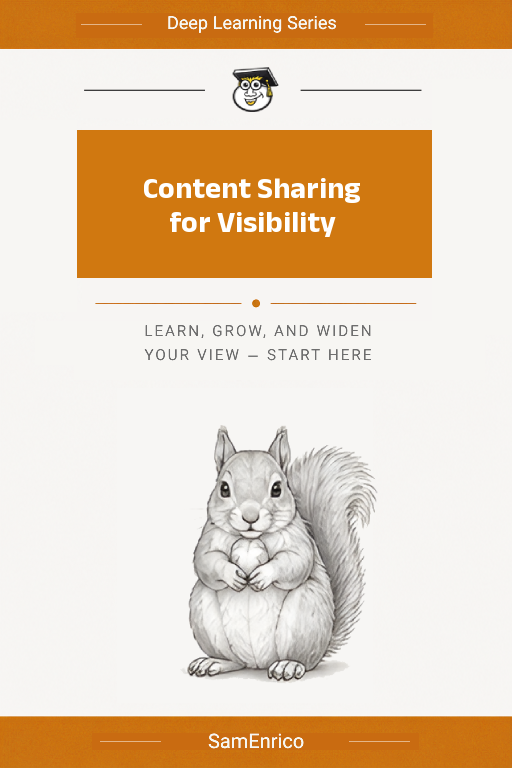
Content Sharing for Visibility eBook
Post weekly about your learning journey to demonst
Post weekly about your learning journey to demonstrate growth mindset and attract mentors.
Formats
Free sample
Chapter 1: The Guru Trap--–- You are not ready. That is the lie keeping you invisible.If you are holding this book, you have probably said at least one of the following sentences to yourself in the past thirty days:“I’ll start posting once I know more.”“I don’t have enough expertise to speak on this topic yet.”“Who am I to share advice? I’m still learning.”“I need to finish this certification first.”“What if I’m wrong? What if someone more experienced corrects me?”These sentences feel like humility. They feel like responsibility.
You are not the kind of person who speaks before thinking. You are not the kind of person who pretends to know things you don’t. You are waiting until you are good enough, smart enough, credible enough, and polished enough to finally deserve attention.That waiting is the single most expensive decision of your career.Not because waiting is passive. Waiting feels active when you are reading books, taking courses, and practicing in private. You are doing the work.
You are grinding. You are paying your dues. But here is the hard truth that no one tells you: the dues you are paying are being paid to the wrong bank. You are depositing hours into a savings account that pays zero interest in the attention economy.The world does not reward the person who becomes an expert in silence. The world rewards the person who learns out loud.The Expert Fatigue Epidemic Let’s start with a provocation that might sting: no one trusts experts anymore.Not in the way they used to.
Twenty years ago, a title, a degree, or a blue checkmark was enough to command attention. You could publish a book after twenty years of experience, and people would buy it because you had earned the right to speak. The hierarchy was clear. The ladder was linear. You paid your dues in private, and then you collected your rewards in public.That world is gone.We are living through what I call Expert Fatigue.
Audiences have been burned too many times by polished personas who turned out to be hollow. The Linked In influencer who posts motivational quotes but has never managed a team. The productivity guru who sells courses but has never held a real job. The marketing expert whose only success was teaching other people how to be marketing experts. The cycle of performance has collapsed under its own weight.Consider the data.
A 2023 study by Edelman found that only 42% of people trust business leaders to tell the truth. Trust in “experts” has declined every year since 2018. But here is the fascinating contradiction: trust in peers and people like me has risen to 68%. The people we trust most are not the polished experts on stages. They are the learners sitting next to us.Why?
Because a learner cannot fake it.A learner’s struggle is visible. When someone posts “I tried X and it failed, here’s what I learned,” there is no marketing team behind that post. There is no curated image. There is just a human being who tried something and is willing to show you the wreckage. That vulnerability is not a weakness.
In the current attention economy, vulnerability is the only remaining currency that cannot be counterfeit.Let me give you a specific example. I want you to imagine two Linked In posts appearing in your feed at the same time.Post A (The Expert):“After 15 years of leadership experience, I’ve discovered the 7 habits of highly effective teams. Here is my framework. Save this post for later.”Post B (The Learner):“I’ve been leading a team of 4 people for 90 days, and yesterday I completely failed at giving feedback. I tried the SBI model (Situation-Behavior-Impact).
It came out robotic and cold. My team member looked confused. Here’s what I think I did wrong: I skipped the empathy step. Has anyone else struggled with making feedback models sound human? What adjustment would you make?”Which post do you want to read?
Which post would you comment on? Which post makes you think “I could learn something from this person”?Post B wins every time. Not because it is better written, but because it is real. Post A has no cracks. Post A is a monument.
You cannot talk to a monument. Post B is a construction site. You can walk onto a construction site, pick up a tool, and help. That is the difference between visibility and invisibility in 2025.The Perfectionism Paradox There is a name for the belief that you must be perfect before you speak. I call it the Perfectionism Paradox.
The paradox works like this:You believe that hiding until you are perfect will protect your reputation. In reality, hiding until you are perfect destroys your reputation before you ever build one.Let me walk you through the mechanics of this paradox.When you hide, no one knows you are learning. Your potential mentors have no idea you exist. Your future collaborators are building relationships with other people. Your audience is forming opinions based on the voices they can hear, and you are not one of them.
Silence is not safety. Silence is a decision to let other people control the narrative about who you are and what you know.But the Perfectionism Paradox has an even more insidious effect: it trains your brain to believe that visibility is dangerous. Every day you wait, the bar gets higher in your mind. “I need to finish this certification.” Then you finish it. “I need to read ten more books.” Then you read them.
“I need to get a promotion first.” Then you get it. The bar moves. It always moves. Perfectionism is not a standard you reach; it is a treadmill you die on.I have worked with hundreds of professionals who stayed silent for years while they “prepared.” Almost all of them regretted it. Not because the preparation was worthless—learning is never worthless—but because the silence cost them opportunities they could have seized earlier.
The job that went to someone less qualified but more visible. The mentorship that went to someone who asked a dumb question in public while they perfected their smart questions in private. The speaking opportunity that went to someone who posted their failure while they waited for their success.Here is what I need you to hear: you are already good enough to start.Not perfect. Not finished. Not authoritative.
Just good enough. Good enough to share one thing you learned this week. Good enough to ask one question you don’t know the answer to. Good enough to show one failure that made you smarter. That is the only bar.
It has always been the only bar. The Perfectionism Paradox told you the bar was higher, but the bar was a lie.Introducing Liquid Literacy If the old model of expertise is crumbling, what replaces it? I propose a new framework called Liquid Literacy.Liquid Literacy is the ability to learn, unlearn, and relearn publicly. It is the opposite of what I call “Solid Expertise”—the belief that knowledge is a fixed asset you…
This is the end of the free sample. Get the eBook to keep going. Buy now
About this book
Details
- Author
- Raines Tyisha
- Publisher
- SamEnrico
- Language
- English
- Genre
- Non-Fiction, First 30 Days, Content
- Released
- 2026-05-29
- Pages (approx.)
- 147
- Available as
- eBook, Audiobook

Read better in the ZLOADR app
Your eBooks on your phone or tablet. Sign in with your SamEnrico account and start reading.
More by Raines Tyisha
 Research Proposal Appendix CompilationRaines Tyisha$11.99
 College Student PhobiaRaines Tyisha$11.99
 Parent Adult Day Care GuideRaines Tyisha$11.99
 Autistic Student Academic GuideRaines Tyisha$11.99
 Loving Kindness For AnxietyRaines Tyisha$11.99
 Commodity Market DynamicsRaines Tyisha$11.99
 Aging and Exercise Self EsteemRaines Tyisha$11.99
 R&D Talent MigrationRaines Tyisha$11.99
 Bryce Canyon Hoodoo MysteriesRaines Tyisha$11.99
 Whispers in the Wind: The Star-Crossed Lovers of the Great PlainsRaines Tyisha$11.99
 The Bamboo Curtain: The Untold Story of the 1975 Mayaguez IncidentRaines Tyisha$11.99
 Growing DocyniaRaines Tyisha$11.99
You may also like
 Hong Kong Handover 1997Dunn Johnnie$11.99
 Zumba For Postnatal Recovery CourseNeal Christian$11.99
 Zumba for BeginnersLadner Nikia$11.99
 YouTube Comment Mining GuideHumes Pandora$12.99
 Worry Box MeditationCarlin Rudy$11.99
 Workplace Stress MeditationNguyen Lynn$11.99
 Workplace Stress and Sleep RepairHawley Ivory$11.99
 Workplace Perfectionism CureDelaney Jeffry$11.99
 Workplace Injustice Anger GuideWallen Isabelle$11.99
 Work Addiction and Burnout LinkGreenwood Ester$11.99
 Women in Yoga and WellnessBeattie Galina$11.99
 Women in Stand Up ComedyChun Evangeline$11.99