
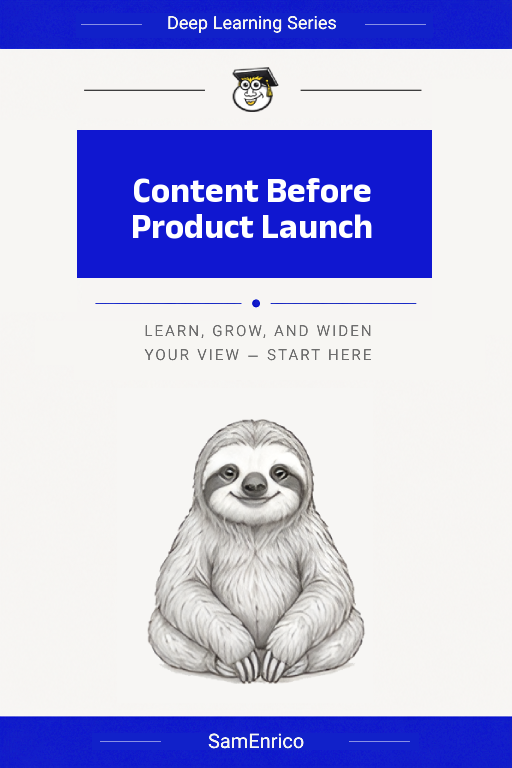
Non-FictionStartup GuideWaitlist Strategy
Content Before Product Launch eBook
Create content that builds community before launch
Create content that builds community before launch. Blog posts, videos, and social content.
Formats
Free sample
Chapter 1: The $200k Mistake--–- I remember the exact moment I realized my launch was going to fail. It was 11:47 AM on a Tuesday. I was standing in a warehouse in Portland, Oregon, surrounded by 5,000 pounds of coffee beans I could not sell. My phone buzzed with exactly three notifications: a spam email, a calendar reminder, and my mother asking if I wanted to come over for dinner. Three months earlier, 5,000 people had been on my email list.
That morning, twelve people had opened my launch day email. Twelve. I had raised $200,000 from friends and family. I had quit my job. I had spent nine months in stealth mode, perfecting a product no one knew existed.
And on the day that was supposed to be my breakthrough, I learned a brutal truth: nobody was waiting.That warehouse became my classroom. Over the next six months, as I liquidated inventory at 80 percent off just to make rent, I studied every successful launch I could find. I interviewed founders who had sold out in hours. I analyzed their content archives, their social media timelines, and their community platforms. And I discovered something that none of them had written down in a book yet: the most successful launches did not start with a product.
They started with content. They started with a story. They started before they had anything to sell.This book is the funeral for the big bang launch. It is the birth of a different way.The Confetti Lie We have been sold a fantasy. The fantasy looks like this: you work in secret, you perfect your product, you build a beautiful website, you schedule a launch day, and then—confetti.
Orders pour in. Customers cheer. The algorithm rewards you. The fantasy comes from Hollywood montages, from tech unicorn origin stories that skip the messy middle, from founders who got lucky and mistook timing for strategy. But the fantasy is a lie, and believing it has destroyed more startups than any other single belief.Let me show you the math of the lie.A traditional "big bang" launch typically follows this sequence: six to twelve months of product development in stealth, two to four weeks of pre-launch marketing, one to three days of launch hype, and then a long, quiet fade into customer acquisition costs that slowly eat you alive.
The assumption buried inside this sequence is that attention is free on launch day and trust is automatic. Neither is true. In fact, the opposite is true. Attention has never been more expensive. The average cost per thousand impressions on Meta platforms has increased 47 percent since 2020.
The average email open rate for a first-time sender is below 20 percent. The average conversion rate from a cold landing page is below 3 percent. And yet, founders pour money into these channels as if the rules have not changed.Here is what actually happens in a big bang launch. You spend months building in secret. You emerge with a product that solves a problem.
You announce it to the world. The world, which has never heard of you, does not care. You buy ads to force attention. The ads cost more than you projected because you are bidding against incumbents with deeper pockets. You get a small spike of curiosity-driven traffic.
Most of those people leave because they do not trust you yet. You lower prices. You run promotions. You burn through your launch budget. And six weeks later, you are back to square one, except now you have inventory you cannot sell and a bank account you cannot replenish.I know this because I lived it.
But I also know this because I have since analyzed over two hundred launch post-mortems across Saa S, e-commerce, and creator businesses. The pattern is shockingly consistent. The businesses that succeed are not the ones with the biggest launch budgets. They are the ones with the biggest pre-launch audiences. And those audiences are not built with ads.
They are built with content.The Surprise Party Fallacy Let me give you a name for the cognitive error that kills most launches. I call it the Surprise Party Fallacy.Imagine you are throwing a surprise party for a friend. You send invitations. You buy decorations. You bake a cake.
On the day of the party, you turn off the lights and wait. Your friend walks in. Everyone yells "Surprise!" Your friend is delighted. The party is a success.Now imagine you throw a surprise party for a stranger. You do not know their name.
You do not know their preferences. You do not know if they even like parties. You send invitations to random addresses. You buy decorations in colors they might hate. You bake a cake they might be allergic to.
On the day of the party, you turn off the lights and wait. No one comes. Because you cannot surprise a stranger.Most product launches are surprise parties for strangers. You have spent months building something in secret. You have not told anyone about it.
You have not built a relationship with the people who might want it. Then, on launch day, you turn on the lights and expect applause. But there is no one in the room. You cannot surprise a stranger. You can only surprise a friend.The Surprise Party Fallacy explains why stealth mode is so dangerous.
Stealth mode assumes that secrecy creates advantage. But in almost every case, secrecy creates obscurity. The only people who benefit from stealth mode are incumbents with massive existing audiences, because they can afford to disappear and reappear. For everyone else, stealth mode is not a strategy. It is avoidance disguised as discipline.The solution is simple to say and hard to execute: build your audience before you build your product.
Make friends before you throw the party. Send invitations before you bake the cake. And most importantly, do not hide. Let people see the messy, embarrassing, uncertain process of creation. Because that process is the content that builds the relationship.The Two Hundred Thousand Dollar Warehouse Let me take you back to that warehouse in Portland, because the details matter.I had raised $200,000 from seventeen people.
My parents. My college roommate. My aunt, who took out a small loan because she believed in me. I had spent nine months developing a premium coffee subscription. Not just any coffee.
Single-origin, small-batch, ethically sourced coffee from a cooperative in Guatemala that I had visited personally. The beans were roasted in a facility that I had inspected myself. The packaging was compostable. The branding was minimalist and expensive-looking. I had done everything right by the old playbook.The launch plan was elaborate.
We would spend two weeks building buzz with teaser posts on Instagram. We would send a "coming soon" email to our list of 5,000 people (most of whom had signed up for a free coffee tasting guide two years earlier and forgotten about us). We would launch on a Tuesday with a 24-hour discount. We would run Facebook ads at $500 per day for the first week. We would measure success by orders, revenue, and customer acquisition cost.Here is what actually happened.The teaser posts got modest engagement—a few…
This is the end of the free sample. Get the eBook to keep going. Buy now
About this book
Details
- Author
- Burgos Shandi
- Publisher
- SamEnrico
- Language
- English
- Genre
- Non-Fiction, Startup Guide, Waitlist Strategy
- Released
- 2026-05-30
- Pages (approx.)
- 137
- Available as
- eBook, Audiobook

Read better in the ZLOADR app
Your eBooks on your phone or tablet. Sign in with your SamEnrico account and start reading.
More by Burgos Shandi
 Francis Fioretti TranslationsBurgos Shandi$11.99
 Mindfulness for Better SleepBurgos Shandi$11.99
 Customer Service Customer PortalBurgos Shandi$11.99
 Quality Over Quantity FriendshipBurgos Shandi$11.99
 The Hypnosis Audio Editing BasicsBurgos Shandi$11.99
 The Shot That Captured a Nation: The Unlikely Alliance of a Photographer and a Football LegendBurgos Shandi$11.99
 Apprentice Motor Vehicle MechanicBurgos Shandi$11.99
 How to Start a First-degree Level Higher Education Business (Beginners Guide)Burgos Shandi$11.99
 Negotiation MOOC CertificatesBurgos Shandi$12.99
 Learn to Play the Chromatic Button AccordionBurgos Shandi$11.99
You may also like
 Hong Kong Handover 1997Dunn Johnnie$11.99
 Zumba For Postnatal Recovery CourseNeal Christian$11.99
 Zumba for BeginnersLadner Nikia$11.99
 YouTube Comment Mining GuideHumes Pandora$12.99
 Worry Box MeditationCarlin Rudy$11.99
 Workplace Stress MeditationNguyen Lynn$11.99
 Workplace Stress and Sleep RepairHawley Ivory$11.99
 Workplace Perfectionism CureDelaney Jeffry$11.99
 Workplace Injustice Anger GuideWallen Isabelle$11.99
 Work Addiction and Burnout LinkGreenwood Ester$11.99
 Women in Yoga and WellnessBeattie Galina$11.99
 Women in Stand Up ComedyChun Evangeline$11.99