
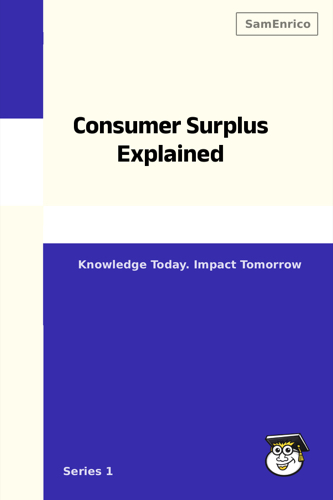
Consumer Surplus Explained
Measure the benefit consumers receive when they pa
Measure the benefit consumers receive when they pay less than their maximum willingness.
Formats
About this book
Free sample
Chapter 1: The $5 Heist--You have been robbed thousands of times. You have also been the thief. And until this moment, you have never noticed either crime.Consider your morning coffee. Yesterday, you walked into a café, ordered a medium latte, and paid $5.50. You walked out feeling fine—neither elated nor cheated.
But here is the question this entire book is built upon: what was the most you would have paid?If the answer is $8.00, then you experienced $2.50 of consumer surplus—a psychological gain you never consciously registered. If the answer is $5.75, your surplus was a mere $0.25, a sliver of satisfaction so thin it evaporated before you reached the door. And if the answer is $4.50? Then you experienced negative surplus. You were robbed, not by a pickpocket, but by the gap between what the coffee was worth to you and what you actually paid.
You felt it as a low-grade resentment: This isn't worth it.Every purchase you have ever made contains this hidden mathematics. Every price tag is a guess. Every transaction is a negotiation—sometimes explicit, usually silent—between what a seller asks and what you would secretly give. Consumer surplus is the name economists gave to the gap. But naming it is not the same as seeing it.
And seeing it changes everything.The Geography of a Good Deal Why does the same umbrella generate wildly different feelings depending on the weather? In a sudden downpour, your willingness to pay for any dry shelter spikes. A $20 umbrella feels like a bargain because your alternative is $200 in ruined electronics and an hour of shivering misery. Your maximum willingness to pay (WTP) might be $40. Pay $20, and you walk away with $20 of consumer surplus—and a small, secret smile.On a sunny Tuesday, that same umbrella is an inconvenience.
Your WTP drops to $8. The store still wants $20. You feel nothing but mild disgust. The surplus is negative $12.Notice what happened here. The umbrella did not change.
Your WTP changed. And because your WTP changed, the gap between what you would pay and what you did pay changed. That gap is the entire…
This is the end of the free sample. Get the eBook to keep going. Buy now
Contents
- Chapter 1
- Chapter 2
- Chapter 3
- Chapter 4
- Chapter 5
- Chapter 6
- Chapter 7
- Chapter 8
- Chapter 9
- Chapter 10
- Chapter 11
- Chapter 12
Details
- Author
- Hong Sebastian
- Publisher
- SamEnrico
- Language
- English
- Genre
- Non-Fiction, Business Brief, Consumer Welfare, Surplus
- Released
- 2026-06-08
- Pages (approx.)
- 149
- Available as
- eBook, Audiobook

Read better in the ZLOADR app
Your eBooks on your phone or tablet. Sign in with your SamEnrico account and start reading.
More by Hong Sebastian
 Menopause Eye HealthHong Sebastian$11.99
 Food Addiction and GastroparesisHong Sebastian$11.99
 Body Scan for AthletesHong Sebastian$11.99
 The Hollow King's Last Ride: A Medieval Phantom's CurseHong Sebastian$11.99
 Department Budget Software GuideHong Sebastian$12.99
 How to Produce ACID NeutralizersHong Sebastian$11.99
 Project Management AssistantHong Sebastian$11.99
 How to Become a PairerHong Sebastian$11.99