
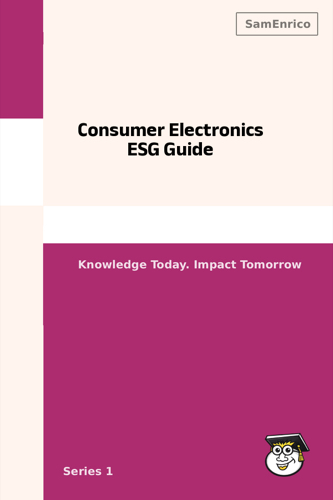
Non-FictionStrategic AtlasElectronics ESG
Consumer Electronics ESG Guide eBook
Evaluate repairability scores and recycling progra
Evaluate repairability scores and recycling programs among smartphone and laptop makers.
Formats
Free sample
Chapter 1: The Manufacturing Debt--–- The moment you tap “Place Order” is the most carbon-intensive second of your device’s entire existence. Not the day it stops charging. Not the hour you drop it in a recycling bin. Not the years it spends plugged into a wall. The second you buy it.
That single click commits more greenhouse gases to the atmosphere than all the charging you will ever do. This is the manufacturing debt, and almost nobody talks about it.Walk into any electronics store or scroll through any online marketplace, and the marketing hits you like a wave. “Energy-efficient charger.” “Low-power mode.” “Carbon-neutral shipping.” These phrases feel good. They make you believe that your new smartphone or laptop is a responsible choice, that the brand has done the hard work for you. But here is the uncomfortable truth that no unboxing video will ever tell you: 80 to 85 percent of the total carbon footprint of a typical smartphone or laptop is locked in before the device ever reaches your front door.That number is not a guess.
It comes from peer-reviewed lifecycle assessments (LCAs) conducted by organizations like the Fraunhofer Institute, the European Commission’s Joint Research Centre, and academic labs at MIT and UC Irvine. These studies track every gram of CO2 equivalent from the moment a mining drill bites into the earth to the moment you throw the device away. And what they find, year after year, is a stunning inversion of consumer intuition. We obsess over chargers and battery life because those are the things we can see and touch. But the real damage happens in places we will never visit: the open-pit cobalt mines of the Democratic Republic of Congo, the rare earth refining complexes in Inner Mongolia, the silicon wafer fabs in Taiwan that consume millions of gallons of ultrapure water per day.This chapter is about making the invisible visible.
It will teach you to see the manufacturing debt hidden inside every glossy aluminum shell and every edge-to-edge glass screen. You will learn the difference between embodied energy and operational energy, why your charger is almost irrelevant to your carbon footprint, and how a single decision—keeping your device for one more year—does more for the planet than buying “carbon neutral” for the rest of your life.The Lifecycle Analysis That Will Change How You Shop Let us perform a simple mental exercise. Imagine you buy a new smartphone. Not the most expensive one, not the cheapest. A mid-range device that costs around $500 and will serve you for two years before the battery degrades, the screen cracks, or the software updates stop.
That device has a lifecycle that can be divided into four phases: raw material extraction, manufacturing and assembly, transport and distribution, and consumer use. Here is where the carbon actually lives.Raw material extraction accounts for roughly 30 to 35 percent of the total carbon footprint. This is the mining stage. To build one smartphone, you need approximately 30 different chemical elements, including copper, gold, silver, palladium, tin, tungsten, cobalt, lithium, rare earths (neodymium, praseodymium, dysprosium), and a dozen more. Each of these has its own mining footprint.
Copper, for example, requires moving hundreds of tons of rock per kilogram of metal. Rare earths, despite being called “green” because they enable electric vehicles and wind turbines, are nightmare materials from a toxic waste perspective. For every ton of rare earth oxide you produce, you generate approximately 2,000 tons of toxic waste, including radioactive thorium and heavy metals.Manufacturing and assembly is the heavyweight champion of emissions, accounting for another 45 to 50 percent of the total footprint. This is where raw materials are turned into components: the logic board etched with lasers, the lithium-ion battery wound into jelly rolls, the OLED screen deposited onto glass, the aluminum chassis milled from a solid block. The single most carbon-intensive component in any smartphone or laptop is not the battery, not the screen, not the processor.
It is the logic board. More precisely, it is the silicon chips soldered onto that board. Semiconductor fabrication, or “fab,” is a miracle of modern engineering and an environmental disaster. A single 300-millimeter silicon wafer takes between 2,000 and 5,000 gallons of ultrapure water to process. The fabs run 24 hours a day, 365 days a year, consuming electricity at rates comparable to small cities.
And because most of the world’s leading fabs are located in Taiwan, South Korea, and China, where coal still supplies a significant portion of the grid, the carbon price per chip is enormous.Transport and distribution is surprisingly small. Even if you pay for overnight air freight from a factory in Shenzhen to your doorstep in Chicago, transport adds only 3 to 5 percent to the total carbon footprint. Container ships are incredibly efficient per ton-mile, and air freight, while carbon-intensive, moves such small volumes per device that the impact remains low. This is why “carbon-neutral shipping” badges on e-commerce sites are mostly marketing theater. Even if you neutralize the transport emissions entirely, you have only addressed 5 percent of the problem.Consumer use is the smallest piece of the puzzle, typically 10 to 15 percent of the total footprint over a three-year lifespan.
This includes every hour you spend scrolling social media, every Zoom call, every game of Candy Crush, every overnight charge. Modern smartphones and laptops are astonishingly efficient. An i Phone drawing 5 watts during heavy use costs pennies per year in electricity. A Mac Book Pro with Apple’s M-series chip sips power so gently that you could leave it plugged in for a month and still use less energy than driving a car one mile. The charger in your wall is not the villain.
You are not the villain. The villain was the factory that built your device.Embodied Energy vs. Operational Energy: Why Your Charger Is a Distraction The distinction between embodied energy and operational energy is the single most important concept in this entire book. Once you understand it, you will never look at a “fast charger” the same way again.Embodied energy (sometimes called “embedded energy” or “grey energy”) is the total energy required to extract, refine, manufacture, transport, and assemble every single atom in your device. It includes the diesel burned by mining trucks, the electricity used by smelters, the natural gas heating the fab cleanrooms, the jet fuel moving finished goods across oceans.
Embodied energy is paid upfront, in a lump sum, the moment you buy the device. It is the mortgage on your carbon house.Operational energy is the energy you use while operating the device. Charging the battery, powering the screen, running the processor. Operational energy is paid in small installments over time, like rent. And for modern consumer electronics, the rent is astonishingly cheap compared to the mortgage.Let us put real numbers on this.
According to a 2020 lifecycle assessment published in the Journal of Industrial Ecology, a typical smartphone has an embodied carbon footprint of approximately 80 kilograms of CO2 equivalent. Over a two-year lifespan, the operational footprint (charging plus network usage) adds another 15 kilograms. That means the embodied footprint is five times larger than the operational footprint. For laptops, the ratio is similar but slightly less extreme: a premium laptop…
This is the end of the free sample. Get the eBook to keep going. Buy now
About this book
Details
- Author
- Andersen Curt
- Publisher
- SamEnrico
- Language
- English
- Genre
- Non-Fiction, Strategic Atlas, Electronics ESG
- Released
- 2026-06-06
- Pages (approx.)
- 152
- Available as
- eBook, Audiobook

Read better in the ZLOADR app
Your eBooks on your phone or tablet. Sign in with your SamEnrico account and start reading.
More by Andersen Curt
 Memory Reconstruction TheoryAndersen Curt$11.99
 PCOS Pregnancy Loss Support GuideAndersen Curt$11.99
 The Refugee Metta GuideAndersen Curt$11.99
 The Virtual Meeting NonverbalsAndersen Curt$11.99
 The Lion of Pasargadae: Artaxerxes I and the Achaemenid Empire's Golden AgeAndersen Curt$11.99
 Understanding Schereshevskij TurnerAndersen Curt$17.99
 Informational Interview Request GuideAndersen Curt$12.99
 AliExpress Dropshipping GuideAndersen Curt$12.99
 Platform Bed CraftAndersen Curt$11.99
 How to Become a Dry-starch OperatorAndersen Curt$11.99
You may also like
 Hong Kong Handover 1997Dunn Johnnie$11.99
 Zumba For Postnatal Recovery CourseNeal Christian$11.99
 Zumba for BeginnersLadner Nikia$11.99
 YouTube Comment Mining GuideHumes Pandora$12.99
 Worry Box MeditationCarlin Rudy$11.99
 Workplace Stress MeditationNguyen Lynn$11.99
 Workplace Stress and Sleep RepairHawley Ivory$11.99
 Workplace Perfectionism CureDelaney Jeffry$11.99
 Workplace Injustice Anger GuideWallen Isabelle$11.99
 Work Addiction and Burnout LinkGreenwood Ester$11.99
 Women in Yoga and WellnessBeattie Galina$11.99
 Women in Stand Up ComedyChun Evangeline$11.99