
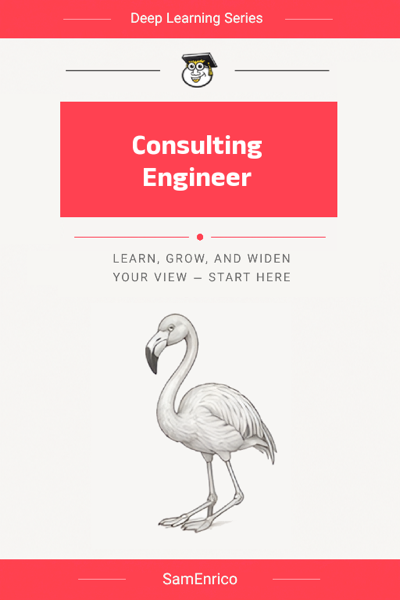
Non-FictionInformativeEducational
Consulting Engineer eBook
A Coursebook on Consulting Engineer
by Fink Mac
A Coursebook on Consulting Engineer
Formats
Free sample
Chapter 1: The Stamp That Changed Everything--The first time Maria Vasquez stamped a set of drawings, she felt nothing. That was the problem.She had expected fireworks. Or at least a quiet sense of accomplishment—a whispered acknowledgment from the universe that she had crossed some invisible threshold. Instead, she stood alone in the fluorescent glare of her cubicle at 11:47 PM, the black ink still wet on the title block, and felt only a dull ache behind her eyes and the faint smell of stale coffee rising from the stain on her keyboard tray.The stamp was new. Her Professional Engineer license had arrived in the mail six days earlier, a heavy parchment certificate that now leaned against a stack of ASCE journals she meant to read.
The physical stamp—a metal-and-rubber device that cost her $48.50 from an online engraver—felt like a toy in her hand. She pressed it onto the mylar sheet anyway, rocked it gently to ensure full contact, and watched the impression appear:MARIA VASQUEZ, P.E.STATE OF TEXASLICENSE NO. 142,887The letters were so small. She had expected them to look more important.She leaned back in her chair and looked at the drawing set. Sixty-three sheets of a four-story medical office building in Plano.
She had designed the lateral force resisting system—the steel braced frames that would keep the building standing when the wind blew or the ground shook. She had run the calculations three times. She had reviewed the connection details twice. She had checked every bolt, every weld, every gusset plate.And now, with a single press of a rubber stamp, she had declared to the world that this building was safe.No. That wasn't quite right.
She had declared that this building met the minimum requirements of the applicable building codes. The distinction was important, though no one outside the profession seemed to understand it. An engineer's stamp did not mean "this building will never fail." It meant "this building satisfies the standard of care—the level of competence expected of a reasonable engineer under similar circumstances."It was a statement about process, not outcome. But try explaining that to a jury.Maria closed the drawing set and stacked it on top of the other three sets waiting for her review. Tomorrow she would have to face the architect, a man named Roger who had already asked her twice to "relax a little" on the connection details because his structural bay spacing had "artistic constraints." Roger did not understand that a braced frame was not a suggestion.
Roger did not understand that if she relaxed too much, people died.Roger did not have a stamp.The Three Engineers in the Room If you want to understand what a consulting engineer actually does, you need to first understand what a consulting engineer is not.Picture a job site. Any job site. A highway bridge under construction. A chemical plant undergoing maintenance. A high-rise where the foundation is being poured.
Now, imagine three different people standing at the edge of that site, each wearing a hard hat, each holding a clipboard. They look similar. They are not.The first person is the plant engineer or facility engineer. This person works for the owner. They are salaried employees, paid to keep the facility running.
Their job is uptime: the pump must spin, the conveyor must move, the lights must stay on. When something breaks, the plant engineer's phone rings at 3 AM. They have authority to make decisions—shut down a production line, call in overtime crews, spend up to a certain limit on replacement parts—but their authority is bounded by budget cycles and maintenance schedules. Their duty is to their employer. Their metric is reliability.The second person is the contractor.
This person works for a construction company that has been hired to build something. Their job is means, methods, and schedules: how to put steel in the air, how to pour concrete in the rain, how to finish the job before the liquidated damages clause kicks in. The contractor's authority comes from a contract. Their duty is to build according to the drawings and specifications. Their metric is completion.The third person is the consulting engineer.
This person works for neither the owner nor the contractor. They have been hired by the owner as an independent advisor. Their job is code compliance, liability, and lifecycle performance. They do not operate the facility. They do not swing the hammer.
They design the thing, specify the thing, and then—if the contract includes construction administration—they observe the thing being built and decide whether it matches the design.The consulting engineer's authority comes from a license granted by the state. Their duty is to public safety first, then to the client, then to themselves. Their metric is not uptime or completion. Their metric is did anyone die? And if the answer is no—if the building stands for forty years, if the bridge carries traffic through a hundred winters, if the treatment plant discharges clean water day after day—then the consulting engineer has done their job so well that no one will ever know their name.Maria Vasquez understood this distinction intellectually.
But understanding a thing intellectually and feeling it in your bones are two different experiences, and she was about to have the second.The Phone Call Three weeks after she stamped the Plano medical office building, Maria got a call from a number she didn't recognize.She was in the middle of a takeoff—counting rebar for a retaining wall—and almost let it go to voicemail. But something made her pick up."Ms. Vasquez? This is Tom Chen. I'm a project manager with HKS Architects.
I got your name from Roger at the Plano job."Maria's stomach tightened. When an architect calls an engineer three weeks after permit drawings are issued, it is never good news. Either the budget has been cut, the client has changed their mind, or someone has discovered a conflict that should have been caught earlier."Hi, Tom. What's going on?""I have a problem, and Roger said you're the person who actually reads code books."She waited."I'm working on a renovation for a food processing facility in Garland. Existing building, built in 1982.
Single story, tilt-wall construction. The client wants to add a mezzanine for new packaging equipment. Nothing crazy—maybe two thousand square feet of new steel deck.""Sounds straightforward.""It would be, except the existing building doesn't have any as-built drawings. The original engineering firm went out of business in 1995. The client has no record of the foundation design, no record of the wall reinforcing, nothing.
We need someone to figure out what's actually there and whether it can support a mezzanine."Maria understood the problem immediately. The building had been standing for forty-plus years. That meant it was probably fine—buildings that were going to collapse usually did so within the first decade. But "probably fine" was not a standard of care. She needed to verify.
She needed to expose concrete, measure rebar spacing, test core samples. She needed to do forensic engineering before she could do structural engineering."And what's the timeline?"…
This is the end of the free sample. Get the eBook to keep going. Buy now
About this book
Details
- Author
- Fink Mac
- Publisher
- SamEnrico
- Language
- English
- Genre
- Non-Fiction, Informative, Educational
- Released
- 2026-06-02
- Pages (approx.)
- 155
- Available as
- eBook, Audiobook

Read better in the ZLOADR app
Your eBooks on your phone or tablet. Sign in with your SamEnrico account and start reading.
More by Fink Mac
 Phobia HandbookFink Mac$11.99
 Method of Loci for ActorsFink Mac$11.99
 Visual Trauma Triggers GuideFink Mac$11.99
 Switzerland Consumer OutlookFink Mac$11.99
 The Emotion Naming DBT WorkbookFink Mac$11.99
 The Angel of Fornovo: A Surgeon's Courage in the Italian WarsFink Mac$11.99
 Understanding Palmoplantar Porokeratosis of MantouxFink Mac$17.99
 Ad Frequency and Fatigue GuideFink Mac$12.99
 Anthony Noto GuideFink Mac$12.99
 How to Start a Personal Injury Insurance Business (Beginners Guide)Fink Mac$11.99
You may also like
 Hong Kong Handover 1997Dunn Johnnie$11.99
 Zumba For Postnatal Recovery CourseNeal Christian$11.99
 Zumba for BeginnersLadner Nikia$11.99
 YouTube Comment Mining GuideHumes Pandora$12.99
 Worry Box MeditationCarlin Rudy$11.99
 Workplace Stress MeditationNguyen Lynn$11.99
 Workplace Stress and Sleep RepairHawley Ivory$11.99
 Workplace Perfectionism CureDelaney Jeffry$11.99
 Workplace Injustice Anger GuideWallen Isabelle$11.99
 Work Addiction and Burnout LinkGreenwood Ester$11.99
 Women in Yoga and WellnessBeattie Galina$11.99
 Women in Stand Up ComedyChun Evangeline$11.99