
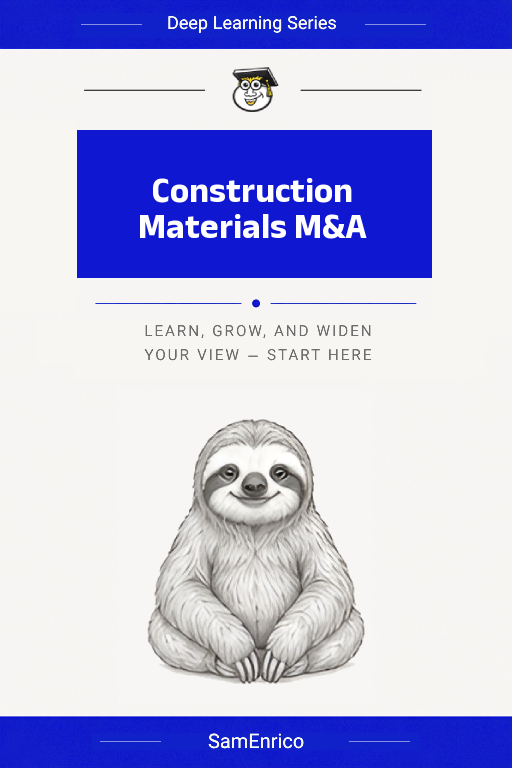
Non-FictionStrategic AtlasConstruction M&A
Construction Materials M&A eBook
Analyze cement, aggregates, and ready-mix targets
Analyze cement, aggregates, and ready-mix targets for Vulcan, Martin Marietta, and CRH.
Formats
Free sample
Chapter 1: The Dirtiest Fortune...--The former FBI agent sipped his black coffee and slid a single photograph across the table. It showed a quarry in rural Georgia—a massive gash in the red clay, haul trucks looking like children's toys against the towering highwalls. “This little hole in the ground,” he said quietly, “almost took down a billion-dollar deal.”I asked him what he meant.“Money laundering,” he replied. “The family that owned it had been running drug proceeds through the business for twelve years. Fake equipment purchases.
Ghost employees. Invoices for rock that never left the pit.” He leaned back. “Martin Marietta had their letter of intent signed. Their due diligence team had spent three weeks on site. And not one person asked to see the cash purchase logs for the crusher parts.”That crusher parts vendor, it turned out, didn't exist.
The address was a P.O. box. The phone number went to a burner. And the $2.3 million in annual “maintenance expenses” had been funding a cocaine pipeline from Atlanta to Savannah.The deal collapsed three days before signing.“The bankers were furious,” the agent recalled. “They said we had ruined a perfectly good transaction.
I told them there was nothing perfect about buying a front for the Sinaloa cartel.”He finished his coffee and stood up to leave. “Here’s what I learned,” he said. “In this industry, everyone is so focused on the rock that they forget to look at the people moving it. And the people? They’ll tell you everything—if you know how to listen.”The Billion-Dollar Blind Spot Aggregates—crushed stone, sand, and gravel—are the most valuable commodity no one thinks about.
The average American uses approximately ten tons of them every year, embedded in the roads beneath their tires, the foundations beneath their homes, and the sidewalks beneath their feet. Yet most people have never seen a quarry, have no idea how rock becomes road, and would be stunned to learn that the global construction materials market is valued at over $400 billion annually.This blind spot extends to Wall Street. Investment bankers who can recite the EBITDA multiples of software companies or the revenue run rates of biotech startups often find themselves lost when confronted with a cement kiln, a crushing circuit, or a fleet of ready-mix trucks. They model cash flows and discount rates with precision—but they miss the sinkholes, the permits, the truck driver shortages, and the quiet family feuds that actually determine whether a deal succeeds or fails.This book exists because that gap between financial theory and operational reality is where fortunes are made and lost.The thesis is simple: Construction materials M&A is not about spreadsheets. It is about geology, logistics, regulation, and—above all—people.
The companies that understand this have built empires. The companies that don’t have lost billions.Over the next twelve chapters, we will follow the three titans of the industry—Vulcan Materials, Martin Marietta, and CRH—as they buy, sell, swap, and fight their way across the American landscape. We will sit in the boardrooms where billion-dollar decisions are made. We will descend into the quarries where those decisions become reality. And we will learn the hard-won lessons of the dealmakers who have succeeded—and the ones who have failed.But first, we need to understand why this industry matters.
And to understand that, we need to look at the dirt beneath our feet.The Rock That Built America Every civilization is built on stone. The Romans had their travertine and tuff. The Egyptians had their limestone and granite. The Americans have their crushed granite, their washed sand, their river gravel—millions of tons of it, excavated daily from thousands of quarries scattered across the continent.Aggregates serve three fundamental purposes in modern construction:First, they provide bulk. Concrete is roughly 75% aggregate by volume.
Asphalt is 95% aggregate. The rock is the skeleton; the cement or bitumen is just the glue. Without aggregates, every building, every bridge, every highway would be impossibly expensive and structurally unsound.Second, they provide stability. Properly graded aggregates interlock to create a load-bearing matrix that distributes weight and resists compression. This is why Roman concrete structures have survived for two thousand years—the aggregate grading was superb, even if the Romans didn't fully understand the mechanics.Third, they provide drainage.
Permeable aggregates allow water to flow through road bases and foundation beds, preventing the freeze-thaw damage that destroys solid rock. A highway without a properly designed aggregate base will crack within a single winter.In economic terms, aggregates are what economists call a “local monopoly” good. They are heavy (approximately 1.6 tons per cubic meter of crushed stone) and low-value (typically 10–10–10–20 per ton delivered). Transporting them more than thirty miles by truck is economically prohibitive—the fuel and labor costs eat the entire margin. This means that every quarry competes only with other quarries within a roughly fifty-mile radius.
If you own the only quarry within fifty miles of a growing city, you have pricing power that would make a software CEO weep.This local monopoly dynamic is the foundation of the entire industry. It explains why Vulcan and Martin Marietta have spent decades accumulating quarries in the path of suburban expansion. It explains why CRH has built a global empire by acquiring local champions and optimizing their operations. And it explains why private equity firms have discovered that “rolling up” mom-and-pop quarries into regional platforms can generate returns that rival Silicon Valley's best venture funds.But the local monopoly dynamic also creates a paradox: the value of a quarry is not determined by the rock in the ground. It is determined by the quarry's position relative to demand.
A quarry with mediocre reserves but excellent highway access to a growing metro area is worth more than a quarry with world-class reserves but located in a declining rural county.This is the first lesson of construction materials M&A: Location is not just important. Location is everything.The Three Kings To understand modern construction materials M&A, you must understand the three dominant players: Vulcan Materials, Martin Marietta, and CRH. Together, they control approximately 40% of the US aggregates market, and their influence is growing.Vulcan Materials is the largest producer of aggregates in the United States. Headquartered in Birmingham, Alabama—the heart of the Southern limestone belt—Vulcan operates approximately 400 quarries and distribution facilities across the country. The company's strategy is ruthlessly simple: own the best reserves in the fastest-growing markets, and run them with obsessive operational efficiency.
Vulcan's CEO, Tom Hill, has a reputation for demanding precision. “We don't buy quarries for their potential,” he once told an analyst. “We buy them for their proven reserves, their permitted status, and their position on the map. Everything else is negotiable.”Martin Marietta is the second-largest aggregates producer, with a history that stretches back to a 1961 merger of two aerospace and materials giants. The company's current CEO, Ward Nye, has engineered a remarkable transformation, shedding cement assets and ready-mix operations to become a pure-play aggregates business.
The logic, as Nye explains it, is simple: “Aggregates have the highest returns, the most pricing power, and the longest…
This is the end of the free sample. Get the eBook to keep going. Buy now
About this book
Details
- Author
- Childs Trinidad
- Publisher
- SamEnrico
- Language
- English
- Genre
- Non-Fiction, Strategic Atlas, Construction M&A
- Released
- 2026-05-30
- Pages (approx.)
- 148
- Available as
- eBook, Audiobook

Read better in the ZLOADR app
Your eBooks on your phone or tablet. Sign in with your SamEnrico account and start reading.
More by Childs Trinidad
 Home Office Distraction Management GuideChilds Trinidad$11.99
 Computer Science Essay GuideChilds Trinidad$11.99
 Jamaican BPO Legal ComplianceChilds Trinidad$11.99
 Divorce and Premarital AgreementsChilds Trinidad$11.99
 The Siege of Calahorra: Blood on the Ebro (920 AD)Childs Trinidad$11.99
 The Hillel and Shammai Debate GuideChilds Trinidad$11.99
 How to Start a Television Broadcasting BusinessChilds Trinidad$11.99
 QuickBooks Sales Receipt GuideChilds Trinidad$12.99
 Understanding Plasmalogenes Synthesis Deficiency IsolatedChilds Trinidad$17.99
 Aurora Borealis GuideChilds Trinidad$11.99
You may also like
 Hong Kong Handover 1997Dunn Johnnie$11.99
 Zumba For Postnatal Recovery CourseNeal Christian$11.99
 Zumba for BeginnersLadner Nikia$11.99
 YouTube Comment Mining GuideHumes Pandora$12.99
 Worry Box MeditationCarlin Rudy$11.99
 Workplace Stress MeditationNguyen Lynn$11.99
 Workplace Stress and Sleep RepairHawley Ivory$11.99
 Workplace Perfectionism CureDelaney Jeffry$11.99
 Workplace Injustice Anger GuideWallen Isabelle$11.99
 Work Addiction and Burnout LinkGreenwood Ester$11.99
 Women in Yoga and WellnessBeattie Galina$11.99
 Women in Stand Up ComedyChun Evangeline$11.99