
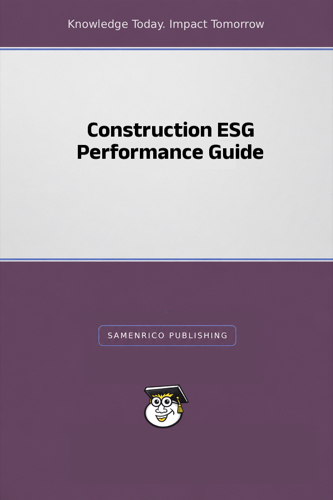
Non-FictionStrategic AtlasConstruction ESG
Construction ESG Performance Guide eBook
Compare green building certifications and material
Compare green building certifications and material sourcing among engineering firms.
Formats
Free sample
Chapter 1: Beyond Compliance...--–- The conference room on the 47th floor of a Manhattan skyscraper was silent except for the hum of the HVAC system. Across the polished walnut table sat six representatives from one of the world’s largest pension funds. Opposite them, the leadership team of a mid-sized engineering firm—renowned for its structural work on hospitals and transit hubs—waited for the verdict. They had just spent two hours presenting their portfolio: LEED Platinum buildings, net-zero energy promises, and a glossy sustainability report. The pension fund’s procurement lead, a woman with thirty years of infrastructure investment experience, slid a single sheet of paper across the table.
It was a one-page questionnaire titled “Supplier ESG Mandatory Disclosure.” Question number four read: “Provide third-party verified Environmental Product Declarations (EPDs) for all concrete and steel procured in the last 24 months, including quarry-level water withdrawal data and smelter-specific Scope 3 emissions.” The engineering firm’s CEO stammered: “We have LEED certifications for most of our projects. Isn’t that enough?” The pension fund lead shook her head. “LEED tells us about your design intent. It does not tell us whether your concrete came from a quarry that uses child labor or whether your steel was made in a coal-fired furnace. We need supply chain data, not building labels.
This RFP is closed.”That story, drawn from a real 2023 procurement dispute involving a California pension fund, captures the central argument of this book. The era of “green building” as a marketing exercise is over. It has been replaced by the era of Environmental, Social, and Governance (ESG) performance as a verifiable, auditable, financially material requirement. For engineering firms—the companies that design, specify, and sometimes procure the materials that become bridges, airports, data centers, and skyscrapers—this shift is not incremental. It is tectonic.
Chapter 1 establishes why traditional green building credentials are no longer sufficient, how institutional investors and regulators are forcing engineering firms to look beyond operational energy, and what vocabulary every engineer must master to survive in this new landscape. By the end of this chapter, you will understand why a firm with a hundred LEED Accredited Professionals can lose a contract to a smaller firm with better material traceability, and you will be equipped with the foundational definitions—Scope 3 emissions, embodied carbon, circular economy, social equity—that underpin every subsequent chapter of this book.The Great Disconnect: Certifications vs. Supply Chains For nearly three decades, the construction industry has relied on green building certification systems as proxies for environmental responsibility. LEED (Leadership in Energy and Environmental Design), BREEAM (Building Research Establishment Environmental Assessment Method), and their regional variants have certified more than one million projects globally. These systems have done genuine good: they pushed the industry toward energy-efficient HVAC, low-flow water fixtures, daylighting, and reduced construction waste.
But they were never designed to solve the problem of embodied carbon or supply chain ethics. A building can achieve LEED Gold using concrete from a quarry that depletes local aquifers and steel from a mill that dumps process water into a river. The certification looks at the building as a finished product; it does not look inside the supply chain.The disconnect is now becoming a liability. Institutional investors—Black Rock, Vanguard, State Street, and the world’s largest pension funds—have collectively signed the Net Zero Asset Managers initiative, committing to align their portfolios with a 1.5°C warming scenario. To do that, they need data.
They cannot simply ask a portfolio company “Are you green?” They need to know: What is the carbon intensity of your purchased steel? What percentage of your concrete suppliers have audited water withdrawal permits? Have any of your aggregate quarries been cited for labor violations? These questions fall under the domain of ESG, which expands the aperture beyond environmental metrics to include social (labor practices, community impact) and governance (supplier transparency, anti-corruption) dimensions.The engineering firm that cannot answer these questions will not win the next generation of large-scale contracts. As one infrastructure financier told a industry conference in 2024, “We are moving from reputational ESG to regulatory ESG.
If you cannot produce auditable supply chain data, you will not get our capital.” Chapter 3 will dive deeply into how certification systems are evolving to address this gap, but the essential point for Chapter 1 is this: certifications are necessary but not sufficient. They are a starting point, not a finish line.The Regulatory Hammer: Why Voluntary is Becoming Mandatory If investor pressure were the only driver, some engineering firms might still choose to delay action. But regulation is accelerating the timeline. Three regulatory developments, spanning the European Union and the United States, are reshaping the procurement landscape.The European Union’s Corporate Sustainability Reporting Directive (CSRD)The CSRD, which took effect in phases starting in 2024, represents the most ambitious corporate sustainability disclosure regime in the world. It applies to any company with significant operations in the EU, regardless of where the parent company is headquartered.
Under CSRD, covered firms must report on their environmental, social, and governance impacts using a double materiality standard: they must disclose not only how sustainability issues affect their financial performance (the traditional view), but also how their operations affect the environment and society. Critically for engineering firms, CSRD requires detailed reporting on Scope 3 emissions—indirect emissions that occur in the value chain, including the production of purchased materials. For an engineering firm that designs a bridge but does not pour the concrete, the concrete’s carbon footprint still counts as a Scope 3 emission if the firm is the lead contractor or design authority on a project covered by CSRD.The penalties for non-compliance are substantial. EU member states are required to impose “effective, proportionate and dissuasive” penalties. While final rules vary by country, guidance suggests fines of up to €10 million or 5% of global annual turnover for material misstatements.
That is not a rounding error. An engineering firm with €500 million in annual revenue could face a €25 million fine for failing to accurately report its supply chain emissions—or, more dangerously, for making a false claim about its material sourcing.The U.S. Securities and Exchange Commission (SEC) Climate Disclosure Rules As of 2025, the SEC’s climate disclosure rules (though subject to legal challenges) require publicly traded companies to disclose material climate-related risks, including those arising from supply chains. While the SEC’s final rules were less aggressive than initially proposed—dropping a requirement to report Scope 3 emissions—the agency made clear that companies must still assess whether Scope 3 emissions are material to their financial condition. For a construction or engineering firm where purchased materials represent 80% or more of project costs, Scope 3 emissions are almost certainly material.
The SEC’s enforcement division has already signaled that it will scrutinize “greenwashing” claims. In 2024, the SEC fined a major investment advisor $19 million for overstating the ESG integration in its funds. Similar enforcement against operating companies—including engineering firms—is expected.The Rise of Mandatory Due Diligence Laws Beyond climate-specific rules, a wave of mandatory human rights and environmental due diligence laws is sweeping Europe. Germany’s Supply Chain Due Diligence Act (Lieferkettengesetz), which took effect in 2023, requires covered companies to analyze and report on human rights and…
This is the end of the free sample. Get the eBook to keep going. Buy now
About this book
Details
- Author
- Halcomb Nubia
- Publisher
- SamEnrico
- Language
- English
- Genre
- Non-Fiction, Strategic Atlas, Construction ESG
- Released
- 2026-06-08
- Pages (approx.)
- 139
- Available as
- eBook, Audiobook

Read better in the ZLOADR app
Your eBooks on your phone or tablet. Sign in with your SamEnrico account and start reading.
More by Halcomb Nubia
 The Ronald Cotton Case StudyHalcomb Nubia$11.99
 Secondary Infertility After Loss HandbookHalcomb Nubia$11.99
 The Thirty Day Metta ChallengeHalcomb Nubia$11.99
 The Letting Go of ExpectationsHalcomb Nubia$11.99
 The Golden Quill: How Amina of Zaria Became West Africa's First Female Poet LaureateHalcomb Nubia$11.99
 Understanding ScabiesHalcomb Nubia$17.99
 Physical Vapor Deposition (Pvd)Halcomb Nubia$11.99
 Trade References Credit GuideHalcomb Nubia$12.99
 Voice Messaging for Mentor OutreachHalcomb Nubia$12.99
 How to Become a Legal InvestigatorHalcomb Nubia$11.99
You may also like
 Hong Kong Handover 1997Dunn Johnnie$11.99
 Zumba For Postnatal Recovery CourseNeal Christian$11.99
 Zumba for BeginnersLadner Nikia$11.99
 YouTube Comment Mining GuideHumes Pandora$12.99
 Worry Box MeditationCarlin Rudy$11.99
 Workplace Stress MeditationNguyen Lynn$11.99
 Workplace Stress and Sleep RepairHawley Ivory$11.99
 Workplace Perfectionism CureDelaney Jeffry$11.99
 Workplace Injustice Anger GuideWallen Isabelle$11.99
 Work Addiction and Burnout LinkGreenwood Ester$11.99
 Women in Yoga and WellnessBeattie Galina$11.99
 Women in Stand Up ComedyChun Evangeline$11.99