
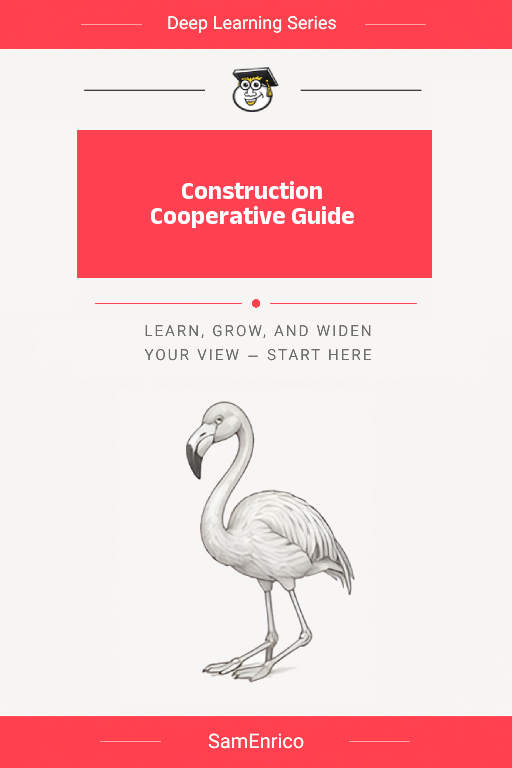
Non-FictionBusiness BriefConstruction Cooperatives
Construction Cooperative Guide eBook
Organize masons, carpenters, and electricians into
Organize masons, carpenters, and electricians into cooperatives for joint bidding on construction projects.
Formats
Free sample
Chapter 1: The Last Handshake--The old way of winning construction work alone is not just dying—it is already dead, and most tradespeople simply haven't attended the funeral.You remember the handshake. The one where a developer you knew from church clapped you on the shoulder and said, "I've got a small renovation, thirty thousand bucks, you're my guy." No paperwork. No bond. No prequalification. Just trust earned over twenty years of showing up on time and never leaving a mess.
That handshake built thousands of small contracting businesses across America. It put kids through trade school and paid off pickup trucks. And it is never coming back.Not because developers have become dishonest, though some have. Not because owners don't trust you, though many don't. The handshake died for one simple, structural reason: the people who control the money no longer have the authority to shake on it.Consider what happens when a municipal school district issues a Request for Proposals for a $4 million addition.
The person writing that RFP is not a superintendent who can make a gut call. She is a procurement officer bound by state law to evaluate bids against a published rubric. Her job depends on defending every decision in writing, sometimes in court. She cannot hire you because she likes you. She cannot hire you because your uncle sits on the school board.
She can only hire the bid that checks every box—and the first box on every modern RFP is "ability to deliver multiple trades under a single contract."That box eliminates you if you work alone.This chapter will show you exactly how the bidding landscape has changed, why the numbers prove that solo bidding is a losing strategy for all but a tiny fraction of tradespeople, and what the "bidding consortium" model offers as an alternative. By the end, you will understand why the question is no longer whether you should join forces with other trades, but how quickly you can find the right partners before the remaining opportunities disappear.The Myth of the Lone Wolf Let us start with a confession: the lone master craftsman was never as common as memory suggests. The great cathedrals of Europe were built by guilds, not individual masons. The skyscrapers of New York rose through the coordinated labor of dozens of subcontractors working under general contractors. Even the romanticized small-town builder of the 1950s typically employed three to five men and subcontracted electrical and plumbing work.But something real has been lost.
For most of the last century, a skilled carpenter with a truck and a reputation could build a comfortable middle-class life bidding on small commercial jobs, custom homes, and light renovation work. He did not need a website, a surety bond, or a quality management plan. He needed a phone number and a steady hand.That world ended between 2008 and 2012. The financial crisis did not just destroy demand for construction—it permanently rewired how owners buy it. Before the crash, public agencies and large private owners often accepted bids from single-trade contractors, managing the coordination themselves or hiring a separate construction manager.
After the crash, two things happened simultaneously.First, owners laid off their internal project management staff. School districts, hospitals, and municipal governments shrank their facilities departments to balance budgets. They could no longer afford to coordinate separate masonry, carpentry, and electrical contractors. They needed someone else to handle the headache.Second, insurance carriers and bonding companies tightened requirements dramatically. A solo mason who had been bonded for twenty years suddenly found his premium doubled.
New solo operators found they could not get bonded at all without three years of audited financials and a net worth most small tradespeople do not have.The result was a rapid shift toward what the industry calls "integrated project delivery"—a fancy way of saying owners want one throat to choke. They want a single contract, a single schedule, a single point of contact for change orders, and a single insurance certificate covering everyone on site. That single point can be a general contractor. Or it can be a cooperative of trades. But it cannot be a solo mason.What the Numbers Actually Say Before we go further, let us be honest about the data.
You have probably heard that "most small contractors fail." That statistic is usually deployed to scare tradespeople into making poor decisions—signing unfavorable subcontracts, buying expensive franchises, or joining questionable "networks" that charge high fees for low value.The truth is more nuanced and more useful.According to the most reliable data from the Construction Financial Management Association and the U.S. Bureau of Labor Statistics, approximately 80 percent of single-trade construction firms with fewer than five employees fail to win a profitable public or large-scale private contract in any given year. That is not a lifetime failure rate. It is an annual filtration system. Every year, four out of five small firms get shut out of the most lucrative segment of the market.But that means one in five succeeds.Who are these successful solo operators?
They fall into three categories. The first is the specialist with an irreplaceable skill—a historic restoration mason, a custom metal fabricator, a theatrical lighting electrician. These tradespeople win not because they bid low but because no one else can do what they do. The cooperative model is not for them, and this book does not pretend otherwise.The second category is the relentless networker who spends forty percent of their time bidding, schmoozing, and chasing leads. These individuals work sixty to eighty hours per week, have high rates of burnout and divorce, and rarely retire with significant savings.
They succeed by any objective measure of revenue but fail by any reasonable measure of quality of life.The third category is the lucky. They bid on the right job at the right time, faced weak competition, and built a relationship that sustained them for years. Luck is not a strategy.The cooperative model is designed for the remaining eighty percent—the competent, reliable tradespeople who do good work, show up on time, and cannot break through the single-bid barrier because they lack breadth, not skill. It is also designed for the successful solo operators in the second category who are tired of trading their lives for revenue.The question is not "Can I win alone?" The question is "What kind of life do I want to build?"Anatomy of a Modern Request for Proposals Let us walk through a real RFP. Not a hypothetical.
Not a simplified example. An actual solicitation from a mid-sized school district in the Pacific Northwest, issued in 2023, for an elementary school addition.The document runs 147 pages. Buried on page 34 is the "Contractor Qualifications" section. It requires the bidder to demonstrate experience in the following trades within the last five years: site excavation, concrete foundation, structural steel erection, masonry, rough carpentry, finish carpentry, roofing, HVAC rough-in, HVAC trim-out, plumbing rough-in, plumbing trim-out, electrical rough-in, electrical trim-out, low-voltage data cabling, drywall installation, painting, floor covering, and landscaping.Eighteen trades. A solo operator cannot bid this contract.
Neither can a mason and carpenter working together. You need at least eight specialized firms to cover the scope. But…
This is the end of the free sample. Get the eBook to keep going. Buy now
About this book
Details
- Author
- Hanes Calista
- Publisher
- SamEnrico
- Language
- English
- Genre
- Non-Fiction, Business Brief, Construction Cooperatives
- Released
- 2026-06-01
- Pages (approx.)
- 147
- Available as
- eBook, Audiobook

Read better in the ZLOADR app
Your eBooks on your phone or tablet. Sign in with your SamEnrico account and start reading.
More by Hanes Calista
 Attribute Rating Mapping CourseHanes Calista$11.99
 Sleep Spindle EnhancementHanes Calista$11.99
 Confronting a Lying PartnerHanes Calista$11.99
 Lister Antiseptic RevolutionHanes Calista$11.99
 Etsy Digital Planner Profit GuideHanes Calista$11.99
 The Dark Rivers of Karst: Exploring Central Asia's Hidden Underground Worlds (1905-1920)Hanes Calista$11.99
 The Silent Codebreakers: How a Group of Women Outsmarted the NazisHanes Calista$11.99
 High-Retention Video StructuresHanes Calista$11.99
 Understanding Chiari Type 1 MalformationHanes Calista$17.99
 Global Team Meeting EtiquetteHanes Calista$12.99
 How to Become a BulkerHanes Calista$11.99
You may also like
 Hong Kong Handover 1997Dunn Johnnie$11.99
 Zumba For Postnatal Recovery CourseNeal Christian$11.99
 Zumba for BeginnersLadner Nikia$11.99
 YouTube Comment Mining GuideHumes Pandora$12.99
 Worry Box MeditationCarlin Rudy$11.99
 Workplace Stress MeditationNguyen Lynn$11.99
 Workplace Stress and Sleep RepairHawley Ivory$11.99
 Workplace Perfectionism CureDelaney Jeffry$11.99
 Workplace Injustice Anger GuideWallen Isabelle$11.99
 Work Addiction and Burnout LinkGreenwood Ester$11.99
 Women in Yoga and WellnessBeattie Galina$11.99
 Women in Stand Up ComedyChun Evangeline$11.99