
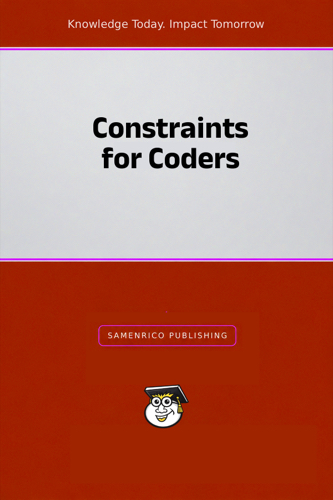
Constraints for Coders eBook
Limited memory or speed drives elegant code.
Limited memory or speed drives elegant code.
Formats
Free sample
Chapter 1: The Abundance Lie--–- The year is 1995. In a cramped dorm room in Norway, a 19-year-old programmer named Jon has just done something impossible. He has rendered a real-time, texture-mapped 3D landscape—complete with a synthesizer soundtrack and interactive camera controls—in exactly 64 kilobytes. That is not a typo. Sixty-four kilobytes.
The email client on your phone, right now, is likely larger than ten thousand copies of Jon's entire program. His toolchain was a hex editor, an assembler, and a mind trained to see constraints not as obstacles but as the very source of creative power.–- Fast forward to 2025. A team of six developers at a well-funded startup is preparing to deploy a "simple" chat application. Their node_modules folder weighs in at 487 megabytes. The production container image, after three rounds of "slimming," is 320 megabytes.
The application, which sends strings of text between two users, consumes 1.2 gigabytes of RAM at idle. When asked why, the lead developer shrugs and says, "Memory is cheap. The cloud scales."–- This book is about the chasm between those two worlds. It is about the lie that abundance tells us, and the truth that scarcity reveals. The lie is that constraints are problems to be eliminated.
The truth is that constraints are design partners to be embraced. The lie is that faster hardware and bigger cloud instances will save us. The truth is that inefficiency is a tax that compounds forever. The lie is that "clever" code is impressive. The truth is that inevitable code—code that, given the constraints, could not have been written any other way—is the only kind that endures.–- Welcome to Constraints for Coders.
This is not a book about making your code slightly faster. It is a book about rewriting your relationship with the machine.The Cloud Fallacy: How Abundance Became a Crutch–- The Cloud Fallacy is not a single misunderstanding but a constellation of them. They cluster around the assumption that resources are effectively infinite because someone else—AWS, Google Cloud, Azure—owns the data center. Let us name each fallacy explicitly, because you cannot dismantle what you refuse to name.Fallacy 1: "Memory is cheap, so don't worry about it."–- At the hardware level, DRAM costs approximately $3 to $5 per gigabyte as of this writing. That is cheap.
But the fallacy confuses unit cost with system cost. A chat application that wastes 500 megabytes of RAM does not cost $2. It costs that $2 multiplied by every running instance, multiplied by every deployment environment, multiplied by every year of operation. More insidiously, wasted memory forces larger instance types, which trigger higher network and storage costs. The true cost of waste is exponential, not linear.–- Worse, memory waste is rarely isolated.
A program that allocates excessively also incurs garbage collection pauses, TLB (Translation Lookaside Buffer) misses, and increased pressure on the CPU cache. As you will see in Chapter 3, a single unnecessary allocation can evict a cache line that another part of the program needed. The cheap memory fallacy is a gateway drug to systemic inefficiency.Fallacy 2: "The cloud scales infinitely, so performance is someone else's problem."–- This is the abdication fallacy. It assumes that when performance degrades, you can simply add more servers. Horizontal scaling is powerful, but it amplifies inefficiency.
A service that requires 100 milliseconds per request and 200 megabytes per instance will cost you exactly twice as much to run as a service that requires 50 milliseconds and 100 megabytes—assuming the same request rate. The cloud does not eliminate inefficiency; it monetizes it with ruthless precision.–- Moreover, scaling has physical limits. Every cloud region has a maximum number of instances. Every load balancer has a maximum connection rate. Every database has a maximum transaction throughput.
The "infinite scaling" myth collapses the moment you hit a real constraint, and by then, your architecture has ossified around waste.Fallacy 3: "Hardware gets faster every year, so my slow code will be fast enough next year."–- Moore's Law—the observation that transistor density doubles approximately every two years—has slowed to a crawl. Single-threaded CPU performance now improves at roughly 3% annually. At that rate, a program that is too slow today will be too slow for the next decade. The hardware improvement fallacy is a form of deferral that turns technical debt into technical bankruptcy.–- The demoscene programmer from our opening did not have the luxury of deferral. His 64KB executable had to run on hardware that was already resource-constrained.
That constraint forced him to discover algorithms and compression techniques that are still relevant thirty years later. Your modern cloud instance is millions of times faster, but your software is thousands of times slower. The ratio—the inefficiency multiplier—has grown, not shrunk.The Abstraction Gap: What Your Language Hides From You–- High-level programming languages are miracles of human ingenuity. Python, Java Script, Java, C#—they free us from manual memory management, pointer arithmetic, and register allocation. But every abstraction has a cost, and the cost of modern language abstractions is unpredictable latency.–- Consider the humble list append.
In Python: my_list.append(42). This is a single line of code. What actually happens?Python checks the type of my_list (dynamic dispatch).It calls list.append, which is a C function.The C function checks if the underlying array has capacity.If not, it allocates a new array (typically 1.125× the current size).It copies every existing element to the new array (O(n) copy).It appends the new element.It increments the reference count of 42 (because Python uses reference counting).It returns None.–- That single line of Python can trigger a garbage collection, a memory allocation, and an O(n) copy—all invisible to the programmer who wrote it. The abstraction gap is the distance between what you think your code does and what the hardware actually executes. That gap is where performance dies.–- This book is not an attack on high-level languages.
Python and Java Script are essential tools. But constraint-aware coding requires that you see the gap. You do not need to close it entirely—that would mean writing assembly—but you must know when you are about to fall into it.The Abstraction Gap Checklist–- Before writing a loop, ask yourself:Does this operation allocate memory? (String concatenation? List comprehension?
Lambda inside a loop?)Does it change the size of a collection? (Appending to an array may cause reallocation.)Does it call a function that I cannot see? (Property getters, operator overloading, implicit conversions.)Does it interact with the garbage collector? (Creating temporary objects, closing over variables in a closure.)–- If you cannot answer these questions with confidence, you are flying blind. The first step toward constraint awareness is turning on the instruments.The Elegance Metric: From Clever to Inevitable–- There is a kind of code that impresses other programmers at conferences.
It uses bitwise tricks. It has nested ternaries. It solves a complex problem in one line of nested function calls. This is clever code. It is also, almost always, brittle code.
It breaks when the requirements change. It baffles the next developer. It cannot be debugged under pressure.–- Then there is code that…
This is the end of the free sample. Get the eBook to keep going. Buy now
About this book
Details
- Author
- Harter Elisha
- Publisher
- SamEnrico
- Language
- English
- Genre
- Non-Fiction, Self-Help, Software
- Released
- 2026-06-09
- Pages (approx.)
- 131
- Available as
- eBook, Audiobook

Read better in the ZLOADR app
Your eBooks on your phone or tablet. Sign in with your SamEnrico account and start reading.
More by Harter Elisha
 Postpartum Psychosis GuideHarter Elisha$11.99
 Estranged Adult Child AngerHarter Elisha$11.99
 Carson National Parks ExpansionHarter Elisha$11.99
 Assertiveness for Blended FamiliesHarter Elisha$11.99
 Marketing Channels ListHarter Elisha$11.99
 Five Senses Grounding TechniqueHarter Elisha$11.99
 Heart Failure Anticipatory GriefHarter Elisha$11.99
 The Ghosts of Naseby: Cromwell's Bloody ReckoningHarter Elisha$11.99
 Love and Strategy: The Unlikely Alliance of Scipio and HannibalHarter Elisha$11.99
 Carolina Dogs: The American DingoHarter Elisha$11.99
 How to Produce Connectors and TerminalsHarter Elisha$11.99
 How to Become a Heading-saw OperatorHarter Elisha$11.99
You may also like
 Hong Kong Handover 1997Dunn Johnnie$11.99
 Zumba For Postnatal Recovery CourseNeal Christian$11.99
 Zumba for BeginnersLadner Nikia$11.99
 YouTube Comment Mining GuideHumes Pandora$12.99
 Worry Box MeditationCarlin Rudy$11.99
 Workplace Stress MeditationNguyen Lynn$11.99
 Workplace Stress and Sleep RepairHawley Ivory$11.99
 Workplace Perfectionism CureDelaney Jeffry$11.99
 Workplace Injustice Anger GuideWallen Isabelle$11.99
 Work Addiction and Burnout LinkGreenwood Ester$11.99
 Women in Yoga and WellnessBeattie Galina$11.99
 Women in Stand Up ComedyChun Evangeline$11.99