
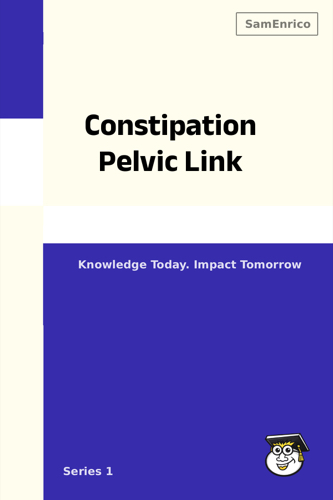
Constipation Pelvic Link eBook
Teaches pelvic floor coordination to relieve chron
Teaches pelvic floor coordination to relieve chronic constipation and straining.
Formats
Free sample
Chapter 1: The Drawbridge Betrayal--–- You have been betrayed by a muscle you never knew existed.Not by your colon, which you have blamed for years. Not by your diet, which you have adjusted a hundred times. Not by your stress, your water intake, or your lack of exercise. Those things matter, yes. But they are not the primary culprit.
The betrayal comes from a small, sling-like muscle called the puborectalis, and it has been doing the exact opposite of what you need every single time you have tried to have a bowel movement.This chapter will introduce you to that muscle, show you exactly how it works in a healthy body, and then reveal the cruel paradox of dyssynergic defecation: the harder you push, the tighter it gets. By the end of this chapter, you will understand why straining is not just ineffective but actively harmful. You will also take the first self-diagnostic step toward learning to poop without pushing.Let us begin with a story.The Thirty-Minute Nightmare Sarah is forty-two years old, a mother of two, and a successful architect. She has not had a spontaneous, complete bowel movement without the aid of an enema or a gloved finger in over fourteen months. Every morning, she wakes up an hour earlier than her family.
She drinks a full glass of warm water with lemon. She eats a bowl of high-fiber bran cereal—because every doctor and every website has told her that fiber is the answer. She sits on the toilet with her phone, scrolls through emails, and pushes. And pushes. And pushes.Twenty minutes pass.
Then thirty. Her legs go numb. Her face flushes from the Valsalva maneuver—the medical term for holding your breath and bearing down. Sometimes a small, hard pellet comes out. Sometimes nothing comes out except a feeling of incompleteness that follows her through the rest of the day like a low-grade fever.
She has tried laxatives (they gave her cramps and dependency). She has tried stool softeners (they made everything slippery but still stuck). She has tried a squatty potty (it helped a little, but not enough). She has seen a gastroenterologist who ordered a colonoscopy—normal—and then said, "Just eat more fiber and drink more water."Sarah wanted to scream. She was already eating thirty grams of fiber a day.
She was already drinking two liters of water. The problem was not the input. The problem was the exit.And the exit was being guarded by a muscle that refused to open.The Muscle You Have Never Heard Of The puborectalis (pronounced pyoo-boh-rek-TAH-lis) is part of the levator ani muscle group, which forms the pelvic floor. It originates at the pubic bone—the front of your pelvis—and wraps around the back of the rectum like a sling or a hammock. In anatomical terms, it is a striated (voluntary) muscle, meaning you can control it consciously, though most people have never been taught how.Here is what the puborectalis does in a healthy body.
When you are going about your day—walking, working, exercising—the puborectalis stays gently contracted. This contraction pulls the rectum forward, creating a sharp angle between the rectum and the anal canal. That angle is called the anorectal angle, and it normally measures about 90 degrees when you are standing or sitting upright. This 90-degree angle is a beautiful piece of evolutionary engineering. It keeps stool in the rectum where it belongs until you decide to release it.
Without this angle, you would leak feces constantly. The puborectalis is, in essence, a continence muscle. It is a gatekeeper.When you are ready to have a bowel movement, your brain sends a signal down the spinal cord, through the sacral nerves (S2, S3, and S4 for anatomy enthusiasts), to the puborectalis. The signal says: Relax. Let go.
Open the gate. When the puborectalis relaxes, the rectum straightens out. The anorectal angle opens from 90 degrees to approximately 120 degrees. The rectum becomes a straight funnel, stool descends, and the anal sphincter—another ring of muscle—relaxes in coordination. A bowel movement happens without conscious effort, without straining, in less than sixty seconds.That is how it is supposed to work.
That is how it worked for you when you were a child, before years of pushing, fear, and paradoxical training rewired your neuromuscular system.The Paradox: When Relaxation Becomes Contraction Now comes the betrayal.In dyssynergic defecation—from the Greek dys (bad, difficult) and synergia (working together)—the brain sends the signal to relax, but the puborectalis does the opposite. It contracts. It tightens. It pulls the rectum forward even harder, making the anorectal angle sharper than normal, sometimes as acute as 60 degrees. You feel the urge to go, you sit down, and instead of a straight funnel, you have a kink in the hose.
Stool hits that kink and stops.But here is where the cruelty of this condition becomes apparent. You do not know that the puborectalis is contracting. All you know is that stool is right there—you can feel it—but it will not come out. So you do what any reasonable person would do. You push.
You bear down. You increase intra-abdominal pressure using the Valsalva maneuver, the same technique weightlifters use to brace their cores.And what happens when you push against a closed gate? The gate does not open. It pushes back. The increased pressure from above compresses the rectum against the contracted puborectalis, making the angle even sharper.
You are, in effect, stepping on the gas and the brake at the same time. The stool is being squeezed from above and blocked from below. No wonder it feels like hitting a wall.This is the central paradox of chronic straining constipation. The harder you push, the tighter the pelvic floor becomes. The more you strain, the more you reinforce the very pattern that is causing the problem.
Every failed pushing episode is a training session for your puborectalis, teaching it to contract in response to the urge to defecate. You have, without knowing it, become an expert at paradoxical contraction.The Drawbridge Effect: A Metaphor for Your Body Because medical terminology can be dry and difficult to remember, I want you to adopt a different image for the rest of this book. Forget about the puborectalis as a sling. Think of it as a drawbridge over a moat.Imagine a medieval castle. Surrounding the castle is a wide, deep moat.
The only way in or out is a drawbridge. When the drawbridge is lowered, people and supplies can pass freely. When the drawbridge is raised, the castle is sealed, impenetrable. Your rectum is the road leading to the drawbridge. The anal canal is the road on the other side.
Stool is the traveler trying to cross.In a healthy defecation, the drawbridge lowers. The puborectalis relaxes, the anorectal angle opens, and stool crosses smoothly. The whole process takes seconds, and you barely notice it. In dyssynergic defecation, the drawbridge raises—or stays raised—when you try to cross. The puborectalis contracts, the angle sharpens, and stool slams into a wall of muscle.Now imagine that you are standing on the castle side of the moat…
This is the end of the free sample. Get the eBook to keep going. Buy now
About this book
Details
- Author
- Hawthorne Noriko
- Publisher
- SamEnrico
- Language
- English
- Genre
- Non-Fiction, Health & Wellness, Digestive Health
- Released
- 2026-06-05
- Pages (approx.)
- 135
- Available as
- eBook, Audiobook

Read better in the ZLOADR app
Your eBooks on your phone or tablet. Sign in with your SamEnrico account and start reading.
More by Hawthorne Noriko
 Cover Letter After LayoffHawthorne Noriko$11.99
 The Audiobook Narrator LifeHawthorne Noriko$11.99
 Widow Self Esteem RecoveryHawthorne Noriko$11.99
 The Growth Mindset for Chronic IllnessHawthorne Noriko$11.99
 Stress and Nutritional DepletionHawthorne Noriko$11.99
 New Parent Sleep MeditationHawthorne Noriko$11.99
 Evening Creative ReflectionHawthorne Noriko$11.99
 The Melian Massacre: Athens' Ruthless Gambit in the Peloponnesian WarHawthorne Noriko$11.99
 The Balloonist and the Bald Eagle: Thaddeus Lowe’s Skyward DreamHawthorne Noriko$11.99
 How to Become a Rug-dry-room AttendantHawthorne Noriko$11.99
 Finnish Spitzes: Barking Bird DogHawthorne Noriko$11.99
 How to Produce Palette KnivesHawthorne Noriko$11.99
You may also like
 Postpartum Constipation GuideMccollum Katlyn$11.99
 Postpartum Constipation ReliefDerr Romona$11.99
 Lactose Intolerance Relief GuideMchenry Carmelita$11.99
 Lactose Intolerance GuideGilbert Elena$11.99
 Fiber Types and BenefitsMora Deidre$11.99
 Diarrhea Management GuidePridgen Kerstin$11.99
 Keto Constipation Relief GuideShore Wes$11.99
 Constipation Relief ExercisesHardwick Dreama$11.99
 Chloride And DigestionThornburg Shawanda$11.99
 The Microbiome ResetSimms Isaiah$11.99
 Low FODMAP Meal PrepRoberge Codi$11.99
 Ginger Oil Digestion GuideMusser Marietta$11.99