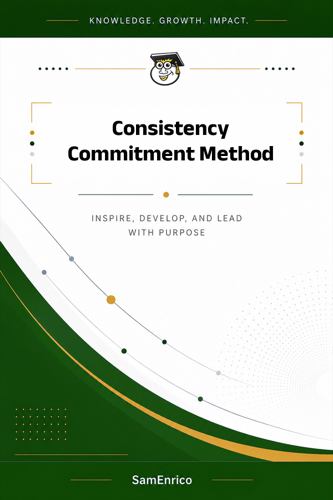
Consistency Commitment Method eBook
Secure small initial agreements to pave the way fo
by Cloud Boyce
Secure small initial agreements to pave the way for larger requests.
Formats
Free sample
Chapter 1: The $2 Billion Nod--In 1971, a 24-year-old fundraising director for a small environmental nonprofit faced a problem that would have broken most people. His organization needed to raise $2 billion over the next decade to protect endangered habitats across the American West. But in his first six months on the job, his direct mail campaigns had generated less than $50,000. His door-to-door canvassing operation was hemorrhaging money. And his board of directors was starting to ask uncomfortable questions about whether a young activist with no business training belonged in the role.The young man's name was Roger Craver, and he was about to discover something that would revolutionize not just his organization but the entire field of fundraising, sales, and persuasion.
He was about to stumble upon a principle so powerful, so deeply embedded in human psychology, that it would eventually help his nonprofit raise not $2 billion but over $5 billion across four decades. And he discovered it not through a Harvard MBA or a consulting firm's expensive research, but through a moment of pure frustration followed by a tiny, almost accidental experiment.One evening, after yet another disappointing day of canvassing, Craver sat in his cramped office reviewing the numbers. His canvassers had knocked on hundreds of doors asking for donations. The response rate was pitiful. People said no to requests for $10, $15, even $5.
They slammed doors, made excuses, or simply refused to engage. Craver realized something fundamental: he was asking for too much, too fast. But asking for less seemed pointless. A $1 donation wouldn't pay for postage, let alone save any habitats.Then he had an idea. What if he stopped asking for money entirely?The next morning, he sent his canvassers back out with a completely different script.
Instead of asking for a donation, they asked a simple question: "Would you be willing to sign a petition supporting the protection of endangered species?" That was it. No request for money. No request for time. Just a signature on a piece of paper. The response was immediate and dramatic.
People who had refused to donate eagerly signed the petition. It cost them nothing. It took three seconds. And it made them feel like the kind of person who cares about the environment.Over the next two weeks, Craver's team collected over 50,000 signatures. Then came the second phase.
The canvassers returned to those same 50,000 households, this time with a request for a donation. The results defied every assumption in fundraising. Among the people who had signed the petition, the donation rate was nearly 50 percent. Among a control group that had never been approached, the donation rate was less than 5 percent. A simple, tiny, cost-free signature had increased donation rates by a factor of ten.Craver didn't know it at the time, but he had just rediscovered a principle that social psychologists had only begun to document five years earlier.
He had discovered the power of the tiny yes.The Science of the Stubborn Mind To understand why a signature on a petition could unlock a donation that a direct request could not, we need to understand something peculiar about the human brain. We like to think of ourselves as rational actors who make decisions based on a careful weighing of costs and benefits. We believe that when we say yes to something, we do so because we have evaluated the option and found it wanting. But this is not how the brain actually works. In fact, it is almost the opposite of how the brain works.The human brain processes approximately 11 million bits of information per second.
That is the estimate from cognitive neuroscience. But the conscious mind can handle only about 50 bits per second. This means that for every conscious decision you make, your brain is unconsciously processing over 200,000 times more information than you will ever be aware of. To survive in this flood of data, the brain has developed shortcuts. Psychologists call them heuristics.
Daniel Kahneman, the Nobel Prize-winning psychologist, calls them System 1 thinking. And one of the most powerful heuristics is the drive for consistency.Here is what the consistency heuristic does. Once you make a decision, take a stand, or perform an action, your brain automatically begins to filter future information through the lens of that prior commitment. Information that supports your prior decision feels good. Information that contradicts it feels bad.
This is not a logical process. It is an emotional one. The brain rewards consistency with a small hit of dopamine, the same neurotransmitter associated with pleasure and reward. Inconsistency, by contrast, triggers a stress response. The brain releases cortisol.
You feel anxiety, discomfort, unease. You might call it a guilty conscience. The brain calls it a warning signal that you are about to violate your own stated identity.This drive for consistency is not a bug. It is a feature. It evolved because consistency is adaptive.
Imagine a prehistoric human who decided one day that a particular berry patch was safe to eat from, and then changed her mind the next day for no reason. She would waste energy re-evaluating the same decision repeatedly. Worse, her tribe would see her as unreliable. Consistency signals reliability to others. It signals that you are predictable, trustworthy, and sane.
In a world where survival depended on cooperation, inconsistency was a death sentence.The modern world is not so different. When a politician changes positions without explanation, we call them a flip-flopper. When a friend cancels plans repeatedly, we stop inviting them. When a brand changes its messaging constantly, we lose trust. Consistency is not just a cognitive shortcut.
It is a social currency. And once you understand how it works, you can begin to see it everywhere.The Experiment That Changed Everything The scientific foundation for the Consistency Commitment Method rests on a single study, elegant in its simplicity and devastating in its implications. In 1966, two social psychologists named Jonathan Freedman and Scott Fraser published a paper titled "Compliance Without Pressure: The Foot-in-the-Door Technique." The study has been cited over 5,000 times, replicated across dozens of cultures and contexts, and remains one of the most robust findings in the history of social psychology.Here is what Freedman and Fraser did. They went door-to-door in a middle-class neighborhood in Palo Alto, California, and asked homeowners to perform a small, seemingly trivial task. Specifically, they asked homeowners to sign a petition promoting safe driving.
The petition was uncontroversial. No one was against safe driving. The request took about three seconds. Signing the petition cost nothing, required no ongoing commitment, and carried no social risk. Nearly everyone agreed.
In fact, the compliance rate was over 90 percent.Two weeks later, a different researcher returned to the same homes with a completely different request. This time, the request was massive. The researcher asked homeowners if they would be willing to allow a large, unattractive billboard to be installed on their front lawn. The billboard read, in enormous letters, "DRIVE CAREFULLY." The researcher showed the homeowners a photograph of the billboard. It was ugly.
It would block their view. It would require a hole to be dug in their yard. Neighbors might complain. The cost of compliance, in social and practical terms, was enormous.Among homeowners who had…
This is the end of the free sample. Get the eBook to keep going. Buy now
About this book
Details
- Author
- Cloud Boyce
- Publisher
- SamEnrico
- Language
- English
- Genre
- Non-Fiction, Business Brief, Behavioral Economics
- Released
- 2026-06-10
- Pages (approx.)
- 135
- Available as
- eBook, Audiobook

Read better in the ZLOADR app
Your eBooks on your phone or tablet. Sign in with your SamEnrico account and start reading.
More by Cloud Boyce
 Entertainment Spending StudyCloud Boyce$11.99
 Gacy Childhood Home IowaCloud Boyce$11.99
 North Korean DefectorCloud Boyce$11.99
 Bipolar Mood ChartingCloud Boyce$11.99
 Dubai Student LeadershipCloud Boyce$11.99
 Circadian Rhythm And ImmunityCloud Boyce$11.99
 Post Infectious IBSCloud Boyce$11.99
 Golden Threads: The Silk Road Dynasty’s Secret HeirCloud Boyce$11.99
 The Boy Who Defied the Dictator: The Untold Story of Peru's Soccer MiracleCloud Boyce$11.99
 How to Produce Soda Maker AccessoriesCloud Boyce$11.99
 How to Produce GearsCloud Boyce$11.99
 A Collector's Handbook to the Citroën Citroen 7cv (Super Modern 12)Cloud Boyce$11.99