
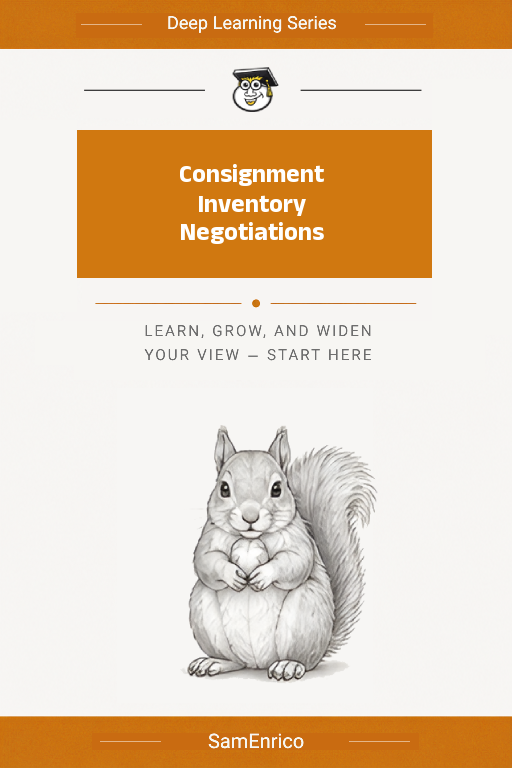
Consignment Inventory Negotiations eBook
Ask Chinese suppliers to hold stock locally, payin
Ask Chinese suppliers to hold stock locally, paying only for what you sell or use.
Formats
Free sample
Chapter 1: The Inventory Trap--–- Most business owners discover consignment inventory the same way they discover quicksand: by stepping into it accidentally while trying to solve a completely different problem. You wake up one morning, log into your bank account, and realize that $500,000 of your cash is sitting in a warehouse in Shenzhen, wrapped in plastic, waiting for customers who haven't decided to buy yet. Your suppliers are paid. Your warehouse is full. Your cash flow is empty.
And somewhere in Guangzhou, a factory owner is using your deposit to buy a new BMW while you struggle to make payroll.This is the inventory trap. It is not a cash flow problem. It is a business model problem disguised as a cash flow problem. And until you understand the difference, no amount of negotiating tactics or supplier scripts will save you.The inventory trap works like this. You find a product that sells.
You negotiate a price with a Chinese supplier. They demand a 30 percent deposit to start production. You pay it. They manufacture 10,000 units. You pay the remaining 70 percent before shipping.
The goods travel for six weeks on a container ship. They arrive at your warehouse. You pay customs duties. You pay warehousing fees. You pay insurance.
Then—and only then—do you start selling.By the time the first unit leaves your warehouse, you have already paid for everything. Your cash has been converted into cardboard boxes sitting on pallets. And if those boxes sit for six months? You have paid for six months of storage. If they sit for a year?
You have paid for a year of borrowing costs, either explicitly through a line of credit or implicitly through the opportunity cost of not investing that cash elsewhere.This is the traditional buy-to-hold model. It is how almost every importer operates. And it is financially insane when you run the actual numbers.Let me show you what I mean. Take a product that costs 10froma Chinesesupplier.Youorder10,000unitsfor10 from a Chinese supplier. You order 10,000 units for 10froma Chinesesupplier.Youorder10,000unitsfor100,000.
You pay 30,000upfront.Sixtydayslater,youpaytheremaining30,000 upfront. Sixty days later, you pay the remaining 30,000upfront.Sixtydayslater,youpaytheremaining70,000. The goods arrive ninety days after your initial deposit. You start selling. You sell 2,000 units in the first month.
That generates 40,000inrevenueifyourmarginis100percent.Butyoualreadypaid40,000 in revenue if your margin is 100 percent. But you already paid 40,000inrevenueifyourmarginis100percent.Butyoualreadypaid100,000. You are still 60,000intheholeoncashflow,eventhoughyouhaveinventoryworth60,000 in the hole on cash flow, even though you have inventory worth 60,000intheholeoncashflow,eventhoughyouhaveinventoryworth80,000 sitting in your warehouse. That $80,000 is not cash. It is potential cash.
And potential cash does not pay rent.Now imagine you do this for ten products. You have 1milliontiedupininventory.Yourbankaccountshows1 million tied up in inventory. Your bank account shows 1milliontiedupininventory.Yourbankaccountshows200,000. You feel poor because you are poor. Your wealth is sitting on shelves, not in your checking account.Consignment inventory inverts this entire model.
Under consignment, your Chinese supplier owns the goods until you sell them or consume them. You pay only for what moves, not what sits. The supplier holds the inventory locally—either in their own warehouse near your market, in a third-party logistics facility, or in a bonded warehouse where duties are deferred until sale. You pull stock as needed. You pay monthly for what you sold.
The supplier carries the carrying cost, the obsolescence risk, and the financing burden.This is not a payment term negotiation. This is a structural transformation of your supply chain. And it is possible right now in a way that it was not possible five years ago.The Window of Opportunity Three forces have converged to create a perfect moment for consignment negotiations with Chinese suppliers. Understanding these forces is not academic. It is the difference between walking into a negotiation with leverage versus walking in with a wish.The first force is post-COVID overcapacity.
Between 2020 and 2022, Chinese manufacturers expanded production capacity to meet unprecedented global demand for goods. Factories bought new machines. They leased larger spaces. They hired more workers. Then demand normalized.
Today, many factories are running at 60 to 70 percent of capacity. Every empty machine is a cost without revenue. Every idle worker is a fixed expense. Factory owners are desperate to keep their lines running. A consignment arrangement that guarantees monthly pull volume, even if payment is delayed until sale, is better than an empty production schedule.The second force is softening Western demand.
Inflation, interest rate increases, and shifting consumer preferences have reduced order volumes from the United States and Europe. Chinese suppliers who once rejected consignment as "not our model" are now hearing the same phrase from their customers: "We are reducing our order quantities." The suppliers who adapt will survive. The suppliers who insist on traditional terms will lose business to Vietnam, Mexico, and India. This is not speculation. It is already happening across electronics, apparel, and home goods.The third force is rising warehousing costs in China.
Domestic logistics have become more expensive as land prices increase and labor costs rise. Chinese suppliers are discovering that holding finished goods inventory in their own factories is not free. The cost of warehousing has created a new economic reality: for many suppliers, the marginal cost of holding your stock for an extra sixty days is lower than the cost of losing your order entirely.These three forces have shifted leverage from suppliers to buyers for the first time in two decades. But leverage is useless if you do not know how to use it. Most buyers will walk into a consignment negotiation, make a clumsy demand, get rejected, and conclude that "Chinese suppliers don't do consignment." They are wrong.
Chinese suppliers do consignment every day for their largest customers. Walmart does not prepay for inventory. Amazon does not prepay for inventory. Apple does not prepay for inventory. These companies have negotiated consignment or vendor-managed inventory agreements with the same suppliers who tell you "we don't do that model."The difference is not the supplier.
The difference is the buyer's approach, preparation, and leverage.What Consignment Actually Means Before you can negotiate consignment, you need to understand the four operational variants. Each has different implications for cost, control, and complexity.The first variant is the supplier-owned local warehouse. In this model, the supplier rents warehouse space near your market—for example, a small depot in Los Angeles if you are a US buyer, or a warehouse in Hamburg if you are buying for Europe. The supplier ships goods from their factory to this local warehouse in bulk, using ocean freight to keep costs low. You pull smaller quantities as needed.
The supplier owns the inventory until you take possession or until you sell it, depending on how you structure the contract.This variant is attractive because it requires no upfront investment from you. The supplier bears the cost of the local warehouse, the inventory financing, and the risk of obsolescence. The downside is that the supplier will build these costs into your pricing. You will pay a higher unit price or a monthly holding fee. But for many buyers, this trade-off is worthwhile because it eliminates the cash flow drag of prepaid inventory.The second variant is the third-party logistics…
This is the end of the free sample. Get the eBook to keep going. Buy now
About this book
Details
- Author
- Edwards Roberto
- Publisher
- SamEnrico
- Language
- English
- Genre
- Non-Fiction, Business Brief, Consignment
- Released
- 2026-05-30
- Pages (approx.)
- 125
- Available as
- eBook, Audiobook

Read better in the ZLOADR app
Your eBooks on your phone or tablet. Sign in with your SamEnrico account and start reading.
More by Edwards Roberto
 DBT For Non Suicidal Self InjuryEdwards Roberto$11.99
 The Neighbor Who Built a PlaygroundEdwards Roberto$11.99
 The Priority Procrastination FixEdwards Roberto$11.99
 Pelvic Floor for Flight AttendantsEdwards Roberto$11.99
 Antwerp Heist PsychologyEdwards Roberto$11.99
 Pomodoro For Art ProjectsEdwards Roberto$11.99
 Evening Breath Wind DownEdwards Roberto$11.99
 Childhood Comparison ScarsEdwards Roberto$11.99
 Operation Gold: The Cuban Spy Who Stole the OlympicsEdwards Roberto$11.99
 The Marble Merchants of Rome: Building an Empire Through TradeEdwards Roberto$11.99
 How to Produce Studio BackgroundsEdwards Roberto$11.99
 A Collector's Handbook to the Ferrari 166Edwards Roberto$11.99