
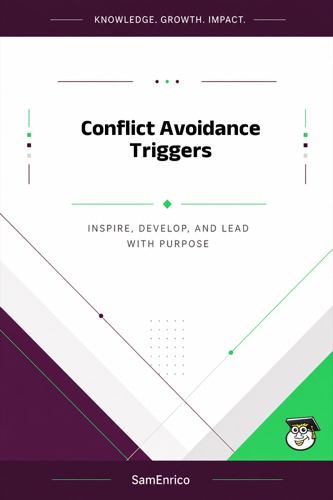
Conflict Avoidance Triggers eBook
Heals trauma response to confrontation and disagre
Heals trauma response to confrontation and disagreement.
Formats
Free sample
Chapter 1: The Silence That Screams...--–- You know the moment well. The words are right there, fully formed, resting on the tip of your tongue. Someone has just asked for your opinion. Or perhaps they have just made a statement you fundamentally disagree with. Or maybe they have crossed a small line—a joke at your expense, a request for yet another favor you don't have the energy to give.
Inside your chest, something stirs. A voice, clear and certain, says: No. I don't agree. That's not okay. Stop.And then nothing happens.
The moment passes. The words dissolve. Someone else speaks, the topic shifts, and you exhale—not with relief, but with something heavier. Shame. Confusion.
A quiet, grinding self-disgust. Why didn't I say something? Why can't I just speak up like a normal person?If this scene feels familiar, this chapter—and this book—is for you.This is not a book about learning to argue better, or memorizing clever comebacks, or becoming more assertive in the way that self-help books have been promising for decades. This is a book about something far deeper and far more hidden: the trauma response that masquerades as politeness, the nervous system hijack that looks like agreeableness, and the protective strategy that has kept you safe but is now keeping you small.You do not have a personality flaw. You are not weak.
You are not broken. You have a nervous system that learned, somewhere along the way, that disagreement equals danger. And that lesson was not taught in words. It was burned into your body.Welcome to the first chapter of Conflict Avoidance Triggers. Before we build new responses, we must understand the old ones.
And before we can heal, we must name what is actually happening.The Paradox of the Silent Yes Let us begin with a simple experiment. Think back to the last time you agreed to something you did not want to do. Perhaps it was an extra assignment at work. Perhaps it was a family gathering you did not have the energy for. Perhaps it was a small request—watching a friend's pet, staying late to help with a project, biting your tongue when someone made a political comment that made your blood boil.Now ask yourself: In the moment before I said yes, what did I actually feel?For many people, the answer is not "I felt fine." The answer is something like: a tightening in the chest.
A sudden urge to escape. A wave of heat or cold. A feeling of being trapped, with only two options—compliance or catastrophe. And then, almost automatically, the word "yes" fell out, followed by a rush of relief that the moment was over.This is the paradox of the silent yes: you said yes to avoid conflict, but the conflict did not disappear. It moved inside you.
It became resentment. Exhaustion. A low-grade depression that you cannot quite explain. And it accumulated, layer upon layer, until you began to feel like a hollow version of yourself—agreeable on the outside, screaming on the inside.The standard explanation for this behavior, offered by well-meaning friends and self-help books alike, is that you lack assertiveness. You need to learn to speak up.
You need to be more confident. You need to practice saying no.This is not wrong, exactly. But it is dangerously incomplete. Telling a trauma survivor to "just speak up" is like telling someone with a broken leg to "just walk." The problem is not a lack of will. The problem is a nervous system that has been wired to perceive disagreement as a threat to survival.The Four F's: Beyond Fight or Flight Most people have heard of the "fight or flight" response.
When an animal (or a human) perceives a threat, the nervous system prepares to either fight the danger or run away from it. This is useful if the danger is a predator or an attacker.But trauma researchers have long recognized that fight and flight are not the only options. There are two other primary responses, and they are far more relevant to conflict avoidance than most people realize.Freeze is the third response. When fighting or fleeing is impossible—or when the nervous system decides that neither would work—the body can freeze. This looks like going numb, feeling stuck, or dissociating from the body altogether.
In the wild, many animals play dead when caught by a predator. The human version is the feeling of "losing your words," going blank, or feeling like you are watching yourself from outside your body.Fawn is the fourth response. This is the most misunderstood and the most relevant to conflict avoidance. Fawn is an appeasement strategy. When the nervous system detects a threat, it may decide that the safest course of action is to please, placate, or merge with the potential aggressor.
The fawn response says: If I make you like me, you will not hurt me. If I agree with you, you will not attack me. If I disappear my own needs and become whatever you want, I will survive.Let that land. The fawn response is not a personality trait. It is not "being nice." It is a survival strategy.
Your body learned, somewhere along the way, that disagreeing was dangerous. And so it developed an elegant, efficient, automatic workaround: just agree. Just smile. Just disappear.This is why you say yes when you mean no. This is why your voice disappears in moments of disagreement.
This is why you feel physically ill before a difficult conversation. Your nervous system is not malfunctioning. It is doing exactly what it was trained to do. It is trying to keep you alive.Discomfort vs. Terror: A Critical Distinction Before we go any further, we need to draw a line that will run through every chapter of this book.
It is the distinction between general discomfort with disagreement and a trauma-driven trigger response.Almost no one enjoys conflict. Most people would rather avoid an argument than start one. This is normal. It is human. It is even wise in many situations.
Learning to pick your battles is a sign of emotional maturity, not a pathology.But there is a difference between choosing not to engage and being unable to engage. There is a difference between feeling nervous before a tough conversation and feeling like you are about to die. There is a difference between the ordinary discomfort of disagreement and the overwhelming, body-wide, thought-obliterating terror of a trauma trigger.Here is a simple test. Think about a recent moment when you avoided conflict. Ask yourself:Did your body react before your mind had time to think?Did you feel physical sensations like a racing heart, tight throat, cold hands, or nausea?Did you lose access to your words, as if your mouth forgot how to form sentences?Did you agree to something without any memory of making the decision?Did you feel ashamed afterward, not just about what you agreed to, but about who you are?If you answered yes to several of these questions, you are not dealing with ordinary discomfort.
You are dealing with a trauma response. And the first step to healing is to stop blaming yourself for having…
This is the end of the free sample. Get the eBook to keep going. Buy now
About this book
Details
- Author
- Hudson Leticia
- Publisher
- SamEnrico
- Language
- English
- Genre
- Non-Fiction, Self-Help
- Released
- 2026-06-10
- Pages (approx.)
- 121
- Available as
- eBook, Audiobook

Read better in the ZLOADR app
Your eBooks on your phone or tablet. Sign in with your SamEnrico account and start reading.
More by Hudson Leticia
 Radiology Burn PreventionHudson Leticia$11.99
 Athlete Morning ProtocolHudson Leticia$11.99
 Cicerone Method PracticeHudson Leticia$11.99
 Emotional Exhaustion RecoveryHudson Leticia$11.99
 Jump Rope HIIT SessionsHudson Leticia$11.99
 Influence For EntrepreneursHudson Leticia$11.99
 EQ Affirmations GuideHudson Leticia$11.99
 The Torso in the Thames: Scotland Yard's First Forensic MysteryHudson Leticia$11.99
 Gladiators and Senators: The Unlikely Alliance That Changed Roman BritainHudson Leticia$11.99
 How to Produce Satellite LnbsHudson Leticia$11.99
 Cardigan Welsh Corgi: Long-backed & BrightHudson Leticia$11.99
 A Collector's Handbook to the Austin 1800Hudson Leticia$11.99
You may also like
 Hong Kong Handover 1997Dunn Johnnie$11.99
 Zumba For Postnatal Recovery CourseNeal Christian$11.99
 Zumba for BeginnersLadner Nikia$11.99
 YouTube Comment Mining GuideHumes Pandora$12.99
 Worry Box MeditationCarlin Rudy$11.99
 Workplace Stress MeditationNguyen Lynn$11.99
 Workplace Stress and Sleep RepairHawley Ivory$11.99
 Workplace Perfectionism CureDelaney Jeffry$11.99
 Workplace Injustice Anger GuideWallen Isabelle$11.99
 Work Addiction and Burnout LinkGreenwood Ester$11.99
 Women in Yoga and WellnessBeattie Galina$11.99
 Women in Stand Up ComedyChun Evangeline$11.99