
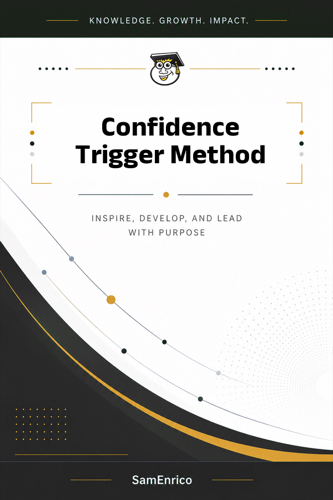
Confidence Trigger Method eBook
Post hypnotic suggestion to boost self assurance b
by Meyer Celia
Post hypnotic suggestion to boost self assurance before challenges.
Formats
Free sample
Chapter 1: The Confidence Trap--–- The first time I watched a client freeze, I thought he was having a stroke. Mid-sentence, standing in front of forty-seven investors, a man named David stopped speaking. His mouth remained open. His eyes went wide. His hands, which had been gesturing confidently just seconds earlier, dropped to his sides like dead weights.
The room went silent. Someone coughed. David blinked once, twice, then whispered, "I'm sorry," and walked off the stage.Later, in my office, he sat hunched forward with his elbows on his knees, staring at the carpet. He was fifty-three years old. He had built a company worth twelve million dollars.
He had raised three children. He had survived a divorce, a lawsuit, and the 2008 financial crash. But standing on that stage, in front of a room full of people who wanted to give him money, his brain had simply... stopped."What happened?" I asked.He looked up. His eyes were red.
"I wasn't ready," he said. "I didn't feel confident."I had heard this exact sentence hundreds of times. From CEOs. From athletes. From actors before auditions.
From students before exams. From parents before difficult conversations with their children. "I wasn't ready. I didn't feel confident." The assumption embedded in those words is so common, so deeply accepted, that no one ever questions it. The assumption is this: Confidence must come before action.
You need to feel ready before you can perform.This assumption is wrong. And it is quietly ruining your life.The Most Expensive Mistake You Make Every Day Let me tell you what I saw in David's brain in the seconds before he froze. I wasn't there with an MRI machine, but I didn't need one. The pattern is universal. When David stood on that stage, his conscious mind was running a program called "Check Readiness." This program asks a series of rapid-fire questions: Do I feel calm?
Do I feel prepared? Do I feel like I belong here? Do I feel confident? For each question, his brain scanned his body for evidence. Heart rate?
Elevated. Palms? Sweating. Stomach? Tight.
Breath? Shallow.Every piece of evidence came back negative. "Not calm. Not prepared. Not confident." So the program returned its verdict: Not ready.
Abort. Abort. Abort.And his brain aborted. That's what freezing is. It is not a failure of skill or knowledge.
It is a protective shutdown ordered by a brain that believes you are in danger. The brain does not know the difference between a stage full of investors and a saber-toothed tiger. It only knows the data from your body. And if your body is sending panic signals, the brain assumes a predator is nearby. It will do anything to get you out—including shutting down your speech, emptying your working memory, and flooding you with cortisol so you run.But here is the crucial detail that changes everything: David's brain never asked, "Can I do this?" It never asked, "Do I know this material?" It never asked, "Have I succeeded at things like this before?" It only asked, "Do I feel confident?"That single question—"Do I feel confident?"—is the most destructive question you can ask yourself before a challenge.
And yet almost everyone asks it automatically. We have been trained to believe that feeling is a prerequisite for action. We wait for the feeling to arrive. We try to manufacture it through affirmations, breathing exercises, motivational videos, or—most commonly—avoidance. We put off the presentation, the conversation, the audition, the date, until we "feel ready."Here is the hard truth: you will never feel ready.
Not because you are inadequate, but because "feeling ready" is not a state that precedes action. It is a state that follows action. The sequence you believe in—first confidence, then action—is backwards. The real sequence is first action, then confidence. Or, more precisely, first trigger, then confidence—which is what this entire book will teach you.The Law of Reversed Effort In the 1920s, a French psychologist and pharmacist named Émile Coué made a discovery that should have revolutionized how we think about confidence.
Coué observed that patients who tried hardest to recover from illness often recovered the slowest. Those who relaxed into the process, who stopped fighting their symptoms, improved faster. He called this the Law of Reversed Effort: the harder you consciously try to do something that should happen automatically, the less likely it is to happen.Coué's most famous example was sleep. People who try to fall asleep cannot fall asleep. The effort itself—the monitoring of whether sleep has arrived yet, the frustration when it hasn't—creates the exact physiological state (alertness, tension, cortisol) that prevents sleep.
The same law applies to confidence. When you stand before a challenge and think, "I need to feel confident," you activate the very system you are trying to calm. You begin monitoring your heart rate, your posture, your voice, your word choice. This monitoring—which psychologists call "self-focused attention"—interrupts automatic processing. You start performing poorly because you are trying to perform well.Consider this experiment, which has been replicated dozens of times.
Two groups of people are asked to give a short speech. The first group is told, "Try to be confident and relaxed." The second group is told, "Just speak naturally; we don't care how you feel." Independent judges rate the second group as significantly more confident and competent than the first. Why? Because the first group's effort to be confident created stiffness, overthinking, and visible anxiety. Their attempt to perform confidence looked like...
performing. Which is to say, fake.The Law of Reversed Effort explains why every "positive thinking" affirmation you have ever tried probably failed. When you tell yourself "I am confident," your brain immediately compares that statement to your actual internal state. If there is a mismatch—and there always is, or you wouldn't need the affirmation—your brain registers the gap. The gap feels bad.
Feeling bad triggers self-doubt. Self-doubt triggers the thought, "This isn't working." And now you are not only not-confident, you are also frustrated that the affirmation failed.You have been sold a lie. The lie is that you can think your way into confidence. You cannot. The conscious mind is not the control room for emotional states; it is the observation deck.
It watches. It comments. It worries. But it does not directly command. Try this right now: consciously command yourself to "feel happy." Really try.
Did it work? Of course not. You can no more command yourself into confidence than you can command yourself into hunger or exhaustion. These states are driven by subconscious processes that do not respond to conscious commands.Introducing the Critical Factor This brings us to a concept that will appear throughout this book: the Critical Factor. The Critical Factor is a filter located in the conscious mind.
Its job is to compare incoming suggestions against your existing beliefs about yourself. If a suggestion matches what you already believe, the Critical Factor says "Yes" and allows the suggestion to pass into your subconscious, where it can influence your behavior. If the suggestion does not match what you…
This is the end of the free sample. Get the eBook to keep going. Buy now
About this book
Details
- Author
- Meyer Celia
- Publisher
- SamEnrico
- Language
- English
- Genre
- Non-Fiction, Self-Help, Confidence
- Released
- 2026-06-07
- Pages (approx.)
- 141
- Available as
- eBook, Audiobook

Read better in the ZLOADR app
Your eBooks on your phone or tablet. Sign in with your SamEnrico account and start reading.
More by Meyer Celia
 Progestin Types In HRT HandbookMeyer Celia$11.99
 Grandparent Custody Legal GuideMeyer Celia$11.99
 PCOS Body Image GuideMeyer Celia$11.99
 Scott Peterson Conner Peterson Legal StatusMeyer Celia$11.99
 The Silent Revolution: How a Teenage Girl Cracked the Code of the UniverseMeyer Celia$11.99
 Understanding Pelizaeus–merzbacher Disease, Recessive, Acute InfantileMeyer Celia$17.99
 Domain Parking for Geo TLDsMeyer Celia$12.99
 Lockheed Martin PatentsMeyer Celia$12.99
 On Site Service RepresentativeMeyer Celia$11.99
 How to Start a Orange Groves BusinessMeyer Celia$11.99
You may also like
 Affirmations for Confidence BuildingWilliford Celestine$11.99
 Hypnotic Confidence BoosterKuntz Lauri$11.99
 Conversation Confidence CourseNegron Dung$11.99
 The Cowboy StanceWeddle Audie$11.99
 Name Recall Confidence BoostLanders Normand$11.99
 Confidence Affirmations GuideMullen Fidel$11.99
 The Efficacy Restoration GuideRegalado Deon$11.99
 Scripting for Confidence BuildingTiller Carletta$11.99
 Confidence Boost Hypnosis ScriptsRoach Paul$11.99
 Build Mastery Emotions GuideCarpenter Mack$11.99
 The Confidence Affirmation HandbookStuckey Romelia$11.99
 The Body Language of ConfidenceSpurlock Gerda$11.99