
Non-FictionHealth & WellnessNeurology
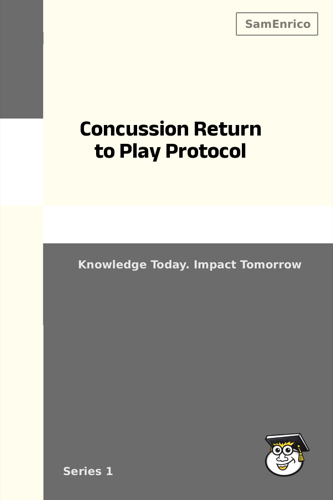
Concussion Return to Play Protocol eBook
Provides graduated steps from rest to full contact
Provides graduated steps from rest to full contact after head injury.
Formats
Free sample
Chapter 1: The Cocoon Lie--–- The fluorescent lights of the emergency room hummed at a frequency that made fourteen-year-old lacrosse goalie Mia Chen want to crawl out of her own skull. Thirty-six hours earlier, she had taken a direct shot to the side of her helmet—a routine play in a routine Tuesday game. Now she lay in a darkened bedroom, blackout curtains taped to the window frames, her mother tiptoeing past the door like a burglar avoiding motion sensors. No phone. No TV.
No school. No sound. No light. Complete and total isolation.Her mother had read online that “cocoon therapy”—keeping the concussed brain in a sensory deprivation chamber—was the fastest path to healing. For two days, Mia complied.
By the morning of day three, she was not better. She was worse. Her headache had transformed from a dull throb into a pulsing vice. Her anxiety had climbed from a three to a seven. And when she finally tried to sit up and walk to the bathroom, the world spun so violently that she vomited into her own lap.Mia’s mother called the pediatrician in tears.
The doctor’s response changed everything: “Take down the curtains. Turn on the lights. And get her walking around the block—slowly—today.”What happened next defied everything Mia’s family thought they knew about concussions. Within twenty-four hours of abandoning the cocoon, Mia’s headache dropped from an eight to a four. Within forty-eight hours, she could read for fifteen minutes without nausea.
Within one week, she was back to light exercise. And within three weeks, she returned to the lacrosse field—not because she had rested more, but because she had rested differently.This chapter will prove why Mia’s story is not an exception but the rule—and why the most dangerous advice you will ever hear about concussion recovery is also the most common.The Myth That Refuses to Die For nearly two decades, the standard of care for concussion could be summarized in four words: cocoon until you are better. The prescription was simple, intuitive, and utterly wrong. Athletes were told to sit in dark rooms, avoid all cognitive stimulation, abstain from physical activity, and wait. And wait.
And wait.The logic seemed unassailable. The brain had been injured. Rest was how every other organ healed. A sprained ankle needed immobilization. A torn muscle needed rest.
Therefore, a bruised brain needed complete sensory shutdown.But the brain is not a sprained ankle.The brain is an electricity grid, not a broken bone. It heals through regulated activity, not through shutdown. When you isolate a concussed patient in a dark room for days on end, you do not protect the brain—you starve it. You trigger deconditioning of the vestibular system. You promote anxiety and depression.
You allow the brain’s natural fear response to wire itself into permanent avoidance behavior. And worst of all, you delay the very physiological processes—regulated blood flow, autonomic re-regulation, and glymphatic waste clearance—that actually drive recovery.The scientific literature is now unequivocal. A landmark 2019 randomized controlled trial published in JAMA Pediatrics compared two groups of concussed adolescents. One group followed the traditional “strict rest for five days” protocol. The other followed what the researchers called “relative rest”—meaning they stayed home from school but engaged in light cognitive activity, short walks, and gradual re-exposure to daily life.
The results were stunning. The strict rest group did not heal faster. They healed slower. They reported more symptoms at day ten. They took longer to return to school.
And they had higher rates of prolonged post-concussion syndrome.The cocoon is not a healing chamber. It is a trap.What Actually Happens Inside a Concussed Brain To understand why relative rest works and why cocoon therapy fails, you need a basic map of the injured brain. Do not worry—this will not be a neurology textbook. But you do need to understand four key players.The Metabolic Storm. When the brain experiences acceleration-deceleration forces—the rapid whip of a hit in football, the jarring stop of a fall in soccer, the sudden change of direction in hockey—neurons are stretched, twisted, and compressed.
This mechanical injury triggers a cascade of metabolic chaos. Potassium floods out of cells. Calcium rushes in. The brain burns through glucose at an alarming rate while simultaneously experiencing reduced blood flow. This mismatch—high energy demand, low energy supply—is the metabolic storm.
It typically lasts five to ten days in adults and ten to twenty-eight days in adolescents.The Glymphatic System. Discovered only in the last decade, the glymphatic system is the brain’s waste clearance network. During deep sleep, cerebrospinal fluid pulses through the brain, washing away metabolic debris—including the toxic proteins that accumulate after concussion. This is why sleep disturbance after head injury is so dangerous. When you cannot access deep, restorative sleep, the glymphatic system cannot do its job.
Toxic waste builds up. Inflammation persists. Recovery stalls.The Autonomic Nervous System. Your autonomic nervous system has two branches: the sympathetic (“fight or flight”) and the parasympathetic (“rest and digest”). Concussion frequently dysregulates this balance, leaving athletes stuck in sympathetic overdrive.
Their resting heart rate climbs. Their heart rate variability crashes. They feel jittery, anxious, and unable to settle. Exercise—done correctly, at the right intensity—is one of the most powerful tools for retraining autonomic balance. But complete rest allows the dysregulation to become entrenched.The Vestibular and Visual Systems.
The vestibular system (inner ear balance) and visual system (eye tracking, convergence, saccades) are exquisitely sensitive to head trauma. After concussion, many athletes develop subtle deficits: dizziness with head movement, difficulty tracking a moving object, trouble reading a page of text without losing their place, a sense that the world is “lagging” behind their head movements. These deficits are not just symptoms—they are drivers of prolonged recovery. And they do not improve in a dark room. They improve through targeted exposure to movement, visual challenge, and graded balance tasks.Relative rest—the protocol at the heart of this book—acknowledges all four of these biological realities.
It respects the metabolic storm by avoiding symptom explosion. It protects the glymphatic system by prioritizing sleep hygiene. It retrains the autonomic nervous system through carefully dosed exercise. And it rehabilitates the vestibular and visual systems through graded exposure to movement and tracking.Cocoon therapy respects none of these. It treats the brain as if it were a broken leg—immobilize it and wait.
But the brain is not immobilized by darkness. It is provoked by it. In the absence of external stimulation, the brain turns inward, amplifying pain signals, magnifying anxiety, and reinforcing the sensation that something is wrong. This is not speculation. Functional MRI studies have shown that sensory deprivation increases activity in the brain’s pain and threat networks.
The cocoon does not calm the brain. It makes the brain louder.The First 48 Hours: What to Do, What to Avoid The first forty-eight hours after a head injury are not about advanced rehabilitation. They are about damage control and stabilization. Think of this period as the “emergency room of recovery”—you are not…
This is the end of the free sample. Get the eBook to keep going. Buy now
About this book
Details
- Author
- Reynolds Johnathan
- Publisher
- SamEnrico
- Language
- English
- Genre
- Non-Fiction, Health & Wellness, Neurology
- Released
- 2026-06-10
- Pages (approx.)
- 150
- Available as
- eBook, Audiobook

Read better in the ZLOADR app
Your eBooks on your phone or tablet. Sign in with your SamEnrico account and start reading.
More by Reynolds Johnathan
 The Apology MythReynolds Johnathan$11.99
 The MBSR Habit TrackerReynolds Johnathan$11.99
 ABCDE For Interruptions GuideReynolds Johnathan$11.99
 Metta For Coworker ConflictReynolds Johnathan$11.99
 Naive Realism PreventionReynolds Johnathan$11.99
 Missionary Presence FactorReynolds Johnathan$11.99
 Mentorship Program ROI MeasurementReynolds Johnathan$11.99
 Assertiveness For ParentsReynolds Johnathan$11.99
 The Last Voyage of the Mary Celeste: Ghost Ship of the AtlanticReynolds Johnathan$11.99
 Aotearoa Ascendant: New Zealand's Starward LeapReynolds Johnathan$11.99
 The Armada's Last Stand: England's Defiance at Gravelines (1588)Reynolds Johnathan$11.99
 How to Start a Hobby in FacebookingReynolds Johnathan$11.99
You may also like
 Hong Kong Handover 1997Dunn Johnnie$11.99
 Zumba For Postnatal Recovery CourseNeal Christian$11.99
 Zumba for BeginnersLadner Nikia$11.99
 YouTube Comment Mining GuideHumes Pandora$12.99
 Worry Box MeditationCarlin Rudy$11.99
 Workplace Stress MeditationNguyen Lynn$11.99
 Workplace Stress and Sleep RepairHawley Ivory$11.99
 Workplace Perfectionism CureDelaney Jeffry$11.99
 Workplace Injustice Anger GuideWallen Isabelle$11.99
 Work Addiction and Burnout LinkGreenwood Ester$11.99
 Women in Yoga and WellnessBeattie Galina$11.99
 Women in Stand Up ComedyChun Evangeline$11.99