
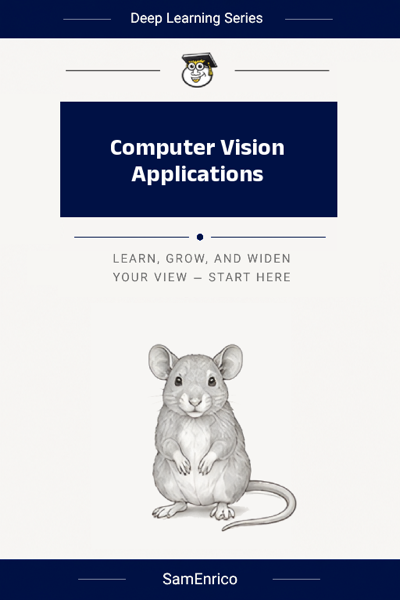
Non-FictionInformativeEducational
Computer Vision Applications Audiobook
A Coursebook on Computer Vision Applications
A Coursebook on Computer Vision Applications
Formats
Free sample
Chapter 1: The Lost Photon...--–- Before a computer can recognize a face, drive a car, or detect a tumor, it must first answer a deceptively simple question: What is light, and how does it become a number? This chapter follows the journey of a single photon—from the moment it leaves a light source, bounces off a physical surface, travels through a glass lens, and finally gets trapped by a silicon sensor. Along the way, that photon loses information: depth becomes color, continuous reality becomes discrete pixels, and the three-dimensional world collapses into a two-dimensional grid of numbers. Understanding what is lost is the first and most important step in building any computer vision system. Without this knowledge, every algorithm you write—no matter how sophisticated—will fail in ways you cannot predict.The Journey of a Single Photon Imagine a photon leaving the sun.
Eight minutes later, it strikes a red apple sitting on a wooden table. The apple absorbs most of the light but reflects specific wavelengths—those our eyes and cameras perceive as "red." That reflected photon now travels toward a camera lens. What happens next determines everything.Reflection is not perfect. The apple's surface is not perfectly smooth. Microscopic irregularities scatter light in many directions.
Some photons bounce directly into the lens (specular reflection), creating bright highlights. Others penetrate the apple's skin, bounce around inside, and emerge from different points (diffuse reflection), giving the apple its soft, matte appearance. A camera cannot tell these paths apart. It only records the total light arriving at each sensor pixel.The photon's journey is probabilistic. In low light, a camera might capture only a few photons from the apple.
In bright sunlight, it captures millions. The difference between "enough photons" and "not enough" determines whether your vision system sees an apple or just noise. This is not a minor implementation detail—it is a fundamental physical limit.The Pinhole Camera: The Ideal That Does Not Exist The simplest possible camera has no lens. It is a box with a tiny hole (the pinhole) on one side and a light-sensitive surface on the opposite side. Light from the scene passes through the hole and projects an inverted image onto the back wall.
This design has been known since ancient times—Chinese philosopher Mozi described it in the 5th century BCE, and Ibn al-Haytham gave the first clear scientific explanation around…
This is the end of the free sample. Get the Audiobook to keep going. Buy now
About this book
Details
- Author
- Pomeroy Naoma
- Publisher
- SamEnrico
- Language
- English
- Genre
- Non-Fiction, Informative, Educational
- Released
- 2026-06-02
- Pages (approx.)
- 142
- Available as
- eBook, Audiobook

Listen in the VoxFlicks app
Audiobooks and audio dramas wherever you go. Sign in with your SamEnrico account and press play.
More by Pomeroy Naoma
 Emotional Regulation AssessmentPomeroy Naoma$11.99
 Birthday Loneliness RecoveryPomeroy Naoma$11.99
 Free Creator Minimalist Stack GuidePomeroy Naoma$11.99
 Order Solar Temple Jean-Pierre Lardanchet WorkbookPomeroy Naoma$11.99
 Mindfulness for Dental AnxietyPomeroy Naoma$11.99
 The Frozen Dreamers: How Two Women Survived Antarctica AlonePomeroy Naoma$11.99
 Echoes of the Abyss: The SS Andrea Doria’s Last BroadcastsPomeroy Naoma$11.99
 Research Proposal Writing GuidePomeroy Naoma$12.99
 Dubai Student Museums GuidePomeroy Naoma$12.99
 How to Start a Portfolio Management BusinessPomeroy Naoma$11.99
 Understanding Cerebroretinal VasculopathyPomeroy Naoma$17.99
You may also like
 Hong Kong Handover 1997Dunn Johnnie$11.99
 Zumba For Postnatal Recovery CourseNeal Christian$11.99
 Zumba for BeginnersLadner Nikia$11.99
 YouTube Comment Mining GuideHumes Pandora$12.99
 Worry Box MeditationCarlin Rudy$11.99
 Workplace Stress MeditationNguyen Lynn$11.99
 Workplace Stress and Sleep RepairHawley Ivory$11.99
 Workplace Perfectionism CureDelaney Jeffry$11.99
 Workplace Injustice Anger GuideWallen Isabelle$11.99
 Work Addiction and Burnout LinkGreenwood Ester$11.99
 Women in Yoga and WellnessBeattie Galina$11.99
 Women in Stand Up ComedyChun Evangeline$11.99