
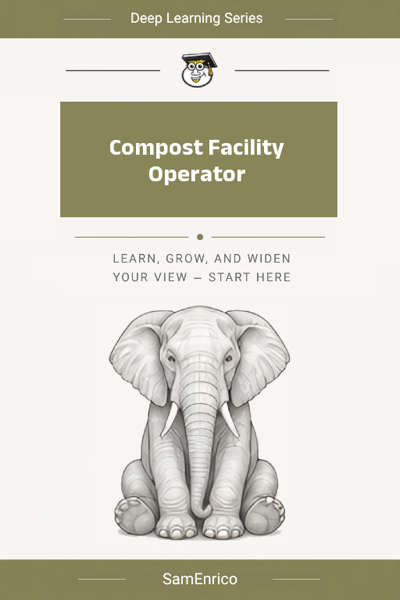
Non-FictionInformativeEducational
Compost Facility Operator eBook
A Coursebook on Compost Facility Operator
A Coursebook on Compost Facility Operator
Formats
Free sample
Chapter 1: The Environmental Hitman...--You have probably never thought about what happens to your banana peel after you drop it into a kitchen pail. You might imagine it shrinking away into harmless nothingness, or perhaps you vaguely picture it becoming “dirt” somewhere far from your life. The truth is far more violent, far more intentional, and far more important than any tidy fantasy. That banana peel does not disappear. It is conscripted into a war.
The battlefield is a windrow—a long, triangular pile of organic material that can reach internal temperatures high enough to cook a turkey. The weapons are oxygen, moisture, timing, and a microbial army so ferocious that it can destroy pathogens, annihilate weed seeds, and transform rotting flesh into living soil in a matter of weeks. And the general of this army is the compost facility operator.If you are reading this book, you are either already an operator, aspire to become one, or have been tasked with managing the people who are. In any case, you need to understand something immediately: you are not a garbage worker. You are not a glorified trash man or a landfill attendant with a nicer view.
You are an environmental hitman. Your targets are specific: pathogens like Salmonella and E. coli, weed seeds that would otherwise plague farms and gardens, methane-producing organic waste that would cook the planet in a landfill, and the sheer, stupid tonnage of material that civilization discards without a second thought. Your tools are not glamorous. You will wield thermometers, front-end loaders, aeration blowers, and three-ring binders full of regulatory forms.
But the outcome of your work is nothing less than the regeneration of topsoil, the mitigation of climate change, and the protection of public health.This chapter will redefine your identity. It will strip away any romantic notion that composting is a passive, gentle process. It will replace that fantasy with a professional framework: the ten core competencies you must master, the difference between a Level 3 technician and a Level 4 manager, the legal and ethical duties that come with handling other people’s waste, and the single most important document on your facility—the Site Operating Plan. By the end of this chapter, you will never look at a banana peel the same way again. More importantly, you will understand why the world needs you to stop being a waste handler and start being a hitman.The Hidden History of Composting and Why It Matters Now Composting is not new.
Archaeological evidence suggests that farmers in the Neolithic period recognized that mixing organic matter into soil improved crop yields. The Romans wrote about it. George Washington maintained a compost heap at Mount Vernon. For most of human history, composting was simply what farmers did with manure and crop residues—a quiet, decentralized, unremarkable practice. Then came the industrial revolution, and with it, the invention of synthetic fertilizers.
Suddenly, farmers could bypass the slow, patient work of building soil biology. They could apply a white powder of ammonium nitrate and watch crops green up overnight. Composting became old-fashioned, dirty, and irrelevant.For nearly a century, that attitude persisted. Cities built massive landfills and incinerators. Food waste, yard trimmings, paper, and wood were buried or burned.
And the planet paid the price. Landfills are the third-largest source of human-related methane emissions in the United States—and food waste alone generates the bulk of that methane because it decomposes anaerobically under tons of other garbage. A single ton of food waste in a landfill produces as much methane over time as driving a car for six months. Meanwhile, industrial agriculture has stripped topsoil from farmland at rates 10 to 40 times faster than natural soil formation. The United Nations estimates that at current rates of degradation, the world has only 60 years of viable topsoil remaining.Enter the modern composting industry.
Beginning in the 1990s, states like California, Vermont, and Washington began passing organics diversion mandates. Cities like San Francisco and New York launched curbside food waste collection. The goal was simple: keep organic material out of landfills. But the execution required something unprecedented: a trained, professional workforce capable of managing large-scale composting facilities that could handle thousands of tons of food waste, biosolids, and yard trimmings every year. The days of the farmer with a single manure pile were over.
The era of the certified compost facility operator had begun.Today, there are more than 4,800 composting facilities in the United States, processing approximately 25 million tons of organic material annually. That number is growing rapidly as more states adopt organics bans. But the industry faces a severe labor shortage. According to the US Composting Council, the number of certified operators has not kept pace with facility growth. Facilities are running with underqualified staff.
Operators are burning out. Fines for regulatory violations are rising. And the public, increasingly aware of climate change and soil health, is demanding better.That is where you come in. Whether you are a rookie looking for your first job or a veteran seeking certification, you are entering a field that is simultaneously ancient and brand new. You will need skills that no single university degree provides: microbiology, heavy equipment operation, regulatory law, customer service, fire safety, and business math.
This book will teach you all of it. But first, you must understand the structure of the profession.The Ten Core Competencies: Your Professional Backbone Every certified compost facility operator, regardless of state or country, is expected to demonstrate proficiency in ten distinct areas. These competencies come from the National Occupational Standards for Compost Plant Operators, developed through years of consultation with facility managers, regulators, and trainers. If you are seeking certification, you will be tested on these ten topics. If you are a manager, you will train your staff in these ten areas.
If you are a regulator, you will audit facilities against these ten standards. Memorize them now.First, Biology. You must understand the microorganisms that drive decomposition: bacteria that generate heat, fungi that break down lignin and cellulose, and actinomycetes that produce the earthy smell of finished compost. You need to know the four phases of composting and the temperature ranges associated with each. You do not need a microbiology degree, but you do need to know what happens in a pile at 100 degrees versus 140 degrees versus 160 degrees.Second, Feedstock Chemistry.
You must be able to calculate the Carbon-to-Nitrogen ratio of any incoming material within a reasonable margin of error. You must know the moisture content, bulk density, and porosity of common feedstocks. You must understand how these variables interact and why a pile of wet grass clippings alone will turn into a slimy, stinking mess.Third, Process Control. This is the art of turning science into action. You must know how to take core samples, interpret temperature and oxygen readings, troubleshoot bad smells, and decide when to turn a pile.
Process control separates the operator who guesses from the operator who knows.Fourth, Environmental Compliance. You must understand how to manage leachate, control odors, prevent dust and bioaerosol emissions, and keep vectors like rodents and birds away from your facility. Environmental compliance is not optional; it is the difference between a good neighbor and…
This is the end of the free sample. Get the eBook to keep going. Buy now
About this book
Details
- Author
- Brinkley Deadra
- Publisher
- SamEnrico
- Language
- English
- Genre
- Non-Fiction, Informative, Educational
- Released
- 2026-05-11
- Pages (approx.)
- 128
- Available as
- eBook, Audiobook

Read better in the ZLOADR app
Your eBooks on your phone or tablet. Sign in with your SamEnrico account and start reading.
More by Brinkley Deadra
 Bipolar And ADHD OverlapBrinkley Deadra$11.99
 Alcohol Detox for Pregnant WomenBrinkley Deadra$11.99
 Return to Work Imposter SyndromeBrinkley Deadra$11.99
 The Junk Food Addiction CycleBrinkley Deadra$11.99
 The Golden Notes of Ancient Nubia: The Lost Symphonies of the Kerma KingdomBrinkley Deadra$11.99
 How to Become a Composition-stone ApplicatorBrinkley Deadra$11.99
 Blockchain for Certification TraceabilityBrinkley Deadra$12.99
 Search Console Structured DataBrinkley Deadra$12.99
 Understanding Prenatal InfectionsBrinkley Deadra$17.99
You may also like
 Hong Kong Handover 1997Dunn Johnnie$11.99
 Zumba For Postnatal Recovery CourseNeal Christian$11.99
 Zumba for BeginnersLadner Nikia$11.99
 YouTube Comment Mining GuideHumes Pandora$12.99
 Worry Box MeditationCarlin Rudy$11.99
 Workplace Stress MeditationNguyen Lynn$11.99
 Workplace Stress and Sleep RepairHawley Ivory$11.99
 Workplace Perfectionism CureDelaney Jeffry$11.99
 Workplace Injustice Anger GuideWallen Isabelle$11.99
 Work Addiction and Burnout LinkGreenwood Ester$11.99
 Women in Yoga and WellnessBeattie Galina$11.99
 Women in Stand Up ComedyChun Evangeline$11.99