
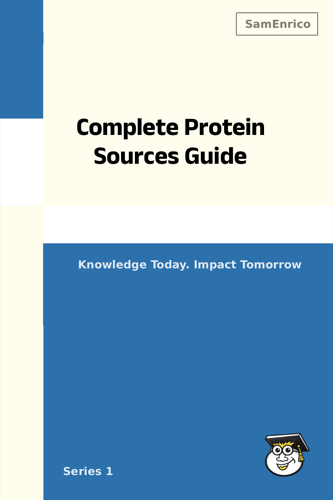
Non-FictionHealth & WellnessPlant Based Nutrition
Complete Protein Sources Guide
Lists animal and plant based complete proteins and
Lists animal and plant based complete proteins and complementary pairings.
Formats
About this book
Free sample
Chapter 1: Beyond the Gram--–- On a humid July morning in 2019, a 34-year-old marathon runner named Sarah collapsed during a routine training run. Her diet logged 140 grams of protein daily – well above the recommended intake – mostly from brown rice protein shakes, lentil pasta, and nut butters. Her physician ran standard tests and found nothing alarming. A sports nutritionist, however, asked a different question: What kind of protein, from what source, eaten how? The answer unraveled a quiet crisis.
Sarah had been eating almost exclusively plant-based incomplete proteins without any understanding of complementary pairing. Her body was receiving plenty of total grams but was chronically short on two essential amino acids: lysine and methionine. She wasn't protein-deficient by the scale; she was protein-deficient by the blueprint. Her collapse wasn't dramatic – a slow erosion of muscle repair, flagging immunity, and eventually, a body that couldn't sustain high output. This book exists because Sarah's story is not rare.
It is the silent epidemic of the modern health-conscious eater.The Protein Paradox We have been measuring protein wrong for decades. Walk into any grocery store, gym, or nutritionist's office, and you will hear the same question: "How many grams of protein did you eat today?" It is a reasonable question, grounded in decades of dietary guidelines. But it is also dangerously incomplete. Twenty grams of protein from an egg, twenty grams from wheat bread, and twenty grams from a collagen supplement are not the same twenty grams. They are as different as twenty dollars in US currency, twenty dollars in a foreign denomination you cannot exchange, and twenty dollars' worth of buttons that merely look like coins.This is the protein paradox: we obsess over quantity while neglecting quality, yet quality determines what quantity actually delivers.The science behind this paradox has been available for nearly sixty years.
In 1965, the Food and Agriculture Organization (FAO) and the World Health Organization (WHO) established the first official method for evaluating protein quality. That method has been refined twice since then, most recently in 2013 with the adoption of the Digestible Indispensable Amino Acid Score (DIAAS).…
This is the end of the free sample. Get the eBook to keep going. Buy now
Contents
- Chapter 1
- Chapter 2
- Chapter 3
- Chapter 4
- Chapter 5
- Chapter 6
- Chapter 7
- Chapter 8
- Chapter 9
- Chapter 10
- Chapter 11
- Chapter 12
Details
- Author
- Creech Cecila
- Publisher
- SamEnrico
- Language
- English
- Genre
- Non-Fiction, Health & Wellness, Plant Based Nutrition
- Released
- 2026-06-11
- Pages (approx.)
- 150
- Available as
- eBook, Audiobook

Read better in the ZLOADR app
Your eBooks on your phone or tablet. Sign in with your SamEnrico account and start reading.
More by Creech Cecila
 Major Depressive Disorder Explained for Social WorkersCreech Cecila$11.99
 Anacaona Taíno ChiefCreech Cecila$11.99
 Substance Abuse Prevention CoordinatorCreech Cecila$11.99
 The Resilience PharmacyCreech Cecila$11.99
 Loving Kindness for Addiction CounselingCreech Cecila$11.99
 Daily Review Evening RitualCreech Cecila$11.99
 Purpose in Retirement YearsCreech Cecila$11.99
 The Phantom Trucker: Australia's Highway of HorrorsCreech Cecila$11.99
 The Secret Stitch: How a Medieval Tailor Revolutionized Rugby in the Southern CrossCreech Cecila$11.99
 Service Providers Guide to Portrait & Wedding PhotographyCreech Cecila$11.99
 How to Start a Cork Products (except Cork Life Preservers)(manufacture) Business (Beginners Guide)Creech Cecila$11.99
 How to Produce Watering Can AccessoriesCreech Cecila$11.99
You may also like
 Hong Kong Handover 1997Dunn Johnnie$11.99
 Zumba For Postnatal Recovery CourseNeal Christian$11.99
 Zumba for BeginnersLadner Nikia$11.99
 YouTube Comment Mining GuideHumes Pandora$12.99
 Worry Box MeditationCarlin Rudy$11.99
 Workplace Stress MeditationNguyen Lynn$11.99
 Workplace Stress and Sleep RepairHawley Ivory$11.99
 Workplace Perfectionism CureDelaney Jeffry$11.99
 Workplace Injustice Anger GuideWallen Isabelle$11.99
 Work Addiction and Burnout LinkGreenwood Ester$11.99
 Women in Yoga and WellnessBeattie Galina$11.99
 Women in Stand Up ComedyChun Evangeline$11.99