
Non-FictionSelf-HelpCompetitive Analysis
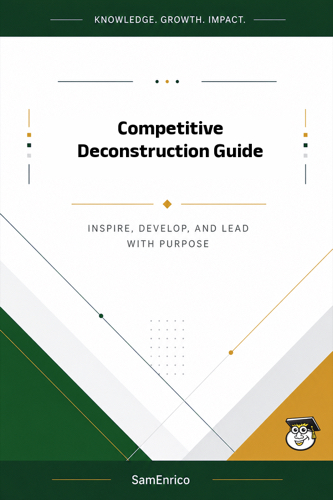
Competitive Deconstruction Guide
Analyze rival products to identify creative gaps a
Analyze rival products to identify creative gaps and opportunities.
Formats
About this book
Free sample
Chapter 1: The Copycat Trap--Most companies are secretly addicted to mediocrity. They don’t realize it, of course. They wake up each morning believing they are pursuing innovation, chasing differentiation, and building something unique. But their actions tell a different story. They open their browsers, navigate to their competitors’ websites, and start making lists.
“Competitor A has a dashboard. We need a dashboard.” “Competitor B offers real-time reporting. We need real-time reporting.” “Competitor C just launched an AI feature. We need an AI feature.” Feature by feature, they assemble a digital Frankenstein’s monster—a product that looks familiar, feels derivative, and excites no one.This is the copycat trap. And it is the single most expensive mistake in product development.The copycat trap is seductive because it feels safe.
You are not sticking your neck out. You are not betting on an unproven hypothesis. You are simply matching what the market leader has already validated. What could be more rational than that? The answer, as this chapter will demonstrate, is that feature-for-feature copying is not safe at all.
It is a slow-motion disaster that guarantees you will always be a follower, never a leader. It ensures you will compete on price, not value. And it blinds you to the most valuable opportunities in your market—the gaps that your rivals are either unaware of or structurally incapable of filling.This book offers a different path. It is called deconstruction, and it has nothing to do with copying. Deconstruction is the systematic dissection of why a rival’s product works or fails at multiple levels: user experience, technical architecture, pricing psychology, and narrative positioning.
It is not about cataloging features. It is about uncovering assumptions. It is about identifying trade-offs. It is about finding the hidden labor that rivals force their users to perform and then eliminating it.Before we dive into the tools and techniques of deconstruction, we must first understand why benchmarking fails. We must confront the uncomfortable truth that most competitive analysis is worse than useless—it is actively harmful.
And we must establish a new framework for thinking about rivals, one that transforms them from templates to be copied…
This is the end of the free sample. Get the eBook to keep going. Buy now
Contents
- Chapter 1
- Chapter 2
- Chapter 3
- Chapter 4
- Chapter 5
- Chapter 6
- Chapter 7
- Chapter 8
- Chapter 9
- Chapter 10
- Chapter 11
- Chapter 12
Details
- Author
- Luna Paulette
- Publisher
- SamEnrico
- Language
- English
- Genre
- Non-Fiction, Self-Help, Competitive Analysis
- Released
- 2026-06-08
- Pages (approx.)
- 146
- Available as
- eBook, Audiobook

Read better in the ZLOADR app
Your eBooks on your phone or tablet. Sign in with your SamEnrico account and start reading.
More by Luna Paulette
 Endometriosis Pain PracticeLuna Paulette$11.99
 First Trimester Miscarriage GuideLuna Paulette$11.99
 Gambling and Financial RuinLuna Paulette$11.99
 Sunlight Vitamin D GuideLuna Paulette$11.99
 Wholesaling Real Estate CourseLuna Paulette$11.99
 Spore Probiotics BrainLuna Paulette$11.99
 Restructuring Anger for VeteransLuna Paulette$11.99
 The Battle of Megiddo: Pharaoh Thutmose III's Lightning StrikeLuna Paulette$11.99
 The Onibaba's Curse: A Peasant's RevengeLuna Paulette$11.99
 Ultimate Handbook Guide to Indore : (India) Travel GuideLuna Paulette$11.99
 The Essential Guide to WorldLuna Paulette$11.99
 How to Produce a RepairLuna Paulette$11.99
You may also like
 Hong Kong Handover 1997Dunn Johnnie$11.99
 Zumba For Postnatal Recovery CourseNeal Christian$11.99
 Zumba for BeginnersLadner Nikia$11.99
 YouTube Comment Mining GuideHumes Pandora$12.99
 Worry Box MeditationCarlin Rudy$11.99
 Workplace Stress MeditationNguyen Lynn$11.99
 Workplace Stress and Sleep RepairHawley Ivory$11.99
 Workplace Perfectionism CureDelaney Jeffry$11.99
 Workplace Injustice Anger GuideWallen Isabelle$11.99
 Work Addiction and Burnout LinkGreenwood Ester$11.99
 Women in Yoga and WellnessBeattie Galina$11.99
 Women in Stand Up ComedyChun Evangeline$11.99