
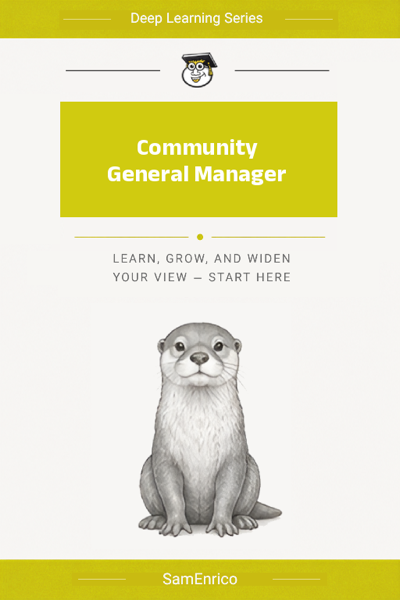
Non-FictionInformativeEducational
Community General Manager eBook
A Coursebook on Community General Manager
by Dixon Marc
A Coursebook on Community General Manager
Formats
Free sample
Chapter 1: Beyond the Toolbelt--The first time the board president called him a “glorified handyman,” Marcus let it slide. The second time, he laughed along, because that was what you did when you were a Community General Manager trying to keep peace with a volunteer board that controlled your contract renewal. The third time, the president said it in front of a resident who had just complained about a leaky faucet, and Marcus felt something shift in his chest. Not anger. Recognition.
He had been acting like a handyman. He had been running work orders, changing lightbulbs, unclogging toilets, and smoothing over complaints while the community’s financial reserves dwindled, the board fractured into warring factions, and three capital projects fell two years behind schedule.Marcus was good at fixing things. But he had never learned how to lead.This book is for every Marcus. For the community manager who has mastered the maintenance checklist but freezes when the board asks for a five-year capital plan. For the general manager who can calm an angry resident but cannot read a reserve study well enough to spot fraud.
For the on-site director who has been promoted for technical competence but never taught the strategic, financial, and human leadership skills that separate a facilities overseer from a true Community CEO.This chapter dismantles the outdated view of the Community General Manager as merely a facilities manager or administrative coordinator. Drawing from decades of research in high-reliability organizations, municipal management, and property operations, it establishes the core argument of this book: the modern CGM must act as the chief executive officer of a small, complex municipality with annual budgets reaching into the millions, physical assets worth tens of millions, and a resident population that can range from dozens to thousands. You are not a handyman with a clipboard. You are the steward of a micro-economy.The Three Pillars of Community Leadership Every community that thrives does so because its general manager balances three distinct and often competing priorities. Neglect any one, and the community will fail.
Neglect two, and it will fail catastrophically, often in ways that destroy property values, trigger litigation, or end careers. These are not abstract concepts. They are the daily, hourly trade-offs that define the difference between a manager who survives and a leader who advances.Pillar One: Resident Satisfaction (The Human Experience)Communities are not buildings. They are collections of human beings who have invested their savings, raised their families, or planned their retirements around a particular address. When a resident is unhappy, they do not simply take their business elsewhere.
They stay. They complain. They organize. They run for the board. They sue.Resident satisfaction is not about being liked.
It is about being trusted. Residents trust a CGM who communicates clearly before problems arise, who responds to complaints with empathy rather than defensiveness, and who enforces rules consistently across all residents regardless of their relationships with board members. The human pillar requires emotional intelligence, conflict resolution skills, and the ability to say no without creating enemies.But here is the trap. Many CGMs, particularly those promoted from maintenance or administrative roles, focus exclusively on resident satisfaction because it is the most visible, the most immediately gratifying, and the easiest to measure. You fix a complaint, and the resident stops complaining.
You send a newsletter, and someone says thank you. This is seductive. It is also dangerous because resident satisfaction, pursued alone, will bankrupt the community. Residents want lower fees, more services, faster repairs, and no special assessments. Giving them everything they want is the fastest path to financial ruin.Pillar Two: Financial Solvency (The Money)Someone has to pay for the roofs, the roads, the pools, the elevators, the security cameras, the landscaping, the insurance, and the salaries.
In a community association, that someone is the residents themselves, collected through monthly assessments. The CGM’s financial responsibility is not to minimize assessments. It is to ensure that the money collected is sufficient to maintain the physical assets over their full lifecycle without unexpected special assessments that destroy trust and trigger resident revolts.Financial solvency requires mastering three documents that most CGMs never fully understand. The operating budget covers the day-to-day expenses of running the community: utilities, landscaping, staff salaries, office supplies, routine maintenance. The reserve study projects the long-term replacement costs of major assets: roofs every twenty years, paving every fifteen, pool plaster every ten, elevators every twenty-five.
The balance sheet, income statement, and cash flow statement tell you, in cold numbers, whether the community is living within its means or slowly bleeding to death.The trap here is the opposite of the first pillar. CGMs who focus exclusively on financial solvency become the enforcers of austerity. They deny every request for improvement. They delay maintenance until it becomes an emergency. They present budgets that make mathematical sense but ignore the human reality of residents who feel unheard, disrespected, and trapped in a declining property.
These CGMs are often praised by boards for their fiscal discipline right up until the moment they are fired for low resident satisfaction and falling property values.Pillar Three: Asset Preservation (The Physical Plant)The physical assets of a community represent hundreds of millions of dollars of resident wealth. A well-maintained community appreciates. A poorly maintained community depreciates, often rapidly, as deferred maintenance compounds into systemic failure. The CGM is the steward of these assets, responsible for preventative maintenance, capital planning, vendor management, and emergency response.Asset preservation requires technical knowledge, project management skills, and the discipline to perform preventative maintenance even when no one is complaining. The best CGMs know that replacing a roof on schedule costs one dollar per square foot while replacing an emergency-failed roof costs three dollars per square foot plus mold remediation, resident relocation, and lawsuit defense.
They know that a well-maintained pool pump lasts fifteen years while a neglected pump fails in five. They know that preventative maintenance is invisible and thankless but absolutely essential.The trap of asset preservation is technical myopia. CGMs who love buildings more than people spend their days in utility closets and on roofs, solving engineering problems while resident complaints pile up in email inboxes. They are often beloved by boards for their technical competence right up until the moment the community explodes over a communication failure or a financial scandal that the CGM missed while focused on a leaking pipe.The Glorified Handyman Fallacy Why does the “glorified handyman” stereotype persist? Because many CGMs perpetuate it.
They carry tool belts. They answer emergency calls at midnight. They personally unclog toilets because it is faster than calling a plumber. They confuse activity with achievement and mistake busyness for leadership.The glorified handyman fallacy has three deadly consequences.First, it prevents CGMs from delegating. If you believe your value lies in your technical skills, you will continue performing technical tasks long after your time should be spent on strategic planning, financial analysis, and board relationship management.
You will burn out. Your team will remain untrained and unempowered. And the community will suffer because no one is thinking about the five-year plan while you are changing lightbulbs.Second, it keeps CGMs underpaid and undervalued.…
This is the end of the free sample. Get the eBook to keep going. Buy now
About this book
Details
- Author
- Dixon Marc
- Publisher
- SamEnrico
- Language
- English
- Genre
- Non-Fiction, Informative, Educational
- Released
- 2026-05-04
- Pages (approx.)
- 157
- Available as
- eBook, Audiobook

Read better in the ZLOADR app
Your eBooks on your phone or tablet. Sign in with your SamEnrico account and start reading.
More by Dixon Marc
 Last Living Veteran InterviewDixon Marc$11.99
 Algorithm Pattern RecognitionDixon Marc$11.99
 French Abolition 1848Dixon Marc$11.99
 Walton's Trucking FleetDixon Marc$11.99
 Dawn Fraser: The Unstoppable Freestyle Queen of the PoolDixon Marc$11.99
 Ultimate Handbook Guide to Honiara : (Solomon Islands) Travel GuideDixon Marc$11.99
 How to Produce Boxing and Mma Hand WrapsDixon Marc$11.99
 Franchise Legacy PlanningDixon Marc$12.99
You may also like
 Hong Kong Handover 1997Dunn Johnnie$11.99
 Zumba For Postnatal Recovery CourseNeal Christian$11.99
 Zumba for BeginnersLadner Nikia$11.99
 YouTube Comment Mining GuideHumes Pandora$12.99
 Worry Box MeditationCarlin Rudy$11.99
 Workplace Stress MeditationNguyen Lynn$11.99
 Workplace Stress and Sleep RepairHawley Ivory$11.99
 Workplace Perfectionism CureDelaney Jeffry$11.99
 Workplace Injustice Anger GuideWallen Isabelle$11.99
 Work Addiction and Burnout LinkGreenwood Ester$11.99
 Women in Yoga and WellnessBeattie Galina$11.99
 Women in Stand Up ComedyChun Evangeline$11.99