
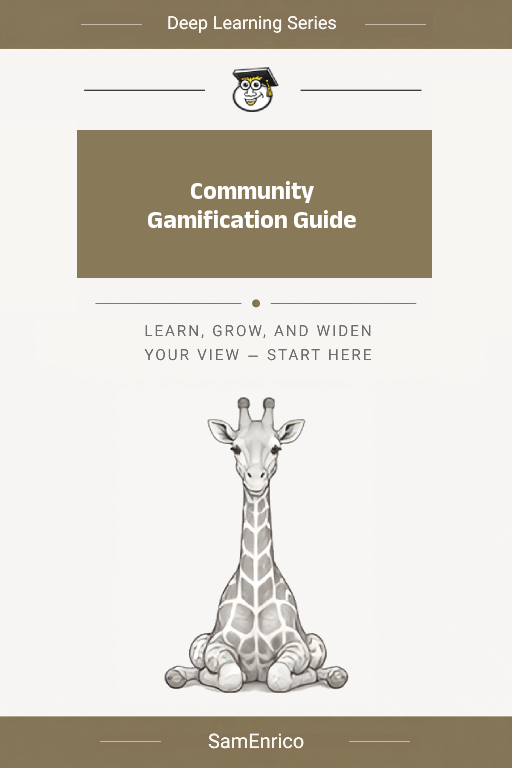
Community Gamification Guide eBook
Use badges, levels, and leaderboards to increase m
Use badges, levels, and leaderboards to increase member activity and retention.
Formats
Free sample
Chapter 1: The Participation Fallacy--–- Most community builders believe a lie. They believe that if they build it, people will come. And if people come, those people will stay. And if they stay, they will contribute. This is the participation fallacy, and it has killed more online communities than spam, trolls, and platform shutdowns combined.The truth is far less romantic.
Most people who join a community never post. Most who post once never post again. And most who post twice eventually fade into silent lurkers—ghosts who scroll, consume, and then vanish without a trace. The data is brutal. Across thousands of online communities studied over the past decade, the average active participation rate hovers between 1% and 5%.
This is known in industry circles as the 90-9-1 rule: 90% of users lurk (consume but never contribute), 9% participate occasionally, and only 1% create the vast majority of content.If you are reading this book, you have likely experienced this firsthand. You launched a forum, a Discord server, a Slack community, or a membership site. You invited your first hundred members with enthusiasm. A few posted introductions. Then silence.
A handful of power users carried the conversation for weeks, then burned out. And you were left wondering: What did I do wrong?The answer, counterintuitively, is that you probably did nothing wrong—and everything wrong at the same time. You assumed that your community's purpose was enough to motivate participation. You assumed that interesting people would naturally want to talk to each other. You assumed that a shared interest in gardening, software development, or fitness would spontaneously generate engagement.
These assumptions are not merely optimistic; they are scientifically backward. Purpose alone does not drive behavior. Behavior is driven by triggers, motivation, and feedback. And without a system that intentionally designs for these three elements, your community will default to silence.This chapter introduces the foundational problem that the rest of the book solves: the gap between joining and participating. We will explore why traditional approaches to community management fail, why "just add points and badges" is a dangerous shortcut, and what actually drives human behavior in digital spaces.
By the end of this chapter, you will understand why most gamification attempts fail—and you will be prepared to build something that actually works.The Silent Majority: Understanding Lurking as Default Behavior Before we can fix participation, we must accept a difficult truth: lurking is rational. From the perspective of a new member, the costs of participation almost always outweigh the benefits. Consider what happens when someone joins your community for the first time.To post a message, they must:Overcome social anxiety (Will I sound stupid?)Learn community norms (Is this the right channel for my question?)Invest time in composing a thoughtful response (What if no one replies?)Risk negative feedback (What if someone disagrees or mocks me?)The potential rewards? Perhaps a "like" from a stranger. Perhaps an answer to a question.
Perhaps the vague satisfaction of being helpful. For most people, most of the time, the math does not work. Silence is the path of least resistance. This is not a failure of your community's culture; it is a feature of human psychology. We are wired to conserve energy, avoid social risk, and default to observation until we have sufficient reason to act.The 90-9-1 rule is not a law of nature.
It is a description of unmanaged systems. In communities where participation is intentionally designed—where triggers, motivation, and feedback loops are carefully architected—the ratio can shift dramatically. Some communities achieve 20% active participation. A rare few reach 40% or higher. These communities are not luckier than yours.
They have simply solved the participation problem by treating it as a design problem, not a culture problem.The BLL Trap: Why Points, Badges, and Leaderboards Fail Alone If you have searched for solutions to low participation, you have almost certainly encountered the standard advice: add points, badges, and leaderboards (BLLs). This trio has become the default prescription for community engagement, peddled by countless Saa S platforms and gamification gurus. Add a point system, the logic goes, and members will compete. Add badges, and they will collect. Add a leaderboard, and they will strive to reach the top.This advice is not entirely wrong.
Points, badges, and leaderboards can increase activity. The problem is that they increase the wrong kind of activity—and they often destroy the intrinsic motivation that sustains communities over the long term.Let us distinguish between two very different things: pointification and true gamification.Pointification is the act of slapping a point system onto an existing activity without changing the underlying experience. You give 10 points for logging in, 50 points for posting, and 100 points for replying. Then you display a leaderboard of who has the most points. This is not gamification; it is a spreadsheet dressed as a game.
It treats human motivation as a simple equation: reward + repetition = loyalty. This works for rats pressing levers. It works less well for human beings who can sense when they are being manipulated.True gamification is the process of redesigning an experience to be intrinsically motivating—to tap into the same psychological drives that make games compelling: mastery, autonomy, purpose, social connection, and progress. Points and badges, when used correctly, are feedback mechanisms that reveal progress toward a meaningful goal. When used incorrectly, they are empty calories that temporarily spike activity while hollowing out the community's soul.Here is the critical insight that most BLL advocates miss: points, badges, and leaderboards are symptoms of engagement, not causes.
A community that is already thriving will naturally develop status markers, informal recognition systems, and social hierarchies. Adding BLLs to a dead community is like putting a racing stripe on a broken car and expecting it to drive faster. The stripe does nothing. The engine is the problem.The 80% Problem: How Leaderboards Demotivate Most People To understand why BLLs fail alone, consider the leaderboard—perhaps the most commonly misused gamification tool. A global leaderboard that ranks all members by points appears, on the surface, to create healthy competition.
But look closer. Who is actually motivated by that leaderboard?The top 5% of members see their names near the top. They feel a sense of status and are motivated to defend their position. They are already highly engaged; they did not need the leaderboard to participate.The next 15% see themselves in the middle. They might be motivated to climb a few ranks.
They are the only group for whom the leaderboard has a net positive effect.The bottom 80% see themselves near the bottom or not at all. They do not see a path to the top. They experience the leaderboard not as a challenge but as a reminder of their low status. For these members, the leaderboard is demotivating. It signals that they are losing a game they never agreed to play.
The rational response is to stop paying attention to the leaderboard entirely—and, often, to stop participating in the community altogether.This is known as the hopelessness cliff. Once a member falls far enough behind that catching up seems impossible, they disengage. Not gradually. Suddenly. The cliff is steep, and the fall is silent because…
This is the end of the free sample. Get the eBook to keep going. Buy now
About this book
Details
- Author
- Townsend Billie
- Publisher
- SamEnrico
- Language
- English
- Genre
- Non-Fiction, Zero-to-One Creator, Gamification
- Released
- 2026-06-01
- Pages (approx.)
- 154
- Available as
- eBook, Audiobook

Read better in the ZLOADR app
Your eBooks on your phone or tablet. Sign in with your SamEnrico account and start reading.
More by Townsend Billie
 Case Study Priority ExamplesTownsend Billie$11.99
 Parental Anger And Holiday StressTownsend Billie$11.99
 Self Hypnosis for Posture HabitsTownsend Billie$11.99
 Remote Work Relationship Stress GuideTownsend Billie$11.99
 Mindfulness for Panic Attacks GuideTownsend Billie$11.99
 The Alchemist of Alexandria: Unlocking the Atom in Ancient EgyptTownsend Billie$11.99
 The Last Empress: How a Teen Queen Outmaneuvered EuropeTownsend Billie$11.99
 Nonprofit Tax Filing SoftwareTownsend Billie$12.99
 Understanding Deafness, Autosomal Dominant Nonsyndromic SensorineuralTownsend Billie$17.99
 Hospitality AideTownsend Billie$11.99