
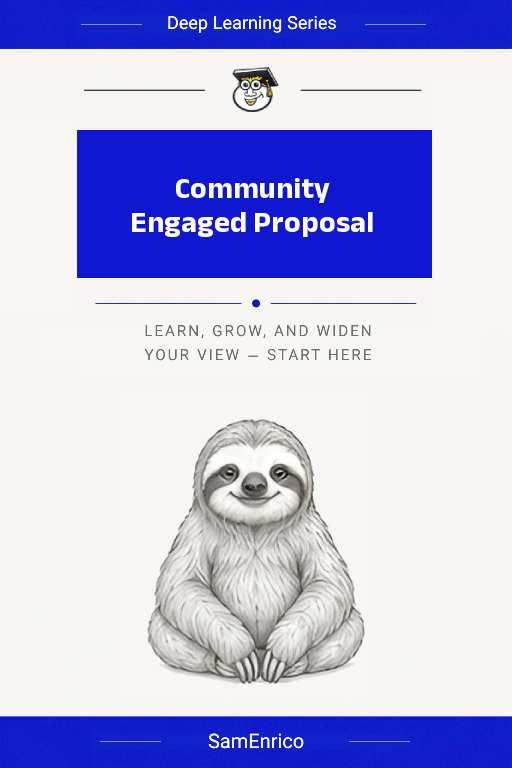
Non-FictionStudent's ShortcutCommunity EngagementParticipatory
Community Engaged Proposal eBook
Write research proposals with community engagement
by Bivens Rhoda
Write research proposals with community engagement components including partner letters and benefit descriptions.
Formats
Free sample
Chapter 1: The Ghosted Researcher...--–- You wrote the perfect email. You spent hours crafting a thoughtful message to a community organization you genuinely admire. You cited their work. You acknowledged their expertise. You offered a stipend.
You hit send with a feeling of hopeful anticipation. And then... nothing. A week passes. Two weeks.
Your grant deadline is approaching, and the silence from the other end of that email thread is deafening. You’ve been ghosted.If this has happened to you, you are not alone. I have sat in countless faculty workshops and graduate seminars where the same hand shoots up to ask the same question: “Why won’t they write me back?” The answer, which no one wants to hear, is simple and brutal. They didn’t respond because your email was about you.This chapter is not about how to write a better email. It is about something far more fundamental.
It is about the chasm between what academics call “community engagement” and what communities actually experience when academics come calling. I learned this lesson the hard way. In 2019, I spent six months building what I thought was the perfect community-engaged research proposal. I had the literature review. I had the IRB approval.
I had the “letter of support” template from my university’s grants office. I sent it to a long-time community partner, a woman who runs a small but powerful mutual aid network in a neighborhood my university had studied for decades. Her reply was four words: “This isn’t for us.”That rejection saved my career. It forced me to stop asking “How do I get them to participate?” and start asking “Why would they want to?” This book is what I wish I had read the night before I sent that proposal. It is a field guide for researchers, nonprofit staff, graduate students, and anyone who has ever been ignored by a potential partner and wants to fix it before the next deadline.
The goal is not to teach you how to check a box marked “community engagement.” The goal is to teach you how to write proposals that communities actually want to say yes to.The Anatomy of a Ghosting: Why Good Intentions Fail Let us begin with a confession. Before that four-word rejection, I thought I understood community engagement. I had read the literature. I had attended the workshops. I had even co-authored a paper on participatory methods.
But my proposal was, in retrospect, a masterpiece of extractive thinking dressed up in collaborative language. I had written about “partnership” but designed for “access.” I had asked for a “letter of support” but offered nothing of tangible value in return. I had assumed that the community’s time was a resource to be managed rather than a gift to be respected.This is the first and most important distinction this chapter will make. There is a world of difference between research in a community and research with a community. Research in a community treats the community as a source of data.
It asks, “What can we learn from these people?” Research with a community treats the community as a partner. It asks, “What can we learn together, and what can we do together with what we learn?” The first is extractive. The second is collaborative. Most proposals that claim to be community-engaged are actually the first dressed up as the second.How can you tell which one you are writing? Look at your timeline.
If your timeline includes community members only during data collection, you are doing extractive research. If your timeline includes community members from problem definition through dissemination, you might be doing collaborative research. Look at your budget. If your budget lists community partners as “in-kind” contributions (a polite way of saying “free”), you are doing extractive research. If your budget pays community partners as co-investigators, you are doing collaborative research.
Look at your data ownership plan. If the data belongs to the university, you are doing extractive research. If the data is jointly owned, you are doing collaborative research.This chapter will help you diagnose where your current proposal falls on this spectrum. By the end, you will have a clear sense of whether you are ready for genuine collaboration or whether you should pursue a less intensive model, like a community advisory board. Both are valid.
What is not valid is claiming collaboration when you are actually doing extraction.The Three Levels of Engagement: Consultation, Collaboration, and Community-Led Before we go any further, we need a shared language. The phrase “community engagement” has been stretched so thin it barely means anything anymore. A one-hour community meeting where a researcher presents already-determined findings is called “engagement.” A decade-long partnership where community members control the budget is also called “engagement.” These are not the same thing. To write a credible proposal, you need to name precisely which model you are using. This chapter introduces three distinct levels.Level 1: Consultation.
This is the most common and least intensive form of engagement. In a consultation model, the researcher makes all major decisions, then asks the community for feedback. The community’s role is advisory. They can suggest changes, but the researcher retains final authority. This model is appropriate when the research question is already well-defined, when the timeline is short, or when the community has explicitly asked not to be burdened with decision-making.
However, it is not collaboration. If you use this model, call it consultation. Funders respect honesty. They do not respect inflated claims.Level 2: Collaboration. In a collaborative model, the community and the researcher make decisions together.
They co-define the research question (see Chapter 3), co-design the methods (see Chapter 8), and co-own the data (see Chapter 6). Authority is shared. This model requires more time, more budget, and more trust. It is appropriate when the research question is not yet defined, when the community has a strong interest in the outcomes, and when the researcher is willing to share power. This is what most funders mean when they ask for “community-engaged research,” though many applicants mistake consultation for collaboration.Level 3: Community-Led.
In a community-led model, the community controls the research from start to finish. The researcher’s role is to provide technical assistance, training, or resources as requested. Authority is fully transferred. This model is rare in academic contexts because it requires the researcher to give up control over publications, timelines, and research questions. It is most common in participatory action research (PAR) and in grants where a community organization is the primary applicant and the university is a subcontractor.
This model is not for everyone, and it is not required for a proposal to be excellent. But if you claim it, you must mean it.Your first task as a proposal writer is to be honest with yourself about which model you are actually using. Do not call it collaboration if you are not prepared to share decision-making power. Do not call it community-led if you are not prepared to hand over the budget. Funders have seen too many proposals that promise collaboration and deliver consultation.
They have learned to look for the telltale signs: vague letters of support, low budgets for community partners, and timelines…
This is the end of the free sample. Get the eBook to keep going. Buy now
About this book
Details
- Author
- Bivens Rhoda
- Publisher
- SamEnrico
- Language
- English
- Genre
- Non-Fiction, Student's Shortcut, Community Engagement, Participatory
- Released
- 2026-06-01
- Pages (approx.)
- 142
- Available as
- eBook, Audiobook

Read better in the ZLOADR app
Your eBooks on your phone or tablet. Sign in with your SamEnrico account and start reading.
More by Bivens Rhoda
 Management Buyout Modeling GuideBivens Rhoda$11.99
 Open World Game Exhaustion CourseBivens Rhoda$11.99
 LBO No Fault Divorce GuideBivens Rhoda$11.99
 Bariatric Surgery Alcohol Risk HandbookBivens Rhoda$11.99
 Gluten Free Athlete Performance GuideBivens Rhoda$11.99
 The Unseen Hand: How a 19th-Century Lawyer Secretly Shaped Modern DemocracyBivens Rhoda$11.99
 The Silk Road to the Stars: Ancient Astronomy in the HimalayasBivens Rhoda$11.99
 Understanding Ccge SyndromeBivens Rhoda$17.99
 AI Financial Data DeduplicationBivens Rhoda$12.99
 Energy AuditingBivens Rhoda$11.99
 How to Become a Inseam TrimmerBivens Rhoda$11.99
You may also like
 Hong Kong Handover 1997Dunn Johnnie$11.99
 Zumba For Postnatal Recovery CourseNeal Christian$11.99
 Zumba for BeginnersLadner Nikia$11.99
 YouTube Comment Mining GuideHumes Pandora$12.99
 Worry Box MeditationCarlin Rudy$11.99
 Workplace Stress MeditationNguyen Lynn$11.99
 Workplace Stress and Sleep RepairHawley Ivory$11.99
 Workplace Perfectionism CureDelaney Jeffry$11.99
 Workplace Injustice Anger GuideWallen Isabelle$11.99
 Work Addiction and Burnout LinkGreenwood Ester$11.99
 Women in Yoga and WellnessBeattie Galina$11.99
 Women in Stand Up ComedyChun Evangeline$11.99