
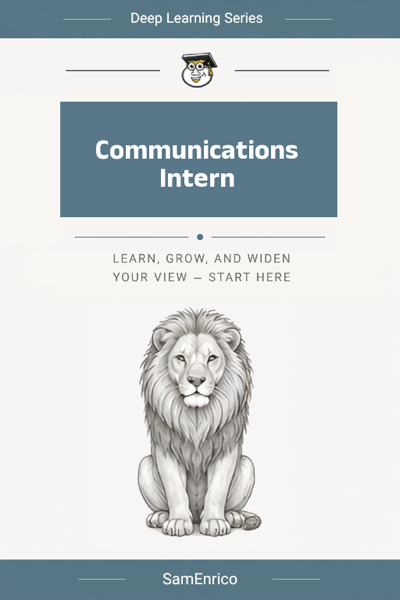
Communications Intern eBook
A Coursebook on Communications Intern
A Coursebook on Communications Intern
Formats
Free sample
Chapter 1: The Theory Trap--–- Emma’s hands were shaking. Not from caffeine—though her third coffee of the morning wasn’t helping—but from the cold realization that she had absolutely no idea what she was doing. She had arrived at her first day as a communications intern at Brightside PR wearing a blazer she’d borrowed from her roommate, carrying a notebook with her university’s logo embossed on the cover, and reciting the elaboration likelihood model in her head like a prayer. She had a 3.8 GPA. She had written fourteen press releases for imaginary clients in her Advanced PR Writing class.
She had aced the mock crisis simulation where a fake airline’s plane had crashed and she’d crafted the perfect holding statement. She was ready.Three hours later, her supervisor—a exhausted senior account executive named Marcus who hadn’t slept since Tuesday—dropped a spreadsheet on her desk. Not a clean, color-coded spreadsheet. A monster. Fifty-seven rows of journalists’ names, email addresses, beats, and a column labeled “Last Pitched” that was mostly empty.
“I need you to call every single one,” Marcus said, already walking away. “Introduce yourself. Ask if they’re covering the Johnson account launch next week. If they say yes, put a star. If they say no, ask why.
If they yell at you, just say ‘thank you for your time’ and hang up. Don’t cry where anyone can see you.”Emma stared at the spreadsheet. She had never cold-called a journalist. Her textbook had a chapter on media relations that began with the sentence, “Building mutually beneficial relationships with members of the press requires strategic alignment of organizational messaging and journalistic values.” That sentence did not tell her what to do when a reporter from the Wall Street Journal answered the phone and said, “Who is this and why should I care?”That was when her hands started shaking.Welcome to the internship. It’s not your fault.
And Chapter 1 is going to save you.The Lie They Told You in Class Let’s be honest with each other. Your communication courses prepared you for a world that does not exist. In your textbooks, campaigns are linear. You conduct research, you identify objectives, you craft messaging, you select channels, you execute, you evaluate. There is a diagram.
It looks professional. It has arrows.In real life, campaigns are chaotic. Objectives change because the client changed their mind. Messaging gets rewritten by three different people who don’t speak to each other. Channels are chosen based on what the intern knows how to use.
Execution happens at 11 PM on a Sunday because someone forgot to hit send. And evaluation? That’s a spreadsheet that your boss will glance at for seven seconds before saying, “Can you make this look better?”This gap—between the clean, rational world of the classroom and the messy, emotional, time-crunched reality of the workplace—is the single biggest source of intern anxiety. You feel unprepared not because you are stupid or lazy or doomed to fail. You feel unprepared because you have been trained to think like a student, not like a professional.
And those are two completely different operating systems.The student mindset asks: “What does the professor want?” The professional mindset asks: “What does the business need?” The student mindset seeks a rubric. The professional mindset seeks a result. The student mindset assumes that if you follow the instructions, you will get an A. The professional mindset knows that the instructions are often wrong, incomplete, or missing entirely—and that your job is to figure it out anyway.This chapter is about uninstalling the student operating system and installing the professional one. It’s not about forgetting what you learned in school.
It’s about learning how to translate it. Because here’s the secret that no one tells you: the theories you studied are actually useful. The elaboration likelihood model? It’s real. It works.
But if you walk into your boss’s office and say, “I’d like to apply the elaboration likelihood model to our social media strategy,” they will stare at you like you just spoke Klingon. If you say, “I think we should write two versions of this Instagram caption—one for people who already love us and one for people who don’t know who we are yet”—you just applied the elaboration likelihood model without sounding like a textbook.That’s the skill. Translation. And it’s the only thing standing between you and a successful internship.The Case of the Disappearing Audience (Or: How Theory Saves the Day)Let me tell you about a real intern. We’ll call her Maya.
Maya was a junior at a large state university, majoring in strategic communications with a minor in digital media. She had taken every required course: Introduction to Public Relations, Research Methods, Crisis Communication, Writing for Media. She had a 4.0. She was, by every measurable standard, the perfect candidate for her summer internship at a midsize marketing agency that specialized in consumer packaged goods.Her first assignment seemed simple. The agency’s client—a brand of organic energy drinks called Volt—was launching a new flavor: Voltage Berry.
The target audience was “active adults aged 18-34.” The goal was to generate buzz on social media. Maya’s boss, a frazzled account director named Priya, asked her to “do some research and tell us who we should be talking to.”Maya opened her laptop and did what any good student would do. She Googled “energy drink demographics.” She found a report from Statista. She summarized it in a three-page memo with footnotes. She concluded that Volt should target “millennials and Gen Z consumers who value organic ingredients, fitness, and convenience.”She sent the memo to Priya at 9 AM on Tuesday.By 2 PM, Priya had not responded.
By 5 PM, still nothing. By Wednesday morning, Maya was convinced she had failed. She re-read her memo. It was perfect. The grammar was flawless.
The citations were correct. Why wasn’t anyone responding?Here’s what Maya didn’t know: the agency had already read the Statista report. Every agency had read the Statista report. “Millennials and Gen Z who value organic ingredients” was not insight; it was a commodity. Priya could have Googled that herself.
What Priya needed was something the research methods textbook couldn’t give her: a specific, actionable, weirdly specific observation about this product, this client, this moment.Maya spent the next day doing something her professor never assigned. She went to a gym. She stood outside the smoothie bar. She watched people buy energy drinks. She noticed something strange: most of the people buying Volt weren’t the “active adults” in the marketing deck.
They were college students who looked exhausted. They were buying Volt not because they cared about organic ingredients but because the convenience store on campus had a two-for-one deal. They were buying it at 10 PM, not 7 AM. They were drinking it while studying, not while running.Maya went back to Priya with a different answer. “Our target isn’t ‘active adults,’” she said.
“It’s ‘tired students who have an exam tomorrow and twenty bucks left on their meal plan.’ They don’t care about…
This is the end of the free sample. Get the eBook to keep going. Buy now
About this book
Details
- Author
- Whitcomb Maile
- Publisher
- SamEnrico
- Language
- English
- Genre
- Non-Fiction, Informative, Educational
- Released
- 2026-05-09
- Pages (approx.)
- 139
- Available as
- eBook, Audiobook

Read better in the ZLOADR app
Your eBooks on your phone or tablet. Sign in with your SamEnrico account and start reading.
More by Whitcomb Maile
 XDR Implementation TrendsWhitcomb Maile$11.99
 Bipolar Online Support GroupsWhitcomb Maile$11.99
 Academic Imposter SyndromeWhitcomb Maile$11.99
 Naloxone for First RespondersWhitcomb Maile$11.99
 The Sugar Detox Meal Plan GuideWhitcomb Maile$11.99
 The Iron Tsar: Peter the Great's Naval RevolutionWhitcomb Maile$11.99
 Understanding Prekallikrein Deficiency, CongenitalWhitcomb Maile$17.99
 MSC Fisheries Export CertificationWhitcomb Maile$12.99
 GA4 Cross Domain Tracking GuideWhitcomb Maile$12.99
 How to Start a Chiffon Weaving From Yarn Spun on The Cotton System Business (Beginners Guide)Whitcomb Maile$11.99