
Non-FictionStudent's ShortcutCollege AdmissionsEssay Writing
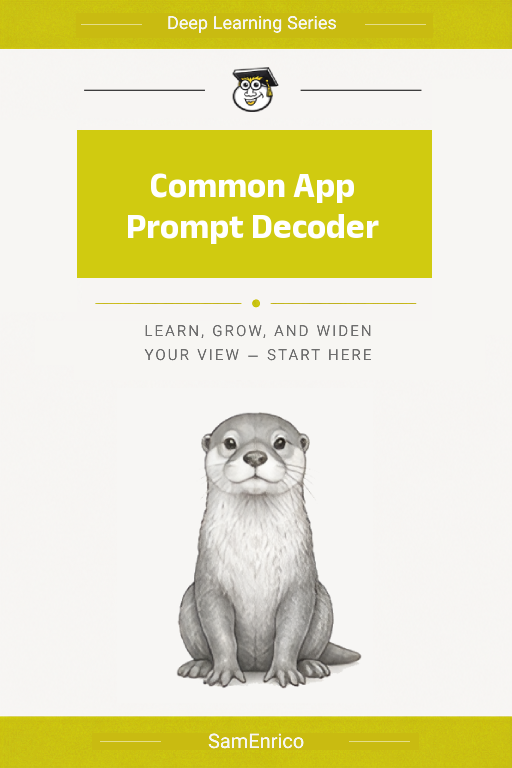
Common App Prompt Decoder eBook
Translate vague essay prompts into concrete story
by Roden Malcom
Translate vague essay prompts into concrete story choices, then apply the showing-not-telling framework admissions officers love.
Formats
Free sample
Chapter 1: The 5-Minute Judgment--–- The smoke alarm was screaming before the cookies even hit the pan. That’s how my student, whom I’ll call Priya, opened her Common App essay. Not with a resume. Not with a list of accomplishments. Not with the words “passionate,” “dedicated,” or “I learned that failure is actually a gift.” She started with a smoke alarm and raw cookie dough.
And she got into a top-twenty university. Meanwhile, another student—let’s call him Marcus—opened his essay with “Winning the state debate championship taught me the value of perseverance.” Marcus had better grades than Priya. Higher test scores. More leadership positions. Marcus did not get in.
Priya did.This is not a coincidence. This is not luck. This is the difference between understanding how admissions readers actually think and writing the essay that 90% of applicants write.Let me tell you something that most college guides won’t: The Common Application essay is not graded. It is felt. There is no rubric.
No points for vocabulary. No bonus for using the word “myriad.” Your essay will be read by a human being who has already read forty-seven other essays that day, who has a headache, who needs coffee, and who will spend somewhere between three and five minutes on yours. Three to five minutes. That’s it. That’s the window you have to make someone care about you.And here’s the part that should terrify you: In that time, most essays are forgettable.
They blend together. They use the same words, the same structures, the same “lessons learned.” Admissions officers call it “essay fatigue.” They read “I learned that failure is a stepping stone to success” for the fifteenth time, and their brain does something remarkable—it stops processing. The words become wallpaper. The student becomes invisible.This chapter is about making sure that does not happen to you. It is about understanding the psychology of the person on the other side of the page.
It is about learning what they are actually looking for, which is not what they say they are looking for. And it is about the single most important question you will ever ask yourself while writing your essay: So what?The Brutal Math of Admissions Reading Let me give you the numbers, because numbers don’t lie. During peak reading season, a typical admissions officer at a competitive university reads between forty and sixty applications per day. That is not a typo. Forty to sixty.
Each application includes grades, test scores, course rigor, activities list, recommendations, and at least one essay. Do the math. If an officer works eight hours with no breaks, that is between four and seven minutes per application. The essay gets three to five of those minutes. Often less.Now add context.
These are not robots. These are people who have been reading for weeks. They have read about the mission trip to Costa Rica, the varsity soccer injury, the grandparent who passed away, the move to a new school, the summer internship that “changed everything.” They have read about passion and dedication and growth. They have read so many of these essays that the words have lost their meaning. “Passionate” now means nothing.
“Valuable” now means nothing. “Community” now means nothing. These words have been used so often that they have become empty containers—sounds without substance.This is the battlefield you are entering. Your essay is not competing against perfection. It is competing against exhaustion.
Your reader is not looking for reasons to reject you. They are looking for reasons to keep reading. That is a very different thing. And the only way to make them keep reading is to give them something they have not seen before.The “Slice of Life” Principle This brings us to the first major insight of this book: You do not need a dramatic story to write a memorable essay. In fact, dramatic stories often fail.
Why? Because they come with baggage. When you write about winning a championship, the reader immediately compares your championship to every other championship they have read about. When you write about a tragedy, the reader braces for manipulation. Big events create big expectations.
And big expectations are almost impossible to meet in six hundred and fifty words.The best essays come from small moments. Tiny, specific, almost embarrassingly ordinary moments. A failed recipe. A jammed printer. A conversation at the dinner table.
Getting lost in a new city. Trying to fix a sink and making it worse. These moments have no expectations attached. The reader comes in neutral, even curious. And that is where you can surprise them.I call this the “Slice of Life” principle.
You are not writing your autobiography. You are not writing your resume in paragraph form. You are giving the reader one scene from your life, told so vividly and honestly that they feel like they were there. And through that single scene, they understand who you are.Priya’s essay about burning cookies worked because it was small. She did not claim to have changed the world.
She did not claim to have discovered the cure for procrastination. She simply showed herself in a moment of failure—the smoke alarm screaming, the dough raw, her younger brother laughing from the doorway—and then showed what she did next. She ordered pizza. And then the next morning, she tried again, this time reading the recipe all the way through before preheating the oven. That was the essay.
Burning cookies and reading instructions. And it worked because it was real. It was specific. It was her.Your life is full of these moments. You just have not been trained to see them as essay material.
That changes now.The Three Questions Hidden Inside Every Prompt Here is a secret that most students never figure out: Every Common App prompt is actually asking the same three questions. The wording changes. The framing changes. But underneath all the academic language, admissions officers want to know three things about you, and only three things.First: What do you value? Not what you say you value in an interview voice.
What do you actually, demonstrably, through your actions, care about? When no one is watching, what pulls your attention? What makes you angry? What makes you lose track of time? Your values are not your parents’ values or your teachers’ values or the values you think you are supposed to have.
They are the ones that show up in your behavior, often without you noticing.Second: How do you operate under pressure? When things go wrong—not when they go right—what do you do? Do you freeze? Do you problem-solve? Do you ask for help?
Do you walk away and come back? Do you make a joke? The essay is not about your successes. It is about your process. And process is most visible when things are not working.Third: What will you bring to our campus?
This is the question that no prompt asks directly but every reader wants answered. They are building a class. They are not just admitting individuals; they are constructing a community.…
This is the end of the free sample. Get the eBook to keep going. Buy now
About this book
Details
- Author
- Roden Malcom
- Publisher
- SamEnrico
- Language
- English
- Genre
- Non-Fiction, Student's Shortcut, College Admissions, Essay Writing
- Released
- 2026-06-01
- Pages (approx.)
- 139
- Available as
- eBook, Audiobook

Read better in the ZLOADR app
Your eBooks on your phone or tablet. Sign in with your SamEnrico account and start reading.
More by Roden Malcom
 Child Loss Support For MomsRoden Malcom$11.99
 Small Talk for Transgender IndividualsRoden Malcom$11.99
 Slack Teams Chat Management GuideRoden Malcom$11.99
 The Wedding Enslavement StoryRoden Malcom$11.99
 Spin Race Day PrepRoden Malcom$11.99
 Parenting EQ Skills HandbookRoden Malcom$11.99
 The Quit Smoking Food GuideRoden Malcom$11.99
 Samsung Galaxy Watch MemoryRoden Malcom$11.99
 The Silent Coup: How a Single Radio Broadcast Toppled a GovernmentRoden Malcom$11.99
 Neon Nights: The Untold Story of Diana Ross’s Private Island GetawayRoden Malcom$11.99
 Fafnir's Last Breath: The Dragon Who Became GoldRoden Malcom$11.99
 How to Start a Plastic Materials In Primary Forms (wholesale) Business (Beginners Guide)Roden Malcom$11.99
You may also like
 Hong Kong Handover 1997Dunn Johnnie$11.99
 Zumba For Postnatal Recovery CourseNeal Christian$11.99
 Zumba for BeginnersLadner Nikia$11.99
 YouTube Comment Mining GuideHumes Pandora$12.99
 Worry Box MeditationCarlin Rudy$11.99
 Workplace Stress MeditationNguyen Lynn$11.99
 Workplace Stress and Sleep RepairHawley Ivory$11.99
 Workplace Perfectionism CureDelaney Jeffry$11.99
 Workplace Injustice Anger GuideWallen Isabelle$11.99
 Work Addiction and Burnout LinkGreenwood Ester$11.99
 Women in Yoga and WellnessBeattie Galina$11.99
 Women in Stand Up ComedyChun Evangeline$11.99