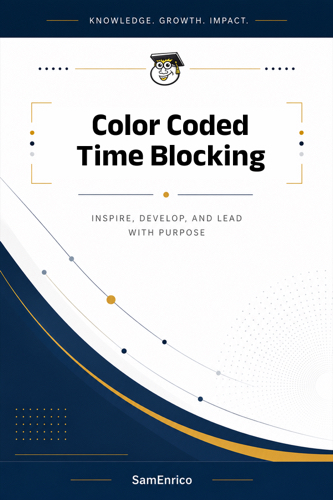
Color Coded Scheduling Guide Audiobook
Use calendar colors to visually distinguish work,
by Alger Man
Use calendar colors to visually distinguish work, personal, and self-care blocks.
Formats
Free sample
Chapter 1: The Invisible Weight--–- It is 3:47 PM on a Tuesday, and you have already switched tasks thirty-seven times. You do not know this number because no one counts the switches. You only feel the result: a low-grade hum of exhaustion that has become so familiar you have stopped naming it. You call it "being busy" or "a hectic day" or simply "Tuesday." But what you are actually experiencing is a measurable cognitive phenomenon called attention residue, and it is the primary reason your calendar—no matter how carefully maintained—has been failing you.The purpose of this chapter is to dismantle the conventional approach to scheduling that almost everyone has been taught: the monochrome to-do list, the single-color calendar, the endless parade of black text on a white background that treats a meeting with your boss as visually identical to a meditation session or a child's piano recital. This chapter will introduce the concept of attention residue, debunk the myth of multitasking, explain why visual cues are essential for cognitive efficiency, and guide you through a one-week Time Audit that will forever change how you see your relationship with time.
By the end of this chapter, you will understand not just why your current system is failing you, but why it was never designed to succeed in the first place.The Attention Residue Problem In 2005, a professor named Sophie Leroy published a research paper that should have changed how every working adult organizes their day. Her subject was attention residue—the phenomenon where your brain remains partially stuck on a previous task even after you have consciously switched to a new one. Leroy found that when people interrupt one task to begin another, their cognitive resources do not transfer cleanly. Instead, a portion of their mental capacity remains tethered to the unfinished work, like a boat dragging an anchor beneath the water.The implications of this research are staggering. Every time you switch from writing a report to answering a text message to scanning your calendar to responding to an email to checking the news, you are not simply moving from one activity to another.
You are leaving behind a trail of partial attention. The human brain is not designed for rapid context switching. It is designed for sustained focus on one thing at a time. But modern schedules demand the opposite. And when those demands are presented in…
This is the end of the free sample. Get the Audiobook to keep going. Buy now
About this book
Details
- Author
- Alger Man
- Publisher
- SamEnrico
- Language
- English
- Genre
- Non-Fiction, Self-Help, Visual Planning
- Released
- 2026-06-06
- Pages (approx.)
- 115
- Available as
- eBook, Audiobook

Listen in the VoxFlicks app
Audiobooks and audio dramas wherever you go. Sign in with your SamEnrico account and press play.
More by Alger Man
 Mirror Therapy Pain GuideAlger Man$11.99
 Anger Trigger Temperature CheckAlger Man$11.99
 Anger And Potty Training ResistanceAlger Man$11.99
 The Black Panther’s Shadow: How a 1970s Cult Film Sparked a RevolutionAlger Man$11.99
 The Alchemist of Timbuktu: Al-Hasan Ibn al-Haytham and the Light of KnowledgeAlger Man$11.99
 Enterprise Sales OptimizationAlger Man$11.99
 Understanding Hyperkalemic Periodic ParalysisAlger Man$17.99
 Red Seal Certification ManualAlger Man$12.99
 Renewable Energy Disruption GuideAlger Man$12.99
 A Beginners Guide to Bar billiards (Volume 1)Alger Man$11.99