
Non-FictionSelf-HelpPrototyping
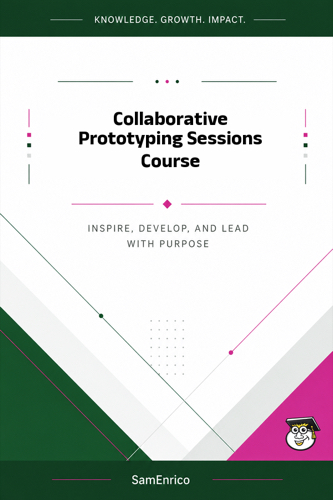
Collaborative Prototyping Sessions Course eBook
Builds rough prototypes together to externalize id
by Kellogg Luci
Builds rough prototypes together to externalize ideas and iterate rapidly.
Formats
Free sample
Chapter 1: The Zombie in the Conference Room--The email arrived at 9:47 AM on a Tuesday. Subject line: “Quick sync – no agenda.” By 10:15 AM, fourteen people had gathered in a conference room named “Innovation Hub.” By 10:45 AM, three people were checking Slack, two were clearly answering other emails, one was doodling, and the person who called the meeting was repeating themselves for the fourth time. At 11:00 AM, the meeting ended with no decisions, no action items, and a vague sense that another meeting would be needed to continue the conversation that this meeting failed to start.This was not a failure. This was a Tuesday.The scene above is not an exaggeration. It is the median workplace meeting.
According to a 2019 study by Atlassian, the average employee attends 62 meetings per month. Half of those meetings are considered a waste of time by the attendees themselves. That translates to 31 hours per month of human potential evaporating into a fog of status updates, polite disagreement, and the quiet resignation of people who have given up on believing that anything productive will ever happen in a room with a whiteboard and a projector that doesn’t quite work.If you are reading this book, you have been in that room. You have felt the slow decay of your attention span. You have watched a colleague explain something that could have been an email.
You have left a meeting and said to no one in particular, “Well, that was an hour I’ll never get back.”This chapter is not about fixing meetings. Meetings cannot be fixed. They are fundamentally broken for the purpose of creative problem-solving. This chapter is about killing them and replacing them with something that actually works: the Collaborative Prototyping Session.The Anatomy of a Zombie Meeting Before we can build something better, we must understand what is killing us. The Zombie Meeting is not a meeting that fails spectacularly.
It is far worse. It is a meeting that looks alive on the outside—people are talking, nodding, writing things down—but is dead on the inside. It has no pulse. It has no direction. It has no hope of producing an outcome that could not have been achieved by a two-paragraph email and a five-minute asynchronous decision.Here are the six diagnostic signs that you are currently in a Zombie Meeting.
If you recognize three or more, you are entitled to leave. (Do not actually leave. But you are entitled to feel justified in your frustration.)Sign One: No Clear Decider in the Room The most reliable predictor of a failed meeting is the absence of someone who can make a final call. In a Zombie Meeting, the conversation is circular because no one has the authority to stop the circle. People debate, suggest, counter-suggest, and compromise—not because they are building toward a better solution, but because they are waiting for someone with power to arrive.
That person rarely arrives. The meeting ends with “we’ll take this offline” because “offline” is where the decider lives.Sign Two: The Same Topic Has Recurred in Three or More Meetings If you have discussed the same problem in three separate meetings, you are not solving the problem. You are performing the ritual of solving the problem. The ritual feels productive because it involves talking, but it produces nothing except more meetings. A healthy organization discusses a problem once, makes a decision, and acts.
A Zombie Meeting organization discusses the same problem until everyone is too exhausted to care.Sign Three: Attendees Are Visibly Multitasking When people check email, Slack, or their phones during a meeting, they are not being rude. They are being rational. They have calculated—consciously or unconsciously—that the marginal value of their attention in this meeting is lower than the marginal value of their attention elsewhere. The meeting has signaled that it is not worth their full presence. The facilitator (if one even exists) has failed to make the case that this time matters.Sign Four: No One Knows What “Success” Looks Like Before a meeting begins, ask every attendee to write down what a successful outcome would look like.
In a Zombie Meeting, you will get seven different answers. Some will say “alignment.” Some will say “a decision.” Some will say “just to share information.” Some will say nothing because they don’t know why they were invited. When success is undefined, failure is guaranteed—but because no one defined success, no one can declare failure. The meeting simply ends, having accomplished nothing and disappointed everyone equally.Sign Five: Decisions from Previous Meetings Have Not Been Acted Upon This is the telltale sign of organizational decay. You have a meeting.
You make a decision. You assign action items. You adjourn. At the next meeting, you discover that none of the action items were completed. So you discuss them again.
You reassign them. You adjourn. The cycle repeats. At no point does anyone ask the uncomfortable question: “If we keep deciding the same thing and no one does it, are we actually deciding anything at all?”Sign Six: The Meeting Ends Without a Next Action The final sign of death is the absence of a pulse. A living meeting ends with a clear next step: who will do what, by when, and how they will report back.
A Zombie Meeting ends with “good discussion” or “we’ll pick this up next time” or—the most damning phrase in the corporate lexicon—“let’s put a pin in that.” You cannot put a pin in a decision. You either make it or you don’t. The pin is a coffin nail.Why Talking Is Not Making The fundamental flaw of the traditional meeting is that it confuses talking with making. In a meeting, the primary activity is verbal discussion. People speak.
People listen. People argue. People agree. But at the end of the hour, there is no artifact. There is no sketch, no prototype, no mockup, no anything except a set of notes that no one will read and a vague feeling of progress that is entirely illusory.This is not an accident.
It is a design flaw baked into the very structure of the meeting. Meetings are optimized for talk. They reward the articulate, the confident, and the loud. They punish the visual, the iterative, and the quiet. If you are good at speaking, you win the meeting.
If you are good at making, you are asked to “socialize” your work after the meeting, in a separate conversation, on your own time.The Collaborative Prototyping Session inverts this entirely. The output is not minutes. The output is an artifact. By the time the session ends, you will have something you can hold, click, point at, and test with real customers. That artifact is worth more than a thousand pages of meeting notes because it externalizes the idea.
It makes it visible. It makes it real.The Externalization Principle: Ideas Do Not Exist Until They Are Visible Here is a statement that sounds like philosophy but is actually practical engineering: an idea is not real until it is externalized.Before you draw it, write it, or build it, your idea is…
This is the end of the free sample. Get the eBook to keep going. Buy now
About this book
Details
- Author
- Kellogg Luci
- Publisher
- SamEnrico
- Language
- English
- Genre
- Non-Fiction, Self-Help, Prototyping
- Released
- 2026-06-10
- Pages (approx.)
- 135
- Available as
- eBook, Audiobook

Read better in the ZLOADR app
Your eBooks on your phone or tablet. Sign in with your SamEnrico account and start reading.
More by Kellogg Luci
 The Messenger Bot Lead FunnelKellogg Luci$11.99
 Burnout Reduced Hours GuideKellogg Luci$11.99
 IBS Gut Directed HypnotherapyKellogg Luci$11.99
 Feeling Trapped in Obligation AngerKellogg Luci$11.99
 The Algorithm That Stole the Election: How Social Media Reshaped DemocracyKellogg Luci$11.99
 The Last Human Job: How AI Is Reshaping WorkKellogg Luci$11.99
 Understanding Chronic Inflammatory Demyelinating PolyneuropathyKellogg Luci$17.99
 Client Service OperationsKellogg Luci$11.99
 BookStack Confluence AlternativeKellogg Luci$12.99
 Checklist Product BlueprintKellogg Luci$12.99
 How to Become a Development MechanicKellogg Luci$11.99
You may also like
 Hong Kong Handover 1997Dunn Johnnie$11.99
 Zumba For Postnatal Recovery CourseNeal Christian$11.99
 Zumba for BeginnersLadner Nikia$11.99
 YouTube Comment Mining GuideHumes Pandora$12.99
 Worry Box MeditationCarlin Rudy$11.99
 Workplace Stress MeditationNguyen Lynn$11.99
 Workplace Stress and Sleep RepairHawley Ivory$11.99
 Workplace Perfectionism CureDelaney Jeffry$11.99
 Workplace Injustice Anger GuideWallen Isabelle$11.99
 Work Addiction and Burnout LinkGreenwood Ester$11.99
 Women in Yoga and WellnessBeattie Galina$11.99
 Women in Stand Up ComedyChun Evangeline$11.99