
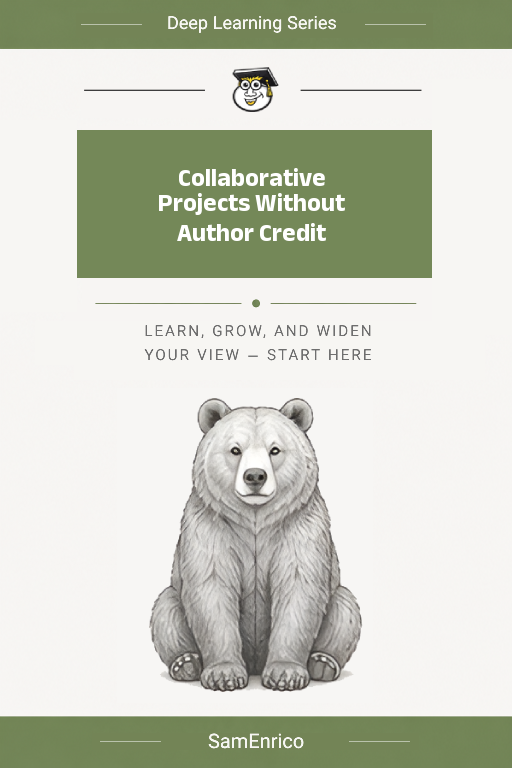
Collaborative Projects Without Author Credit eBook
Describe team science contributions that didn't yi
Describe team science contributions that didn't yield authorship but built essential research skills.
Formats
Free sample
Chapter 1: The Invisible Advantage--The first time I watched a colleague receive sole credit for work we had done together, I expected to feel rage. Instead, I felt confusion. The project had been my idea. I had recruited the team, designed the workflow, cleaned the messy data, and written the first draft of the report. My colleague had contributed one insight during a single meeting — a good insight, yes, but one hour against my two hundred hours.
When the final product was presented to our superiors, my name appeared nowhere. My colleague’s name appeared everywhere.I was twenty-four years old, three years into my research career, and I had just been erased. I spent that night cycling through the standard emotions: disbelief, anger, self-doubt, and finally a cold determination to never let it happen again. I resolved to fight harder for credit, to document every contribution in writing, to refuse collaborations that did not guarantee my name on the final product. I would become someone who got what I deserved.That resolution lasted exactly three months.
In those three months, I said no to five interesting projects because the credit terms were unclear. I spent more time negotiating authorship than doing science. I watched junior colleagues accept those same projects — the ones I had rejected — and watched them learn skills I desperately wanted: how to operate a new piece of equipment, how to analyze a novel data type, how to present findings to a room of skeptical peers. They had no credit on those projects. They had no bylines.
But they had competence. They had relationships. They had, when the next project rolled around, a reputation for being the person who could actually do things.I, meanwhile, had a pristine record of my grievances and nothing to show for them. I had protected my right to be acknowledged, and in doing so, I had locked myself out of the room where learning actually happens.This book is the result of the decade I spent unlearning that mistake. It is not a book about how to get credit.
It is a book about something far more useful: how to build elite research skills through collaborations that will never put your name on the final product. It is for the data cleaner, the protocol writer, the community liaison, the open-source contributor, the technician who keeps the instruments running, the senior trainee who mentors the juniors, and the consultant who solves one specific problem and then vanishes. It is for everyone who has ever done essential work and watched someone else take the bow.And it begins with a provocation that may sound like heresy: The current credit system is not broken, and your invisibility is not a problem to be solved.Let me explain what I mean.The Two Economies of Collaborative Work Every research collaboration operates simultaneously in two distinct economies. Understanding these two economies is the single most important intellectual move this book will ask you to make. If you grasp nothing else, grasp this.The first economy is the one everyone talks about.
Call it the Credibility Economy. In this economy, the currency is citations, publications, patents, presentations, and bylines. The Credibility Economy is zero-sum: when one person gets credit, another person does not. It is hierarchical: first author is worth more than second author, who is worth more than being in the acknowledgments. It is slow: a paper can take years from conception to publication, and the credit you receive today is for work you did long ago.
The Credibility Economy is what most researchers mean when they complain about "not getting credit." It is the economy of the CV, the tenure file, the grant application, and the job interview.The second economy is the one no one talks about. Call it the Skill Acquisition Economy. In this economy, the currency is not external validation but internal competence. The Skill Acquisition Economy is not zero-sum: when one person learns a skill, that does not prevent anyone else from learning it. It is non-hierarchical: the skill you learn from cleaning a dataset is just as valuable as the skill you learn from designing an experiment.
It is fast: you can learn something new in an afternoon, and you will possess that skill forever. The Skill Acquisition Economy is what happens when you stop worrying about who gets credit and start paying attention to what you are becoming.Here is the critical insight that changed my career: The Skill Acquisition Economy is not a consolation prize. It is the better economy.Consider two hypothetical early-career researchers. Researcher A spends two years as the fifth author on a high-profile paper. The paper is cited three hundred times.
Researcher A's CV looks impressive. But Researcher A contributed only one figure and never understood the full experiment. Two years later, Researcher A has a citation but no deep skill.Researcher B spends those same two years as an uncredited data steward for a large collaborative project. Researcher B cleans messy datasets, writes metadata for strangers, troubleshoots inconsistent entries, and builds a relational database from scratch. Researcher B receives no byline — only an acknowledgment at the end of the paper.
But at the end of two years, Researcher B has mastered data cleaning, learned SQL, developed an intuition for spotting errors, and built a reputation among five different PIs as someone who delivers flawless work. Researcher B has no citation but a portfolio of skills that are portable, demonstrable, and in high demand.Who is better positioned for the next five years of their career? The answer, in every labor market I have observed, is Researcher B. Citations impress hiring committees. Skills impress colleagues who will become your collaborators and champions.
And skills — unlike citations — cannot be taken from you.The Novelty Threshold: Separating Crucible Work from Labor Hoovers If the Skill Acquisition Economy is so powerful, why do so many researchers hate being invisible? Why does the complaint "I did all the work but got no credit" echo through every lab, every department, and every field?The answer is that not all invisible labor is created equal. Some invisible labor builds elite skills rapidly. Other invisible labor is merely exploitation. The difference is determined by a single variable: novelty.Let me introduce a concept that will structure the entire book: the Novelty Threshold.
Invisible labor builds skills when — and only when — the task is novel to you. A task is novel if it requires you to learn something new, solve a problem you have not solved before, or operate at the edge of your current competence. When you cross the Novelty Threshold, you are in what I call crucible work — difficult, challenging, sometimes uncomfortable labor that forces you to grow.When a task falls below the Novelty Threshold — meaning you have done it before, you could do it in your sleep, and you are learning nothing new — you are in a labor hoover. A labor hoover is a project that consumes your time and energy without increasing your capability. It is repetitive, predictable, and skill-neutral at best, skill-negative at worst (because it trains you to tolerate boredom).
Labor hoovers are the source of the resentment that drives the "no credit" complaint. They feel like theft because they…
This is the end of the free sample. Get the eBook to keep going. Buy now
About this book
Details
- Author
- Cornelius Zana
- Publisher
- SamEnrico
- Language
- English
- Genre
- Non-Fiction, Student's Shortcut
- Released
- 2026-06-01
- Pages (approx.)
- 144
- Available as
- eBook, Audiobook

Read better in the ZLOADR app
Your eBooks on your phone or tablet. Sign in with your SamEnrico account and start reading.
More by Cornelius Zana
 Reddit Idea Validation GuideCornelius Zana$11.99
 TM for Small Business OwnersCornelius Zana$11.99
 The Anxious Teen WorkbookCornelius Zana$11.99
 Competitive Program Stress GuideCornelius Zana$11.99
 HGH And ResveratrolCornelius Zana$11.99
 Fasting for LongevityCornelius Zana$11.99
 Talking to Kids About DeathCornelius Zana$11.99
 Strom Thurmond DixiecratCornelius Zana$11.99
 Cold Weather Football GritCornelius Zana$11.99
 The Serpent and the Storm: Vritra’s Last StandCornelius Zana$11.99
 The Last Voyage of the Great Lakes Freighter: A Storm That Changed EverythingCornelius Zana$11.99
 The Codebreakers' War: Bletchley Park vs. the Enigma of LoveCornelius Zana$11.99
You may also like
 LSE Online Program LengthAgee Letisha$11.99
 Harvard Extension School for Working AdultsRoush Yer$11.99
 LSE Online Reading ListAshford Ludivina$11.99
 LSE Online Language RequirementsWhitten Daphine$11.99
 LSE Online Class SizeHughey Garret$11.99
 LSE Online Alumni MentorshipWild Lyla$11.99
 London School of Economics Alumni NetworkDutton Chantal$11.99
 Harvard Extension School Student SupportCantrell Christene$11.99
 Harvard Extension School Library AccessSantana Adah$11.99
 Harvard Extension School Degree CompletionBray Wyatt$11.99
 Harvard Extension School Course AuditingAbbott Craig$11.99
 Harvard Extension School Extension DiplomaNew Joane$11.99