
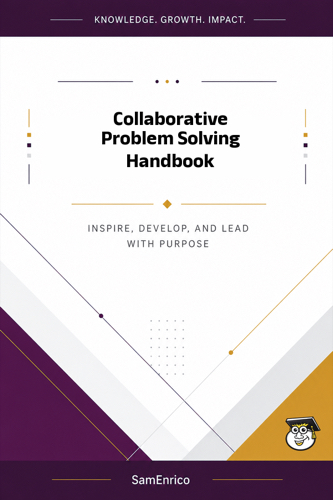
Collaborative Problem Solving Handbook eBook
Tackles complex challenges by pooling group intell
by Cross Lisa
Tackles complex challenges by pooling group intelligence and creative thinking.
Formats
Free sample
Chapter 1: The Collaboration Paradox--–- Every organization I have ever worked with claims to value collaboration. Mission statements celebrate it. Performance reviews reward it. Strategy offsites dedicate entire days to "breaking down silos" and "leveraging collective intelligence." And yet, when I walk into those same organizations six months later, I find the same problems festering, the same departments pointing fingers, and the same smart, well-intentioned people working at cross-purposes. The gap between our stated commitment to collaboration and our actual ability to practice it is not a small gap.
It is a chasm wide enough to swallow strategy after strategy, initiative after initiative, year after year.This is the Collaboration Paradox: the more complex and urgent the problem, the more we claim we need to work together—and the more likely we are to fail at actually doing so. We gather more people in more meetings, produce more slides and more documents, spend more hours debating and deliberating, and then walk away with solutions that please no one, address symptoms rather than causes, and collapse the moment they encounter real-world friction. The meetings feel productive. The whiteboards fill with promising ideas. But the outcomes remain stubbornly unchanged.This chapter is not another motivational argument for why collaboration is good.
You already know that. Instead, this chapter does three things that most books on collaboration never attempt. First, it gives you a precise, actionable framework for distinguishing when collaboration is genuinely necessary from when it is a costly distraction. Second, it names the three hidden costs of collaboration that almost no one talks about—costs that explain why so many collaborative efforts fail despite good intentions. Third, it introduces the Pooling Effect, the single most important concept in this entire handbook: the counterintuitive truth that groups, when structured correctly, can produce insights that no individual—not even the smartest person in the room—could have reached alone.If you read only one chapter of this book, make it this one.
Every tool, mindset, and process in the following pages rests on the foundation laid here. By the time you finish this chapter, you will know exactly when to collaborate, when to stop collaborating, and what makes collaboration worth the considerable effort it demands.The Cynefin Framework: Why Most Groups Collaborate on the Wrong Problems Let me begin with a confession. For the first ten years of my career, I facilitated collaborative problem-solving sessions for anyone who would pay me. I believed—truly, deeply believed—that bringing more perspectives to any problem was always better. More heads, more ideas, better outcomes.
It seemed so obvious. And I was wrong.The turning point came when a manufacturing client asked me to facilitate a two-day offsite for thirty people. The problem, they explained, was declining morale on the factory floor. They had tried surveys, town halls, and a generous bonus program, but nothing worked. So they assembled a cross-functional team—HR, operations, finance, senior leadership, and a half-dozen frontline workers—to "collaborate on a solution."We spent the first day generating ideas.
By noon, frustration was visible. The finance team kept asking for data that didn't exist. The frontline workers described problems that HR claimed were already solved. The senior leaders offered solutions that everyone else had tried years ago. By the end of the second day, we had produced a forty-seven-page action plan that no one believed would work.
Six months later, morale was worse than before.What went wrong? We had violated the first and most important rule of collaborative problem-solving: not every problem requires a group. In fact, most problems do not. The manufacturing client's problem was not complex; it was complicated. There were known best practices for improving factory morale—better shift scheduling, recognition programs, clearer career paths.
These solutions already existed in industry research. What the company needed was a specialist (an organizational psychologist or an experienced operations leader) to diagnose which of those known solutions fit their specific context. Instead, they had assembled thirty people to reinvent a wheel that had already been invented.This is where the Cynefin framework (pronounced kuh-NEV-in) becomes indispensable. Developed by decision theorist Dave Snowden, Cynefin provides a deceptively simple map for understanding what kind of problem you are facing—and therefore what kind of response is appropriate. The framework divides problems into five domains, though this chapter focuses on the four most relevant to collaborative work.Simple Problems: The Domain of Best Practices Simple problems are those where cause and effect are obvious to anyone with basic competence.
If you do X, Y happens reliably. There is a recipe, a checklist, or a rule that works every time. Changing a tire. Processing a reimbursement form. Restocking inventory according to par levels.
These problems require no analysis, no debate, and certainly no cross-functional offsite. They require action by a competent individual following a known procedure.Collaboration on simple problems is not just inefficient; it is actively harmful. Every minute that five people spend discussing how to restock inventory is a minute they are not doing the hundreds of other tasks that require their judgment. Worse, collaboration invites overcomplication. I have watched teams turn a simple problem into a complex mess simply by adding too many voices to a decision that one person could have made in thirty seconds.Complicated Problems: The Domain of Experts Complicated problems are where most organizations mistakenly reach for collaboration.
In this domain, cause and effect exist, but they are not obvious to everyone. Multiple possible solutions may work. Diagnosing the right solution requires expertise, analysis, and sometimes trial and error. Fixing a broken engine. Diagnosing a rare disease.
Optimizing a supply chain for cost.Note what is missing from this list: the need for diverse perspectives. Complicated problems require the right expert, not a room full of generalists. The manufacturing morale problem I described earlier was complicated, not complex. There were known solutions; the company simply lacked the expertise to choose among them. What they needed was a specialist who had solved similar problems before—not thirty people with opinions.The key insight here is painful but necessary: most of the problems that organizations currently tackle with large, time-consuming collaborative processes are actually complicated problems that would be better solved by one skilled expert or a small specialist team.
We collaborate because it feels democratic and inclusive. We collaborate because we are afraid of missing something. But collaboration on a complicated problem is like using a sledgehammer to perform eye surgery. The tool does not fit the task.Complex Problems: The Domain of Collaboration Now we arrive at the small set of problems that genuinely require collaborative problem-solving. Complex problems have five defining characteristics.First, cause and effect are only visible in retrospect.
You cannot predict what will happen when you take an action because the system is too dynamic and nonlinear. Second, the problem has no stable or definitive formulation. The way you define the problem changes as you learn more about it. Third, every attempted solution changes the problem itself, often in unpredictable ways. Fourth, the problem involves multiple stakeholders with legitimate but conflicting perspectives.
Fifth, there is no single "right" answer, only better or worse ones that emerge over time.Examples include: reducing childhood obesity…
This is the end of the free sample. Get the eBook to keep going. Buy now
About this book
Details
- Author
- Cross Lisa
- Publisher
- SamEnrico
- Language
- English
- Genre
- Non-Fiction, Self-Help, Problem Solving
- Released
- 2026-06-09
- Pages (approx.)
- 136
- Available as
- eBook, Audiobook

Read better in the ZLOADR app
Your eBooks on your phone or tablet. Sign in with your SamEnrico account and start reading.
More by Cross Lisa
 Switzerland Building Energy GuideCross Lisa$11.99
 Cold Email Validation MethodCross Lisa$12.99
 Video Game Addiction HandbookCross Lisa$11.99
 Plant Based Weight LossCross Lisa$11.99
 Workplace Stress Reduction for People PleasersCross Lisa$11.99
 The Frozen Odyssey: The Secret Antarctic Crossing of the 16th CenturyCross Lisa$11.99
 Zero Day: The Untold Story of the Stuxnet VirusCross Lisa$11.99Cold Email Validation MethodCross Lisa$12.99
 Founder Identity Separation GuideCross Lisa$12.99
 Understanding Chromosome 4, Monosomy 4p14 P16Cross Lisa$17.99
 Mobile QA EngineerCross Lisa$11.99
 How to Start a Motor Home Manufacturing BusinessCross Lisa$11.99
You may also like
 Define Problem Statement WorkshopNichols Curtis$11.99
 The Interruption MVP MethodLyon Camellia$11.99
 Pain Point Innovation GuideHagan Davina$11.99
 The Struggle Is Data GuideBattle Kirby$11.99
 Problem Solving DBT WorkbookCriswell Violette$11.99
 Problem Solving VisualizationWeeks Jamar$11.99
 Problem Solving for EmotionsCollado Zelda$11.99
 Problem Framing WorkshopDancy Rosario$11.99
 Group Creative Problem Solving HandbookOliveira Mardell$11.99
 Problem Solving DreamsSchmid Ray$11.99
 Collaborative Problem SolvingGilson Dara$11.99
 TM Obstacle TroubleshootingRubio Carly$11.99