
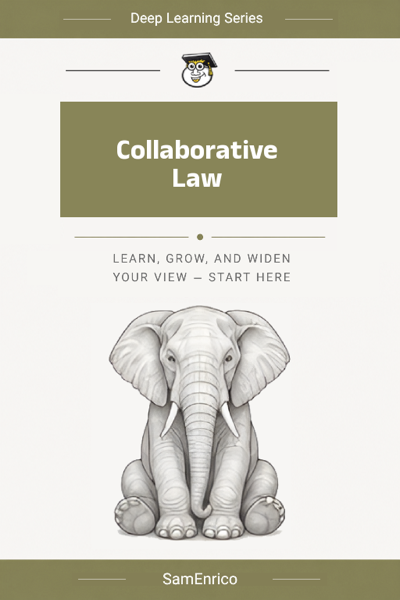
Non-FictionInformativeEducational
Collaborative Law eBook
A Coursebook on Collaborative Law
A Coursebook on Collaborative Law
Formats
Free sample
Chapter 1: The Hundred-Thousand-Dollar Handshake--–- The first time I watched a couple destroy their family savings on litigation, I was a second-year associate tasked with organizing 4,000 pages of discovery exhibits. The case was unremarkable: a 12-year marriage, two children, a house, two 401(k)s, and a dispute over who would keep the timeshare in Florida. Fourteen months later, the couple had burned through $187,000 in legal fees. The wife had liquidated her retirement account to pay her lawyer. The husband had borrowed $40,000 from his elderly father.
The children had stopped speaking to both parents. And the final settlement? It was within 3 percent of what the husband had offered on day one.–- The senior partner called this a "successful result." I called it something else. That week, I quietly began researching alternatives to litigation. What I found would change the entire trajectory of my career.
I found Collaborative Law.The Crisis You Didn't Know You Were In–- If you are reading this book, you are likely one of three people: a lawyer who has watched clients bleed out on the litigation battlefield, a person contemplating a divorce or business breakup who is terrified of the cost, or a professional (therapist, financial advisor, mediator) who has seen the wreckage of adversarial processes and wonders if there is a better way. For all three of you, the answer is yes, and the answer is urgent.–- Let us begin with a truth that the legal industry prefers not to advertise: the traditional litigation system is failing the vast majority of its customers. Not failing in the sense of occasional bad outcomes. Failing systemically, predictably, and tragically. Consider the data.
The average contested divorce in the United States now costs between $30,000 and $100,000 per party, according to the American Academy of Matrimonial Lawyers. The average civil lawsuit takes 18 to 24 months from filing to trial. During that time, parties experience rates of clinical depression that are four times higher than the general population. Children of high-conflict litigants show elevated cortisol levels measurable years after the case concludes.–- But the numbers, as stark as they are, miss the human story. Every litigator has seen the same scene play out hundreds of times: two people who once loved each other, or trusted each other as business partners, sitting in a fluorescent-lit conference room, unable to look at one another, their files overflowing with venomous letters, their children refusing to speak, their retirement accounts gutted.
And for what? For a judge who will spend maybe two hours on their entire case to issue an order that neither party really wanted.–- This is not justice. It is a processing plant for human misery.The Four Promises That Change Everything–- Collaborative Law emerged from a simple, radical insight: what if we stopped pretending that lawyers are warriors and started training them as problem-solvers? In 1990, Minnesota family lawyer Stuart Webb coined the term "collaborative law" and developed the first model. His innovation was not a new legal doctrine or a clever procedural trick.
It was a set of four promises that parties and their lawyers make to each other, in writing, before any work begins. These promises are the "Four Corners" of the Collaborative Law model. They are non-negotiable. They are the entire engine of the process.–- Promise One: Good Faith. Every party agrees to negotiate honestly, respectfully, and with a genuine intention to reach an agreement.
This is not the "good faith" of litigation, which essentially means not committing outright fraud. This is active good faith: showing up prepared, disclosing information voluntarily, listening to the other side, and engaging in creative problem-solving. If a party is simply going through the motions while planning to litigate, they have violated this promise.–- Promise Two: Full Transparency. In litigation, discovery is a game of hide-and-seek. You request documents.
The other side objects. You file a motion to compel. The judge schedules a hearing six weeks out. Eventually, you get some of what you asked for, redacted and months late. In Collaborative Law, transparency is mandatory and immediate.
Both parties sign an agreement to produce all relevant documents, answer all reasonable questions, and disclose all material information without being asked. There are no surprises. There is no hiding. The financial neutral (a role we will explore in depth later) helps both parties lay everything on the table from day one.–- Promise Three: No Court. While the collaborative process is ongoing, neither party may file any motion, petition, or other court action related to the dispute.
No temporary restraining orders. No discovery motions. No requests for emergency hearings. The parties have agreed to resolve their differences at a round table, not in a courtroom. This promise creates psychological safety: you cannot use the collaborative process to gather ammunition for a later litigation ambush.–- Promise Four: The Disqualification Clause.
This is the engine that makes the whole machine run. If any party withdraws from the collaborative process, or if any party files a court action, or if any party is found to have concealed material information—then all collaborative lawyers are immediately disqualified from representing any party in subsequent litigation. They cannot switch gears and become trial lawyers. They are out. This means that the lawyers have no financial incentive to drag out the process or steer it toward court.
Their only path to getting paid is to help the parties reach a settlement. And the parties know that if they blow up the process, they will have to start over with new lawyers, at enormous additional cost.–- Together, these four promises create what practitioners call the "collaborative container." Inside this container, something remarkable becomes possible: honest conversation, creative problem-solving, and the preservation of relationships that litigation would have destroyed.What Collaborative Law Is Not (Clearing Up Confusion)–- Before we go further, we need to clear up three common confusions. Collaborative Law is often mistaken for other dispute resolution processes, and understanding the differences is essential.–- Collaborative Law vs. Mediation. In mediation, a neutral third party facilitates negotiations but has no power to decide anything.
The parties may have their own lawyers, but those lawyers typically are not in the room. Importantly, mediation can happen alongside litigation; many courts order mediation while a case is pending. In Collaborative Law, the lawyers are in the room, actively representing their clients, and the process is exclusive—no litigation is pending. Mediation is often a one-day event; Collaborative Law is a structured process lasting several months. Both are valuable, but they are not the same.–- Collaborative Law vs.
Cooperative Law. Cooperative law is a less formal model where lawyers agree to be civil and cooperative but do not sign a disqualification agreement. If cooperation fails, the same lawyers can take the case to court. This sounds reasonable, but practitioners have found that without the "sword of Damocles" (the disqualification clause), parties have little incentive to stay at the table when negotiations get hard. Cooperative law works for low-conflict cases where the parties already get along.
Collaborative Law works for everyone else.–- Collaborative Law vs. Arbitration. In arbitration, the parties hire a private judge who hears evidence and issues…
This is the end of the free sample. Get the eBook to keep going. Buy now
About this book
Details
- Author
- Banda Jenelle
- Publisher
- SamEnrico
- Language
- English
- Genre
- Non-Fiction, Informative, Educational
- Released
- 2026-06-02
- Pages (approx.)
- 159
- Available as
- eBook, Audiobook

Read better in the ZLOADR app
Your eBooks on your phone or tablet. Sign in with your SamEnrico account and start reading.
More by Banda Jenelle
 Emergency Department NaloxoneBanda Jenelle$11.99
 Content Batching for SuccessBanda Jenelle$11.99
 Telecom Sector Breach ReportBanda Jenelle$11.99
 The Early Career Self EsteemBanda Jenelle$11.99
 Punu White Mask LoreBanda Jenelle$11.99
 The Voice That Shaped a Nation: George Augustus Sala and the Birth of Modern JournalismBanda Jenelle$11.99
 How to Become a Optical-glass EtcherBanda Jenelle$11.99
 GA4 Real Time Report GuideBanda Jenelle$12.99
 Car Rental GuideBanda Jenelle$12.99
 Understanding Powell–venencie–gordon SyndromeBanda Jenelle$17.99
You may also like
 Hong Kong Handover 1997Dunn Johnnie$11.99
 Zumba For Postnatal Recovery CourseNeal Christian$11.99
 Zumba for BeginnersLadner Nikia$11.99
 YouTube Comment Mining GuideHumes Pandora$12.99
 Worry Box MeditationCarlin Rudy$11.99
 Workplace Stress MeditationNguyen Lynn$11.99
 Workplace Stress and Sleep RepairHawley Ivory$11.99
 Workplace Perfectionism CureDelaney Jeffry$11.99
 Workplace Injustice Anger GuideWallen Isabelle$11.99
 Work Addiction and Burnout LinkGreenwood Ester$11.99
 Women in Yoga and WellnessBeattie Galina$11.99
 Women in Stand Up ComedyChun Evangeline$11.99