
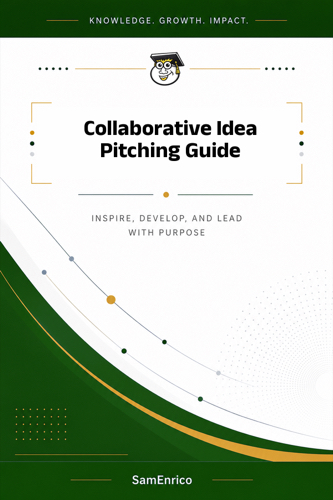
Collaborative Idea Pitching Guide eBook
Teaches teams to sell their creative concepts to s
by Land Joan
Teaches teams to sell their creative concepts to stakeholders effectively.
Formats
Free sample
Chapter 1: The Pitch Trap--–- Every failed pitch begins the same way: with a team that believes in its idea. They gather in a conference room, armed with forty-three slides, three months of data, and the quiet certainty that this time will be different. They have rehearsed the opening. They have memorized the ROI projections. They have anticipated the obvious objections.
And then they walk into the stakeholder’s office, deliver their perfectly polished presentation, and receive a polite, confused, or frustrated “no.” The team walks out bewildered. “But the data was solid,” they say. “We answered every question,” they insist. “They just didn’t get it,” they conclude.The stakeholders, meanwhile, walk away with a completely different interpretation. They think the team was defensive.
They think the idea was half-baked. They think, often correctly, that the team fell in love with their solution before understanding the real problem. This mismatch of perceptions is not a failure of creativity or intelligence. It is a failure of structure. And it happens so reliably that it might as well be a law of organizational physics.This chapter introduces that law, names the hidden trap that destroys most creative pitches, and presents the alternative framework—the Pitch Loop—that turns adversaries into co-creators.
By the end of this chapter, you will understand why your best ideas keep getting rejected and, more importantly, what to do about it before you build another slide.The Anatomy of a Standard Pitch (And Why It’s Designed to Fail)Let us walk through a typical internal pitch. A product team has spent six weeks developing a new feature. They have user research, competitive analysis, and a prototype. They book thirty minutes with a decision maker—a director, a VP, or a committee. The day arrives.
The team projects their first slide: a beautiful title page with the feature name and the team’s logo. They spend the first two minutes on context, the next ten on the solution, the next twelve on benefits and ROI, and the final six on next steps. They leave five minutes for questions.On the surface, this seems reasonable. But beneath the surface, a destructive dynamic is unfolding. The team is in presentation mode: they have a fixed narrative, a predetermined outcome, and a deep emotional investment in being right.
The stakeholder, sensing this, shifts into evaluation mode: they are looking for flaws, inconsistencies, and reasons to say no. The interaction becomes adversarial not because anyone is malicious but because the structure forces it.There are four structural flaws embedded in the standard pitch format. First, the information asymmetry flaw: the team has spent weeks thinking about the idea; the stakeholder is hearing it for the first time. No amount of slide design can bridge that gap. Second, the defensive posture flaw: once a team has built slides, they are psychologically committed to the idea.
Changing direction feels like admitting failure, so they defend rather than adapt. Third, the binary outcome flaw: the stakeholder is forced to say yes or no to a fully formed proposal, which makes no feel safer than yes. Fourth, the post-me amnesia flaw: without a structured artifact, the conversation evaporates within hours, leaving only vague impressions and unresolved questions.These flaws are not random. They are the predictable result of treating a collaborative decision as a theatrical performance. The standard pitch is a monologue disguised as a conversation.
And monologues do not persuade; they provoke resistance.The Hidden Cost of Monologue Pitching Consider what the standard pitch costs organizations beyond the immediate rejection. When a team pours weeks into a pitch that fails, the direct labor cost is obvious: salaries, meeting time, opportunity cost. But the hidden costs are far larger. Teams that experience repeated pitch failures stop proposing creative ideas altogether. They learn, through painful reinforcement, that safe ideas get approved and risky ideas get killed.
This is not cynicism; it is rational adaptation to a broken system.Over time, this dynamic produces what organizational psychologists call pitch aversion: a cultural reflex where teams self-censor before they even begin. They run ideas through an internal filter that asks not “Is this valuable?” but “Will this survive the pitch?” The filter favors incremental improvements over breakthrough concepts, familiar approaches over novel ones, and safe bets over intelligent risks. The organization does not just lose individual ideas; it loses the muscle of creativity itself.The data on this phenomenon is striking. In a study of 447 internal pitches across seven companies, researchers found that teams who used the traditional presentation format succeeded only 28 percent of the time. But more tellingly, those same teams reported a 63 percent drop in the number of creative proposals they generated after three consecutive rejections.
The pitch process did not just kill ideas; it killed the willingness to generate them.Introducing the Pitch Loop: A Four-Phase Alternative The antidote to the pitch trap is not better slides, louder delivery, or more data. It is a fundamental restructuring of how teams engage stakeholders before, during, and after the pitch. This restructuring is called the Pitch Loop, and it consists of four phases: Listen, Ideate, Align, and Advance.Unlike the linear, one-way flow of a standard presentation, the Pitch Loop is circular and iterative. You do not begin with slides. You do not begin with a solution.
You begin with listening—deep, structured, pre-commitment listening that reveals what stakeholders actually need, fear, and want. Only then do you ideate, but not in isolation. You ideate with stakeholders as co-creators. Then you align on a shared definition of success. Finally, you advance only the ideas that have survived this collaborative filter.The Loop is called a loop because it does not end with the pitch.
After you advance, you return to listening. Each pitch, whether it succeeds or fails, feeds back into the next cycle. Teams that adopt the Pitch Loop do not just improve their success rate; they fundamentally change their relationship with stakeholders. They become partners rather than petitioners.Phase One: Listen (The Pre-Pitch That Changes Everything)The Listen phase is the most counterintuitive part of the Pitch Loop because it happens before any pitching occurs. Most teams interpret “preparation” as building slides.
The Pitch Loop interprets preparation as building understanding. And understanding comes from structured conversations with stakeholders—not formal meetings with agendas, but low-stakes, curious, one-on-one interviews.The goal of the Listen phase is to answer five specific questions about each key stakeholder. First, what problem do they believe is most urgent right now? This is not your problem statement; it is theirs. Second, what past initiatives have failed in this area, and why?
Past failures create invisible landmines. If you do not know about them, you will step on them. Third, what metrics or outcomes are they personally measured on? Stakeholders care about what their bosses care about. If your idea does not connect to their incentives, it will not survive.
Fourth, what constraints (budget, headcount, timeline, political) are non-negotiable? Fifth, what would make them say no immediately, regardless of the idea’s quality?The fifth question is the most valuable and the most rarely asked. When you ask a stakeholder “What would make you…
This is the end of the free sample. Get the eBook to keep going. Buy now
About this book
Details
- Author
- Land Joan
- Publisher
- SamEnrico
- Language
- English
- Genre
- Non-Fiction, Self-Help, Persuasion
- Released
- 2026-06-11
- Pages (approx.)
- 139
- Available as
- eBook, Audiobook

Read better in the ZLOADR app
Your eBooks on your phone or tablet. Sign in with your SamEnrico account and start reading.
More by Land Joan
 Massage For Multiple SclerosisLand Joan$11.99
 OKR For Breaking Bad HabitsLand Joan$11.99
 Acupuncture for Neurological HealthLand Joan$11.99
 MMA Fighter Hypnosis CourseLand Joan$11.99
 Self Hypnosis for Perfectionism AnxietyLand Joan$11.99
 Student Meal Prep DubaiLand Joan$11.99
 The Senior Gratitude PracticeLand Joan$11.99
 The Battle of Yique: Ying Zheng's Path to TyrannyLand Joan$11.99
 The Labors of Atalanta: The Hunt for ImmortalityLand Joan$11.99
 A Collector's Handbook to the Volvo 1800esLand Joan$11.99
 How to Produce Pickled Fruits and VegetablesLand Joan$11.99
 10 Ways to Use Asparagus (Recipe Book)Land Joan$11.99
You may also like
 Persuasive Speaking GuideBarlow Emmie$11.99
 The Broken Record Technique GuideKozlowski Cleora$11.99
 Group Creative Pitching Techniques CourseMurray Faye$11.99
 The Persuasive PresentationGeary Kimberli$11.99
 Assertive Requests That Get ResultsRutledge Minh$11.99
 Remote Persuasion GuideBranham Karlyn$11.99
 Closing With Impact GuideBest Debroah$11.99
 Closing With Call To ActionFarrington Kelsey$11.99
 Broken Record AssertivenessHeld Jayson$11.99
 Persuasion Psychology HandbookClick Staci$11.99