
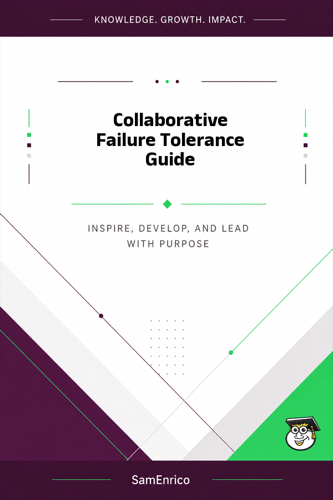
Non-FictionSelf-HelpFailure Tolerance
Collaborative Failure Tolerance Guide eBook
Creates safety for creative risks.
by Handy Stasia
Creates safety for creative risks.
Formats
Free sample
Chapter 1: The Anxiety Paradox--–- The meeting had been going for forty-three minutes when Sarah, a senior product manager with twelve years of experience, felt her stomach tighten. Her team was discussing a new feature that everyone knew—everyone felt—was headed for disaster. The data didn't support it. The user tests had been lukewarm. And yet, one by one, each person around the table had nodded along, offered polite suggestions for improvement, and avoided the obvious truth.Sarah knew what she should say.
She should say, "This feature is going to fail, and we all know it." She should say, "We're wasting six weeks of engineering time on a bet we've already lost." She should say what every person in that room was thinking but could not utter.She said nothing.The meeting ended. The feature was built. It launched to terrible reviews, cost the company nearly two hundred thousand dollars in wasted engineering hours, and damaged the team's credibility with leadership. In the post-mortem, everyone agreed: they had seen it coming. No one had spoken up.This is not a story about cowardice.
It is a story about biology.The Neuroscience of Silence Sarah was not weak. She was not unskilled. She was responding exactly as her brain had evolved to respond—to a threat that felt, in that moment, more urgent than the financial cost of failure. The threat was not physical. No one was going to fire her on the spot.
No one was going to yell. The threat was social: the risk of looking stupid, of being the one who broke consensus, of being labeled "difficult" or "negative" or "not a team player."In the calculus of the human brain, social rejection is processed with the same neural intensity as physical pain. Studies using functional magnetic resonance imaging (f MRI) have demonstrated that the same regions of the brain that activate when you experience physical pain—the dorsal anterior cingulate cortex and the anterior insula—also activate when you are excluded from a group, criticized in front of peers, or made to feel ignorant. Your brain literally cannot tell the difference between a punch and a public correction.Let that land for a moment. The same neural circuitry that evolved to keep you from touching a hot stove is the circuitry that activates when your boss sighs at your suggestion.
When you stay silent in a meeting, you are not being weak. You are being smart—at least, your brain thinks so. It has run a rapid, unconscious calculation: Will speaking up increase or decrease my standing in this group? If the answer is "decrease," your brain floods your system with stress hormones. Your heart rate increases.
Your palms sweat. Your attention narrows. And your vocal cords receive a signal to remain still.This is the Anxiety Paradox: the harder you try to create psychological safety, the more you may actually activate the very fears you are trying to eliminate.The Anxiety Paradox Defined The Anxiety Paradox is a simple but devastating insight: when a leader says, "It's safe to speak up," many people hear something very different. They hear, "This is a trap where I might reveal my ignorance." They hear, "The person in power is about to judge me." They hear, "If I speak and something goes wrong, I will be blamed."Why does this happen? Because declaring safety does not create safety.
Safety is not a statement; it is an experience. And experience is built slowly, over time, through repeated interactions that either confirm or contradict the leader's words.Most leaders make a critical error: they confuse declared safety with experienced safety. Declared safety is what the leader says: "No wrong answers," "I have an open door policy," "We welcome dissent." Experienced safety is what team members feel: the knot in their stomach before speaking up, the memory of the last time someone disagreed and was dismissed, the unspoken rule that "challenging authority" is career-limiting.The gap between declared and experienced safety is where innovation goes to die.Consider the data. Amy Edmondson's research on psychological safety across hundreds of teams found that the single strongest predictor of team learning and performance was not intelligence, not resources, not even leadership skill. It was the team's shared belief that they could take interpersonal risks without fear of punishment.
In teams with high psychological safety, members spoke up early about problems, admitted mistakes freely, and asked for help when they needed it. In teams with low psychological safety, members hid errors, delayed sharing bad news, and engaged in what Edmondson calls "strategic ignorance"—the deliberate choice not to look for problems so that they wouldn't have to report them.The cost of low psychological safety is staggering. A single undiscussed problem can snowball into a catastrophic failure. A single silenced voice can mean the difference between catching an error early and discovering it after it has cost millions.The Two Kinds of Safety To understand the Anxiety Paradox, we must first understand a critical distinction: not all safety is the same.Physical and Job Safety are what most people think of when they hear the word "safety." Physical safety means you will not be physically harmed. Job safety means you will not be fired arbitrarily.
These are low-risk forms of safety because the outcomes are predictable. You know what it means to have a guardrail on a ladder. You know what it means to have a contract that protects your employment. These forms of safety are necessary but not sufficient for innovation.Psychological Safety is something entirely different. Psychological safety is the belief that you can take an interpersonal risk—asking a question, admitting a mistake, proposing a wild idea, disagreeing with a superior—without suffering a social penalty.
Unlike physical safety, the outcomes of psychological safety are inherently unpredictable. You cannot know in advance how your idea will land. You cannot guarantee that your admission of ignorance will be met with curiosity rather than contempt.This unpredictability is what makes psychological safety high-risk. And it is why declaring safety is so ineffective. You cannot declare away unpredictability.
You can only build trust through repeated, consistent experiences of safety.Here is the paradox in its full form: leaders who are most eager to create psychological safety often try the hardest to declare it. They say things like "This is a safe space" and "All ideas are welcome" and "I want to hear your honest feedback." And because they have declared safety, they assume it exists. When team members remain silent, these leaders become frustrated. They blame the team for lacking courage. They double down on their declarations.
And the gap between declared and experienced safety widens further.The team, meanwhile, learns a different lesson: The leader doesn't actually want to hear what we think. The leader wants us to pretend we agree while doing what we were going to do anyway.The Biology of Blame Why is psychological safety so fragile? The answer lies in a phenomenon called negativity bias.The human brain is wired to weight negative events more heavily than positive ones. This made excellent sense on the savanna: missing a potential meal was unfortunate…
This is the end of the free sample. Get the eBook to keep going. Buy now
About this book
Details
- Author
- Handy Stasia
- Publisher
- SamEnrico
- Language
- English
- Genre
- Non-Fiction, Self-Help, Failure Tolerance
- Released
- 2026-06-09
- Pages (approx.)
- 121
- Available as
- eBook, Audiobook

Read better in the ZLOADR app
Your eBooks on your phone or tablet. Sign in with your SamEnrico account and start reading.
More by Handy Stasia
 NVC for Human ResourcesHandy Stasia$11.99
 The Gentle Parenting Anger GuideHandy Stasia$11.99
 Persuasive Cold Email SequenceHandy Stasia$11.99
 Food Addiction CBT GuideHandy Stasia$11.99
 Digital Minimalism PlanHandy Stasia$11.99
 Melanoma Survivor MemoirHandy Stasia$11.99
 Blue Zone Spirituality PracticeHandy Stasia$11.99
 The Quantum Frontier: Canada’s Race to the AtomHandy Stasia$11.99
 Macaulay Culkin AloneHandy Stasia$11.99
 The Navigators of the Indian Ocean: The Swahili Mariners Who Conquered the SeasHandy Stasia$11.99
 Fizzle in the Sky: The $327 Million SpaceX Rocket That Never FlewHandy Stasia$11.99
 Growing Koeleria (Junegrass)Handy Stasia$11.99
You may also like
 Hong Kong Handover 1997Dunn Johnnie$11.99
 Zumba For Postnatal Recovery CourseNeal Christian$11.99
 Zumba for BeginnersLadner Nikia$11.99
 YouTube Comment Mining GuideHumes Pandora$12.99
 Worry Box MeditationCarlin Rudy$11.99
 Workplace Stress MeditationNguyen Lynn$11.99
 Workplace Stress and Sleep RepairHawley Ivory$11.99
 Workplace Perfectionism CureDelaney Jeffry$11.99
 Workplace Injustice Anger GuideWallen Isabelle$11.99
 Work Addiction and Burnout LinkGreenwood Ester$11.99
 Women in Yoga and WellnessBeattie Galina$11.99
 Women in Stand Up ComedyChun Evangeline$11.99