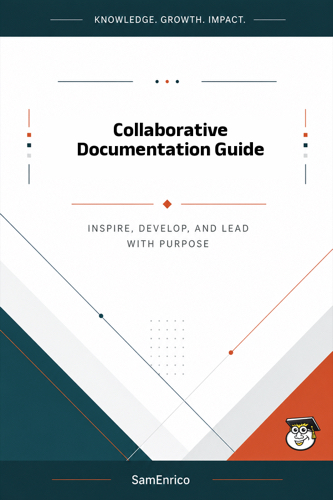
Collaborative Documentation Guide eBook
Captures group creativity in shared knowledge base
Captures group creativity in shared knowledge bases.
Formats
Free sample
Chapter 1: The Scaffolding Lie--–- Every organization believes it rewards collaboration. Every organization is wrong. The typical team celebrates the loudest voice in the room, promotes the person who “owns” the final presentation, and builds elaborate performance reviews around individual output. Yet when you ask that same team where they store their collective knowledge, you get a shrug, a shared drive full of orphaned files, or—worst of all—a whispered confession: “We just use Slack.”This is the great contradiction of modern knowledge work. We have accepted that no single person can hold all the answers, that breakthroughs come from cross-functional dialogue, that the lone genius is a myth.
We have built open offices, invested in collaboration software, and renamed departments “centers of excellence.” And then we have watched as brilliant ideas vanish into the air at the end of every meeting, as the same arguments recur six months later with no memory of the previous resolution, as new hires spend weeks reverse-engineering decisions that were already made.The problem is not a lack of will. The problem is a failure of architecture.This chapter dismantles one of Western culture’s most persistent and damaging myths: that breakthrough ideas emerge from solitary geniuses working in isolation. It traces the true history of innovation—from the invention of the computer to the birth of aviation to the creation of the internet—to prove that every major leap came from networks of people sharing notes, arguing over designs, and building on each other’s half-finished thoughts. More importantly, this chapter exposes the lie that documentation is merely administrative. It argues that documentation is not the boring aftermath of creativity; it is the scaffolding that makes creativity possible in the first place.
Without a shared record, teams do not innovate. They spin.By the end of this chapter, you will never again say “I’ll remember that” or “we should write that down later” without hearing an alarm bell in your head. You will understand that your shared knowledge base is not a library—a passive collection of finished artifacts—but a collaboration engine: an active, breathing system that accelerates group thinking and prevents the slow decay of organizational memory.The Myth We All Believe Let us start with a simple experiment. Think of the most creative person you have ever worked with. Picture them.
Now answer this question: did they produce their best work alone?If you are like most people, you just pictured someone in a moment of solitary focus—a writer staring at a screen, a designer hunched over a sketchbook, an engineer deep in code. We have been trained by movies, biographies, and cultural folklore to equate creativity with isolation. The garret apartment. The late-night epiphany. The solitary genius who emerges from the cave with the finished masterpiece.This image is almost entirely fiction.Consider the invention of the airplane.
The Wright brothers are celebrated as two lone geniuses tinkering in a bicycle shop. But their success came from an extraordinary network of correspondence. They wrote hundreds of letters to Octave Chanute, a French-born engineer who shared his own failed experiments without ego. They studied the work of Otto Lilienthal, a German glider pioneer who died in a crash and whose notebooks they devoured. They corresponded with weather bureaus, engine manufacturers, and other aviation hobbyists around the world.
The Wright brothers did not invent the airplane in isolation. They synthesized a global conversation.Consider the invention of the computer. Walter Isaacson’s The Innovators traces a lineage that includes Ada Lovelace, who corresponded with Charles Babbage about his Analytical Engine and envisioned its potential for more than pure calculation—a leap that Babbage himself missed. It includes Alan Turing, who built on the mathematics of Alonzo Church and David Hilbert. It includes the engineers at Bell Labs, who worked in teams so famously collaborative that they shared office space, lunch tables, and a running poker game.
The computer was not born in a garage. It was born in a network.Consider the internet itself. The ARPANET, the precursor to the internet, was a government-funded project that connected researchers at UCLA, Stanford, UC Santa Barbara, and the University of Utah. The key protocols—TCP/IP—were developed by Vint Cerf and Bob Kahn, who worked separately but communicated constantly, sharing drafts, critiques, and revisions. Tim Berners-Lee invented the World Wide Web while at CERN, a laboratory designed explicitly for international collaboration.
The web was not a solo act. It was a chorus.The pattern is undeniable. From the double helix of DNA (Watson and Crick, building on Rosalind Franklin’s X-ray images) to the structure of the modern automobile (thousands of engineers iterating on each other’s designs) to the software running on your phone (open-source libraries maintained by global volunteers), every significant innovation of the last two centuries emerged from networked minds.Yet we continue to structure our organizations as if the opposite were true. We reward individual performance. We evaluate people on their personal output.
We build knowledge bases that are personal hard drives, not shared ecosystems. And then we wonder why the same conversations happen over and over, why institutional memory evaporates when someone leaves, why teams that should be accelerating instead tread water.The lie is not that individual talent doesn’t matter. It does. The lie is that individual talent is sufficient. It is not.
And the physical trace of that insufficiency is the documentation that never gets written, the shared notes that never get created, the knowledge base that never gets built.Documentation as Scaffolding, Not Chore Why do we resist documentation? The answer is not laziness. It is misclassification.Most people think of documentation as administrative overhead—a necessary evil, an after-the-fact record that exists to satisfy auditors or managers. This framing is catastrophic. If documentation is overhead, it will always be deprioritized.
When a deadline approaches, documentation is the first thing cut. When a meeting runs long, the notes are the first thing skipped. When a project ends, the post-mortem is the first thing forgotten.This book proposes a different metaphor: documentation is scaffolding.Imagine constructing a building without scaffolding. Workers would have no platform to stand on. Materials could not be lifted to higher floors.
Bricklayers could not see the work of electricians, who could not see the work of plumbers. The building would collapse before it reached the second story. Scaffolding is not the building. It is not beautiful. It is not the final product.
But without it, the final product is impossible.Documentation works exactly the same way. A shared knowledge base is the scaffolding that allows ideas to build on previous ideas without collapsing. When you document a decision, you are not creating a boring record. You are creating a platform for the next decision. When you capture a failed experiment, you are not wasting time.
You are preventing the next team from repeating that failure. When you link a customer insight to a technical limitation, you are not doing busywork. You are creating a bridge that someone will cross six months later to build something new.This metaphor changes everything. Scaffolding is not optional. It is not…
This is the end of the free sample. Get the eBook to keep going. Buy now
About this book
Details
- Author
- Ortega Guadalupe
- Publisher
- SamEnrico
- Language
- English
- Genre
- Non-Fiction, Self-Help, Knowledge Management
- Released
- 2026-06-09
- Pages (approx.)
- 145
- Available as
- eBook, Audiobook

Read better in the ZLOADR app
Your eBooks on your phone or tablet. Sign in with your SamEnrico account and start reading.
More by Ortega Guadalupe
 NVC for StepfamiliesOrtega Guadalupe$11.99
 Migraine Supplement GuideOrtega Guadalupe$11.99
 Night Binge Eating GuideOrtega Guadalupe$11.99
 Chat Interruption ControlOrtega Guadalupe$11.99
 Stress and Menstrual DisordersOrtega Guadalupe$11.99
 Duolingo Language InfluencerOrtega Guadalupe$11.99
 School Age Nap Needs GuideOrtega Guadalupe$11.99
 Blue Zone Friendship QualityOrtega Guadalupe$11.99
 The Vanishing of Flight 1956: The Pilot Who Disappeared Mid-AirOrtega Guadalupe$11.99
 The Marble Masters: Carving the Soul of Renaissance FlorenceOrtega Guadalupe$11.99
 Botticelli’s Venus: Birth of the Renaissance IdealOrtega Guadalupe$11.99
 How to Start a Hobby in DIY audioOrtega Guadalupe$11.99