
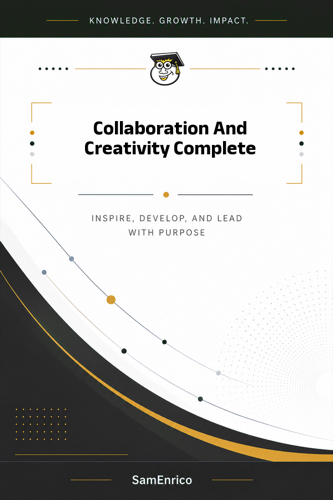
Non-FictionSelf-HelpComplete Guide
Collaboration And Creativity Complete eBook
Master handbook for all group innovation methods.
Master handbook for all group innovation methods.
Formats
Free sample
Chapter 1: The Genius Delusion--–- The light bulb. The i Phone. The theory of relativity. These names conjure single figures—Edison, Jobs, Einstein—as if each breakthrough emerged fully formed from a solitary mind. But here is a disturbing truth that the history books have spent a century hiding: none of those stories are true.
Not one. Every major innovation in human history emerged not from a lone genius but from a messy, invisible, and systematically erased network of collaborators. And until your team understands this—until you can see the hidden web that actually produces breakthroughs—you will keep designing innovation processes that fail.This chapter dismantles the most dangerous myth in creative work: the cult of the lone genius. In its place, we build a practical framework for seeing, measuring, and activating the collaborative networks that actually generate novel ideas. You will learn why the "smartest person in the room" is often a performance risk factor, not an asset.
You will discover the Adjacent Possible and why breakthroughs are always combinations, not inventions from nothing. And you will leave with the Collabograph—a diagnostic tool that will forever change how your team understands its own creative process.Let us begin with two men who could not have been more different. One was a mediocre scientist but a brilliant collaborator. The other was a genuine genius who could not work with others. Their stories reveal everything about why collaboration beats brilliance.The Two Faces of Genius In the late nineteenth century, two inventors raced to dominate the new frontier of electricity.
Thomas Edison was not the smartest man in the room—he admitted he knew little of theoretical physics and had failed more times than he could count. But Edison built the first industrial research laboratory in Menlo Park, New Jersey. He surrounded himself with machinists, chemists, glassblowers, and mathematicians. He called them his "muckers," and they operated as a team. When Edison filed patents, he often listed himself as the sole inventor, but his notebooks tell a different story: his assistant Charles Batchelor co-developed the light bulb filament.
John Kruesi built the first working phonograph. Francis Upton, a Princeton-trained mathematician, did the calculations that made the electrical grid possible. Edison succeeded because he understood that collaboration multiplies intelligence.Nikola Tesla was Edison's opposite. Tesla was a true genius—he could visualize entire AC motor designs in his imagination, run them mentally for hours, and identify flaws without building a single prototype. But Tesla could not collaborate.
He fell out with Edison, then with George Westinghouse, then with J.P. Morgan. He trusted no one, shared credit reluctantly, and died alone and bankrupt in a New York hotel room, his visionary ideas unrealized because he could not translate them through other people.The lesson is not that individual brilliance is worthless. The lesson is that brilliance without collaboration does not scale. Innovation is a team sport, and the teams that win are not necessarily the ones with the highest IQs.
They are the ones with the richest collaborative webs.The Adjacent Possible Why does collaboration matter so much? The answer lies in a concept called the Adjacent Possible, coined by biophysicist Stuart Kauffman and popularized by Steven Johnson. The Adjacent Possible is the set of all states that are one step away from your current state. In biology, a single-celled organism can only evolve into the types of multicellular organisms that are adjacent to its current form. It cannot leap directly to a mammal.
In innovation, the same principle applies: every breakthrough opens doors to nearby possibilities that were previously invisible, and those doors are only visible to people with different expertise, different tools, and different mental models.Consider the invention of the printing press. Johannes Gutenberg is celebrated as the lone inventor, but his press combined technologies that had existed for centuries: the wine press (mechanical pressure), movable type (developed in China), oil-based inks (used by Dutch artists), and paper (invented in China). Gutenberg did not invent any of these components. He was the person who stood at the intersection of multiple adjacent possibles—wine-making, printing, metallurgy, chemistry—and combined them. But he could not have done it alone.
He worked with Johann Fust (a financier), Peter Schöffer (a calligrapher who redesigned the type), and dozens of anonymous apprentices. The myth erased them all.The Adjacent Possible teaches us that no single mind can see all the doors. A materials scientist cannot see what a behavioral economist sees. A designer cannot see what a supply chain manager sees. Innovation emerges when diverse collaborators bump into each other's adjacent possibles.
Your job as a team leader is not to hire the smartest individuals. It is to build a network that maximizes the probability of those collisions.Collaborative Webs, Not Star Hierarchies Keith Sawyer, a psychologist who has spent decades studying the most creative teams in the world—improvisational theater troupes, jazz combos, IDEO design firms, scientific laboratories—has documented a consistent pattern. The most innovative teams do not operate as hierarchies. They operate as collaborative webs: shifting networks where leadership rotates based on who has the relevant expertise at that moment. In a jazz combo, the trumpet player leads during the melody, but during the piano solo, the pianist leads, and the trumpet player lays back.
No single person is "in charge" of creativity. The group itself is the unit of innovation.Sawyer found that collaborative webs share three structural features. First, dense internal connections: team members interact frequently and informally, not just in scheduled meetings. Second, weak ties to outside domains: the most novel ideas come from people who have one foot in the team and one foot in a completely different field. Third, rotating leadership: whoever has the relevant expertise at that moment takes the lead, regardless of title or seniority.Contrast this with the star hierarchy: a team organized around a single recognized genius.
Everyone defers to the star. The star's ideas get explored; everyone else's get suppressed. The star dominates conversation, interrupts others, and signals through micro-expressions which ideas are worthy. Research by Anita Woolley and colleagues at Carnegie Mellon has shown that teams with a single high-IQ star perform worse than teams of average-IQ individuals who collaborate well. The star effect is so powerful that it suppresses the collective intelligence of the group.Here is the counterintuitive finding that changes everything: adding a genius to your team does not automatically make your team smarter.
It often makes your team dumber, because everyone else stops thinking. The solution is not to avoid hiring brilliant people. The solution is to structure interactions so that brilliance does not become a bottleneck. This means explicit protocols for rotating speaking turns, anonymous idea generation (which we will cover in Chapter 5), and a culture that rewards challenge, not deference.The Smartest Person in the Room Problem Let me be specific about the mechanism. When a team includes a person with unquestioned status—whether because of IQ, past success, seniority, or reputation—other team members enter a state of evaluation apprehension.
They self-censor. They think, "My idea is probably not as good as hers, so I will stay quiet." They also…
This is the end of the free sample. Get the eBook to keep going. Buy now
About this book
Details
- Author
- Wilke Celestine
- Publisher
- SamEnrico
- Language
- English
- Genre
- Non-Fiction, Self-Help, Complete Guide
- Released
- 2026-06-10
- Pages (approx.)
- 132
- Available as
- eBook, Audiobook

Read better in the ZLOADR app
Your eBooks on your phone or tablet. Sign in with your SamEnrico account and start reading.
More by Wilke Celestine
 The Exhausted Parent Anger FixWilke Celestine$11.99
 NVC for MusiciansWilke Celestine$11.99
 Bladder Cancer SurvivorWilke Celestine$11.99
 Tension Headache and Tech NeckWilke Celestine$11.99
 Urgency DiscernmentWilke Celestine$11.99
 Food Addiction in ChildrenWilke Celestine$11.99
 Blue Zone Hills And TerrainWilke Celestine$11.99
 Lindsay Lohan MeanWilke Celestine$11.99
 The Harmonic Revolution: Black Composers Who Defied the Classical CanonWilke Celestine$11.99
 The Dragon’s Last Roar: The Ballad of Saint George’s Forgotten RivalWilke Celestine$11.99
 The Art of the Heist: How a Fake Prince Swindled the EliteWilke Celestine$11.99
 Growing LablabWilke Celestine$11.99
You may also like
 Hong Kong Handover 1997Dunn Johnnie$11.99
 Zumba For Postnatal Recovery CourseNeal Christian$11.99
 Zumba for BeginnersLadner Nikia$11.99
 YouTube Comment Mining GuideHumes Pandora$12.99
 Worry Box MeditationCarlin Rudy$11.99
 Workplace Stress MeditationNguyen Lynn$11.99
 Workplace Stress and Sleep RepairHawley Ivory$11.99
 Workplace Perfectionism CureDelaney Jeffry$11.99
 Workplace Injustice Anger GuideWallen Isabelle$11.99
 Work Addiction and Burnout LinkGreenwood Ester$11.99
 Women in Yoga and WellnessBeattie Galina$11.99
 Women in Stand Up ComedyChun Evangeline$11.99