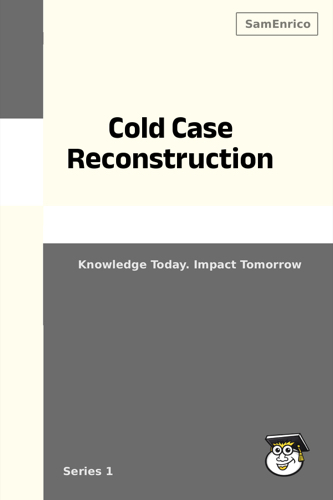
Cold Case Reconstruction eBook
undefined
by Shumate Adam
undefined
Formats
Free sample
Chapter 1: The Frozen Hour...–- The patrol officer’s flashlight cut a weak arc through the November fog. It was 2:47 a.m. when he found her. She lay in the drainage ditch behind the abandoned textile mill, half-covered by wet leaves and the kind of silence that follows violence. He checked for a pulse out of protocol, not hope.
There was none. Her eyes were open, fixed on a sky she could no longer see. He radioed it in as a homicide, then stepped back to wait for the detectives. That was 1995. The case file landed on a desk, then another desk, then a shelf, then a box, then a storage unit.
Twenty-eight years later, that same box was carried into a fluorescent-lit room where I sat waiting. The patrol officer had long since retired. The original detectives were dead or had forgotten her name. The textile mill had been demolished, replaced by a parking lot. The leaves had rotted and been replaced by new leaves, season after season.
But the file remained. And somewhere in that file, buried under decades of assumptions and dead ends and questions never asked, was the answer to who killed her. The case wasn't closed. It was frozen. And frozen things can thaw.This is what a cold case actually is.
Not a mystery to be marveled at from the comfort of an armchair, not a puzzle to be solved over a weekend with a true crime podcast and a notebook. A cold case is a failure. It is a failure of investigation, a failure of resources, a failure of time, and sometimes a failure of will. But more than any of those, it is a failure of imagination—the inability of the original investigators to see what was hidden in plain sight, not because they were stupid or lazy, but because they were human. And humans, even the best detectives, suffer from a predictable set of cognitive traps, procedural blind spots, and resource limitations that turn solvable cases into unsolved ones.The purpose of this chapter is to give you a diagnostic framework for understanding why cases go cold in the first place.
Before you can solve a cold case, you must understand the anatomy of its failure. You must learn to distinguish between different types of cold cases, because a case that was never properly investigated requires a different approach than a case that was aggressively investigated but pointed in the wrong direction. You must learn to identify the "case cripplers"—the specific failures that most frequently doom an investigation beyond repair. And you must learn to perform a cold case triage, a disciplined assessment of whether a case is worth reopening or whether the evidentiary wounds are too deep to heal.This is not academic exercise. Every cold case file you open represents a victim who is still waiting, a family that is still hurting, and a killer who may still be breathing.
The work matters. But the work must be strategic. You cannot chase every ghost. You must learn which ghosts can be caught.The Taxonomy of Investigative States Before we can talk about cold cases, we need precise language. Too many investigators, and too many books about cold cases, use the term "cold case" to describe any unsolved case that has been sitting around for a while.
This is imprecise and, more importantly, it leads to strategic errors. A case where leads have simply dried up requires different tactics than a case where the original investigation produced a mountain of evidence but pointed at the wrong suspect. To solve more cases, we need to classify cases by their actual investigative state, not by their age or their emotional weight.Let me introduce a four-tier classification system that I have used to train cold case units across the country. This system divides all unsolved cases into four categories: Active, Pending, Stalled, and Frozen.Active Cases are those currently under investigation. Leads are being pursued.
Witnesses are being interviewed. Evidence is being processed. The case has a dedicated investigator or team, and that team is actively working the case. No case is truly cold until it leaves this category.Pending Cases are those where leads have temporarily dried up, but the investigation remains staffed and the case file remains active. The detective may be waiting for lab results, or for a witness to return from out of state, or for a tip line to generate new information.
The case is not moving forward at the moment, but it is also not abandoned. A pending case can become active again with a single phone call.Stalled Cases are the first category that most people would call "cold," but that term is imprecise. A stalled case is one where the original investigation produced theories, developed suspects, and gathered evidence—but those theories were wrong. The investigation went down the wrong path and never corrected course. The case stalled because the investigators stopped asking questions once they had a suspect in mind.
They may have arrested someone who was later released. They may have cleared a suspect who should have remained a person of interest. They may have built a narrative that felt satisfying but was factually incorrect. Stalled cases are actually the most promising category for re-investigation, because they usually contain a wealth of evidence that was collected but never properly analyzed. The problem is not a lack of evidence; the problem is a lack of correct interpretation.
With fresh eyes and modern techniques, stalled cases can often be solved relatively quickly.Frozen Cases are the truly cold cases. These are cases where all obvious leads are exhausted. The original investigative team has disbanded; the detectives have retired or died. The case file has been relegated to storage, often in boxes that haven't been opened in years or decades. There are no active theories, no active suspects, and no active leads.
The case is frozen because literally nothing is moving. Frozen cases require generative reconstruction—building new leads from scratch, often using forensic techniques that did not exist at the time of the original investigation. These cases are the hardest to solve, but they are also the ones where modern technology (especially DNA and genetic genealogy) has had its greatest successes.Here is the critical insight that most cold case literature gets wrong: a stalled case and a frozen case feel the same when you first open the file. Both are old. Both are unsolved.
Both may have sat untouched for years. But they require completely different investigative strategies. A stalled case needs corrective reconstruction—identifying where the original investigation went wrong and then correcting course. A frozen case needs generative reconstruction—building new leads from the ground up. Confusing the two leads to wasted time, wasted resources, and a lower solve rate.The first step in any cold case review is therefore classification.
Open the file. Read the first few pages. Ask yourself: Did the original investigators have a theory? Did they have a suspect? Did they gather evidence, even if that evidence was never tested?
If the answer is yes, you likely have a stalled case. If the answer is no—if the file is thin…
This is the end of the free sample. Get the eBook to keep going. Buy now
About this book
Details
- Author
- Shumate Adam
- Publisher
- SamEnrico
- Language
- English
- Genre
- Non-Fiction, True Crime / Cold Cases
- Released
- 2026-06-06
- Pages (approx.)
- 148
- Available as
- eBook, Audiobook

Read better in the ZLOADR app
Your eBooks on your phone or tablet. Sign in with your SamEnrico account and start reading.
More by Shumate Adam
 Palliative Care Anticipatory GuideShumate Adam$11.99
 Dental Anatomy ForensicsShumate Adam$11.99
 Buffer Time Between BlocksShumate Adam$11.99
 Shopping Addiction Flea MarketsShumate Adam$11.99
 The Postpartum and ThyroidShumate Adam$11.99
 Self Hypnosis for Morning SnoozeShumate Adam$11.99
 Body Language for Retail StaffShumate Adam$11.99
 The Healers of Color: Latin America's Impressionist Revolution (1950-1980)Shumate Adam$11.99
 The Kepler Conspiracy: Unlocking the Secrets of the CosmosShumate Adam$11.99
 How to Produce Curling IronsShumate Adam$11.99
 How to Produce Pest Control TrapsShumate Adam$11.99
 A Collector's Handbook to the Vauxhall Viva Ha 90Shumate Adam$11.99