
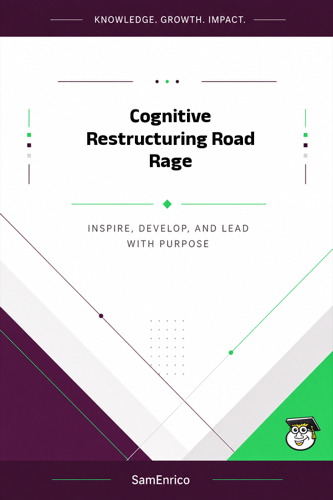
Non-FictionSelf-HelpRoad RageCBT
Cognitive Restructuring Road Rage eBook
Change thoughts that make you explode while drivin
Change thoughts that make you explode while driving in traffic.
Formats
Free sample
Chapter 1: The 3-Second Catastrophe--–- You are driving home on a Tuesday evening. The light ahead has been green for four seconds, which means it could turn yellow at any moment. The car in front of you is going exactly the speed limit, which feels, in this precise instant, like a personal violation. Your right foot tenses on the accelerator. Your jaw tightens.
You glance in the rearview mirror and see the driver behind you is closer than they were three seconds ago. Now the light turns yellow. The car in front brakes. You brake harder. The car behind you swerves slightly.
For one full second, no one moves. Then the light turns red. You slam your palm against the steering wheel. The sound is loud enough that the driver next to you looks over. You don't care.
You are already rehearsing what you would say if you could get out of your car and walk back to the driver who caused this. You would say something like, "What is wrong with you?" Or something worse. Your heart is pounding. Your face is hot. The light will be red for another ninety seconds.
You spend every one of them inside a small, private explosion.This is the 3-second catastrophe. It is called that not because it lasts three seconds—it doesn't; the physiological aftermath can last twenty minutes or more—but because the tipping point, the moment when calm becomes rage, takes approximately three seconds to complete. In that brief window, your brain makes a series of automatic judgments, your endocrine system floods your body with stress hormones, and your prefrontal cortex—the part of your brain responsible for reasoning, impulse control, and seeing things from another person's perspective—is partially shut down. You do not choose to become angry. You become angry because your brain has evolved to treat traffic violations as survival threats.
And that is the first thing you need to understand: your road rage is not a character flaw. It is a neurological overreaction to a stimulus that your ancient brain cannot distinguish from a physical attack. The good news is that you can retrain that response. But first, you have to see it for what it is.The Anatomy of a Rage Blackout Let us walk through the 3-second catastrophe in slow motion. Imagine you are driving on a four-lane highway during light traffic.
You are in the left lane, moving at seventy miles per hour. A driver from the right lane begins to merge into the space directly in front of you. They do not use a turn signal. They do not accelerate to match your speed. They simply drift over, forcing you to brake.
Your foot moves to the brake pedal before you are consciously aware of the threat. That is your amygdala—the brain's fear detection center—firing an alarm signal. In the first second, your amygdala has already classified the merging car as a threat. It does not know the difference between a car drifting into your lane and a predator lunging from the bushes. To your limbic system, a threat is a threat.In the second second, your hypothalamus activates the sympathetic nervous system.
This is the fight-or-flight response. Your adrenal glands release epinephrine (adrenaline) and norepinephrine. Your heart rate jumps from seventy beats per minute to one hundred and twenty beats per minute within two heartbeats. Your breathing becomes shallow and rapid. Blood is redirected away from your digestive system and toward your large muscles.
Your pupils dilate. Your peripheral vision narrows—a phenomenon called "tunnel vision" that is evolutionarily useful for focusing on a predator but catastrophically dangerous for driving, where peripheral awareness of other vehicles is essential. Your hearing sharpens for threat sounds (a honk, screeching tires) but dampens for neutral sounds (your music, your passenger's voice). Your palms begin to sweat. Your grip on the steering wheel tightens from a relaxed 2 out of 10 to a crushing 8 out of 10.In the third second, your prefrontal cortex—the rational, executive part of your brain located just behind your forehead—attempts to assess the situation.
But here is the problem: the amygdala's alarm signal is faster than the prefrontal cortex's reasoning. By the time your prefrontal cortex gets online, your body is already in full threat-response mode. And the prefrontal cortex, when flooded with cortisol and adrenaline, does not work well. It becomes what neuroscientists call "hypofrontal"—reduced in function. You become less capable of empathy, less capable of long-term thinking, less capable of impulse control.
You are, in a very real sense, driving with a compromised brain. This is why people who would never scream at a coworker or shove a stranger in a grocery store will roll down their window and scream at another driver. The 3-second catastrophe has temporarily turned them into a different person.Now add the final ingredient: time. The merging driver is now in front of you, traveling three miles per hour slower than you were going. You tap your brakes again.
The driver behind you taps their brakes. A ripple of slowing propagates backward through traffic. This is not malice. This is physics. But your brain does not see physics.
Your brain sees injustice. And that is where the cognitive part of the catastrophe begins.Two Kinds of Aggression: Instrumental vs. Hostile Not all aggressive driving is the same. In fact, understanding the difference between two distinct types of aggression will determine which of the tools in this book work best for you. This distinction comes from the clinical literature on aggressive driving, particularly the work of Dr.
Tara Galovski and Dr. Edward Blanchard, whose treatment manual for road rage remains the gold standard in the field.Instrumental aggression is aggression aimed at achieving a goal. Behind the wheel, instrumental aggression looks like speeding to make up time, weaving through traffic to get ahead, tailgating to pressure a slower driver to move over, or running a yellow light that has already turned red. The driver experiencing instrumental aggression is not primarily trying to hurt anyone. They are trying to get somewhere faster.
The aggression is a means to an end. The emotional tone is frustration, urgency, and impatience, not necessarily hatred. You can spot instrumental aggression because it typically subsides as soon as the obstacle is removed. If the slow car moves over, the tailgater stops tailgating. If the light turns green, the frustration dissipates.
Instrumental aggression is about efficiency, not punishment.Hostile aggression is different. Hostile aggression is aimed at causing harm. Behind the wheel, hostile aggression looks like brake-checking the driver behind you, cutting someone off deliberately to "teach them a lesson," following a driver who offended you, confronting another driver at a stoplight, or using your vehicle as a weapon. The goal is not to save time. The goal is to make the other person suffer.
The emotional tone is rage, contempt, and moral outrage. Hostile aggression does not subside when the obstacle is removed. In fact, it often intensifies after the event, as the driver replays the scene in their head and imagines what they should have said or done. Hostile aggression is about punishment, not efficiency.Most drivers…
This is the end of the free sample. Get the eBook to keep going. Buy now
About this book
Details
- Author
- Linares Patria
- Publisher
- SamEnrico
- Language
- English
- Genre
- Non-Fiction, Self-Help, Road Rage, CBT
- Released
- 2026-06-08
- Pages (approx.)
- 155
- Available as
- eBook, Audiobook

Read better in the ZLOADR app
Your eBooks on your phone or tablet. Sign in with your SamEnrico account and start reading.
More by Linares Patria
 Slack Disaster Recovery GuideLinares Patria$11.99
 Spin Class Lighting and AtmosphereLinares Patria$11.99
 Financial Stress and Academic SuccessLinares Patria$11.99
 The ED and Alcohol Link GuideLinares Patria$11.99
 Jewelry Operations AssociateLinares Patria$11.99
 Bach and the Baroque: Music of the Holy Roman EmpireLinares Patria$11.99
 Marketing Role Promotion CaseLinares Patria$12.99
 Bubble MVP Development GuideLinares Patria$12.99
 How to Become a LocksmithLinares Patria$11.99
 Understanding Van Der Woude SyndromeLinares Patria$17.99
You may also like
 Hong Kong Handover 1997Dunn Johnnie$11.99
 Zumba For Postnatal Recovery CourseNeal Christian$11.99
 Zumba for BeginnersLadner Nikia$11.99
 YouTube Comment Mining GuideHumes Pandora$12.99
 Worry Box MeditationCarlin Rudy$11.99
 Workplace Stress MeditationNguyen Lynn$11.99
 Workplace Stress and Sleep RepairHawley Ivory$11.99
 Workplace Perfectionism CureDelaney Jeffry$11.99
 Workplace Injustice Anger GuideWallen Isabelle$11.99
 Work Addiction and Burnout LinkGreenwood Ester$11.99
 Women in Yoga and WellnessBeattie Galina$11.99
 Women in Stand Up ComedyChun Evangeline$11.99