
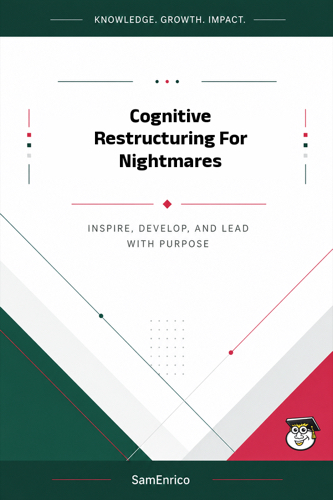
Non-FictionSelf-HelpCognitive Therapy
Cognitive Restructuring For Nightmares eBook
Challenge catastrophic interpretations of dream co
by Dion Kecia
Challenge catastrophic interpretations of dream content.
Formats
Free sample
Chapter 1: The 3 AM Alarm--You are jolted awake at 3:17 AM. Your heart is hammering against your ribs like a trapped animal. Your sheets are soaked with sweat. Your breath comes in short, ragged gasps. For a moment—just a terrible, disorienting moment—you cannot tell if the danger is still there.
Your eyes scan the darkened bedroom. The dresser. The window. The doorway. Nothing.
You are alone. You are safe. But your body does not know that yet.You lie there, staring at the ceiling, waiting for your heart to slow. The images from the dream are still vivid—too vivid. The thing that was chasing you.
The feeling of your legs refusing to move. The scream that wouldn't come out. The face of someone you loved turning away. And now, even though you know it was just a dream, a new thought arrives: What if it means something? What if it comes true?
What if I am actually this helpless in real life?You check your phone. 3:18 AM. You have to be up in three hours. You close your eyes, but the images are waiting there like a trap door. You are afraid to fall back asleep.
So you don't. You lie awake until the alarm goes off, exhausted, haunted, and convinced—on some level you cannot quite articulate—that something is wrong with you.If this has happened to you—once, twice, or every single night—you are not broken. You are not crazy. And you are not alone.Nearly half of all adults report having nightmares that interfere with their daytime functioning at some point in their lives. For approximately four to six percent of the population, nightmares are a chronic problem—meaning they occur at least once per week and cause significant distress or impairment in work, relationships, or daily life.
That is tens of millions of people in the United States alone. And yet, only a tiny fraction—less than three percent—receive evidence-based treatment for their nightmares.This book exists to close that gap.But before we get to the "how," we need to talk about the "what." What is a nightmare, exactly? And why does your brain—your own brain, the organ that is supposed to be protecting you—keep serving up these horrifying experiences night after night?Redefining the Nightmare: Not a Failure, but a Malfunction The word "nightmare" comes from the Old English mare—a mythological demon or goblin that was believed to sit on sleepers' chests, suffocating them and bringing bad dreams. For centuries, nightmares were understood as supernatural attacks, divine punishments, or omens of future disaster. Even today, many people secretly wonder if their nightmares are trying to tell them something prophetic.They are not.The scientific understanding of nightmares has advanced dramatically in the past three decades.
Thanks to brain imaging studies, sleep laboratory research, and clinical trials involving tens of thousands of patients, we now know that nightmares are not messages from beyond, not proof of a fractured psyche, and not a sign of moral failure. They are, instead, a specific type of cognitive event—a malfunction of a system that, in its original evolutionary context, was actually helpful.Let me explain.Every night, your brain cycles through four stages of sleep, culminating in REM (rapid eye movement) sleep, which is when most vivid dreaming occurs. During REM sleep, your brain is almost as active as when you are awake. Your amygdala—the brain's threat-detection center—lights up like a fireworks display. Your hippocampus replays fragments of recent memories.
Your visual cortex generates elaborate images. But crucially, your prefrontal cortex—the part of your brain responsible for logic, self-awareness, and reality testing—is largely offline.This is not a design flaw. It is a feature.The Overnight Therapy Hypothesis In the late 1990s, researchers began proposing what is now called the "overnight therapy hypothesis." The idea is this: dreaming, including bad dreams, serves as a safe simulation space in which the brain rehearses responses to perceived threats. From an evolutionary standpoint, this would have been enormously adaptive. Your ancestors did not have the luxury of reading books about how to escape a predator or survive a natural disaster.
They learned by experience—or by simulated experience. Dreaming allowed them to "practice" threat responses without any real-world risk.Consider the classic nightmare: being chased. Your heart pounds. You run. You hide.
You cannot scream. When you wake up, you are exhausted and terrified. But evolutionarily speaking, that nightmare served a purpose. It rehearsed the neural pathways associated with escape behavior. It kept your threat-detection system sharp.
It reminded you—in the most visceral way possible—that danger exists and that you need to be prepared for it.The problem is not that we have nightmares. The problem is that our modern world no longer matches the threat landscape our brains evolved to navigate. Your brain is still running its ancient simulation software, but the inputs have changed. Instead of saber-toothed tigers, you have social rejection. Instead of falling from a cliff, you have professional failure.
Instead of being abandoned by your tribe, you have a painful breakup or the loss of a loved one.Your brain is not trying to hurt you. It is trying to protect you using tools that were designed for a different world.But when this system malfunctions—when it overfires, when it runs the same catastrophic simulation night after night, when it generalizes from one real threat to a hundred imagined ones—you get chronic nightmares. And chronic nightmares are not adaptive. They are debilitating.The Physiology of Nightmare Stress To understand why nightmares feel so real, you have to understand what happens inside your body during one.In a typical nightmare, heart rate increases from a resting rate of around 60 beats per minute to over 130 beats per minute. Blood pressure spikes.
Breathing becomes rapid and shallow. The palms sweat. Pupils dilate. Stress hormones—cortisol, adrenaline, norepinephrine—flood the bloodstream. The body enters a full fight-or-flight response, even though there is no actual physical threat.This is not a metaphor.
It is measurable physiology.When you wake from a nightmare, your body does not instantly recognize that the threat is gone. It takes time—sometimes five minutes, sometimes twenty, sometimes the rest of the night—for your parasympathetic nervous system to reassert control and calm everything down. That is why you lie there in the dark, heart pounding, scanning the room for danger. Your body is still in threat-response mode, even though your conscious mind knows you are safe.For people with occasional nightmares, this is an unpleasant but manageable experience. You wake up, you calm down, you go back to sleep.
But for people with chronic nightmares—defined in the clinical literature as one or more nightmares per week that cause significant distress or impairment—the cumulative toll is devastating.Chronic nightmare sufferers report daytime fatigue that affects work performance. They develop sleep avoidance behaviors—staying up late, sleeping with lights on, or avoiding sleep altogether because they are afraid of what they will dream. They experience increased anxiety and depression. Their relationships suffer because they are irritable, distracted, or unwilling to share a bed. Some develop…
This is the end of the free sample. Get the eBook to keep going. Buy now
About this book
Details
- Author
- Dion Kecia
- Publisher
- SamEnrico
- Language
- English
- Genre
- Non-Fiction, Self-Help, Cognitive Therapy
- Released
- 2026-06-08
- Pages (approx.)
- 142
- Available as
- eBook, Audiobook

Read better in the ZLOADR app
Your eBooks on your phone or tablet. Sign in with your SamEnrico account and start reading.
More by Dion Kecia
 Anger De escalation for Bus DriversDion Kecia$11.99
 Memory Palace For Science FormulasDion Kecia$11.99
 Low Carb Travel Survival GuideDion Kecia$11.99
 Myo Inositol GuideDion Kecia$11.99
 Grand Canyon Missing PersonsDion Kecia$11.99
 Quit Smoking for Truck DriversDion Kecia$11.99
 Self Exclusion Laws GuideDion Kecia$11.99
 The Hollow Hill: Where the Fair Folk Still BargainDion Kecia$11.99
 The Hapsburgs at War: Splendor and Strategy in the Austro-Hungarian EmpireDion Kecia$11.99
 How to Start a Metal Road Signs Business (Beginners Guide)Dion Kecia$11.99
 Understanding SpasticityDion Kecia$11.99
 Qualified Retirement Plan TransferDion Kecia$12.99
You may also like
 Hong Kong Handover 1997Dunn Johnnie$11.99
 Zumba For Postnatal Recovery CourseNeal Christian$11.99
 Zumba for BeginnersLadner Nikia$11.99
 YouTube Comment Mining GuideHumes Pandora$12.99
 Worry Box MeditationCarlin Rudy$11.99
 Workplace Stress MeditationNguyen Lynn$11.99
 Workplace Stress and Sleep RepairHawley Ivory$11.99
 Workplace Perfectionism CureDelaney Jeffry$11.99
 Workplace Injustice Anger GuideWallen Isabelle$11.99
 Work Addiction and Burnout LinkGreenwood Ester$11.99
 Women in Yoga and WellnessBeattie Galina$11.99
 Women in Stand Up ComedyChun Evangeline$11.99