
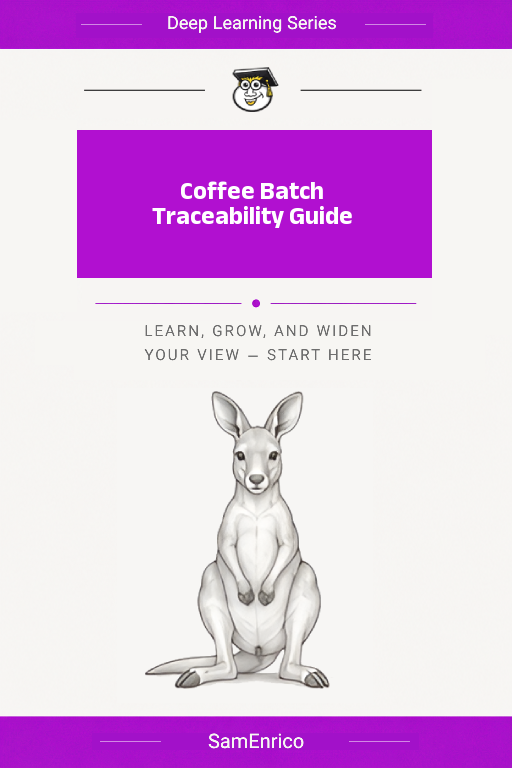
Coffee Batch Traceability Guide
Assign unique batch numbers to coffee lots for Eur
Assign unique batch numbers to coffee lots for Europe export tracking. Link each batch to harvest date, farm GPS, and processing record for transparency.
Formats
About this book
Free sample
Chapter 1: The Rotterdam Reckoning...--–- The container ship had already been cleared for berthing. The buyer had wired the payment. The coffee inside – 19,200 kilograms of washed Ethiopian Sidama – had been cupped at 87 points and sold at a substantial premium. But at 8:47 AM on a cold January morning, a customs official in Rotterdam scanned the shipping manifest and asked a question that no one in the supply chain could answer: "Where exactly was each bean grown, and can you prove it?"The exporter in Addis Ababa had certificates. The cooperative had records.
The farmer had a memory. But none of it was geo-located. None of it was linked to a batch number that could be traced from farm gate to port. And under the European Union Deforestation Regulation, which came into full force just hours earlier, that container was legally inadmissible. It sat on the dock for three weeks.
The buyer canceled the contract. The exporter ate the shipping costs. And the coffee – perfectly good coffee – was sold at a loss on the spot market.This is not a hypothetical scenario. It is the future that awaits every coffee exporter who fails to understand what changed on December 31, 2026. This book exists to ensure that future does not become your reality.The Urgency of December 2026The European Union Deforestation Regulation, or EUDR, was passed in June 2023.
It gave the global coffee industry three and a half years to prepare. That window is now closing. The regulation applies to any operator or trader who places specific commodities – including coffee – on the EU market. It requires that these products be deforestation-free, meaning they were produced on land that was not subject to deforestation after December 31, 2020.But the devil, as always, is in the details. The regulation does not simply ask for a paper certificate or a goodwill declaration.
It demands verifiable, geo-located, batch-level evidence. For coffee, this means four non-negotiable requirements.First, geolocation coordinates of all plots where the coffee was grown, using WGS84 decimal degrees. This is not a suggestion. It is a legal requirement. The coordinates must be precise enough to identify…
This is the end of the free sample. Get the eBook to keep going. Buy now
Contents
- Chapter 1
- Chapter 2
- Chapter 3
- Chapter 4
- Chapter 5
- Chapter 6
- Chapter 7
- Chapter 8
- Chapter 9
- Chapter 10
- Chapter 11
- Chapter 12
Details
- Author
- Fairbanks Ellamae
- Publisher
- SamEnrico
- Language
- English
- Genre
- Non-Fiction, Business Brief, Batch Traceability
- Released
- 2026-06-01
- Pages (approx.)
- 156
- Available as
- eBook, Audiobook

Read better in the ZLOADR app
Your eBooks on your phone or tablet. Sign in with your SamEnrico account and start reading.
More by Fairbanks Ellamae
 Commercial Real Estate BenchmarkingFairbanks Ellamae$11.99
 Colombia Geo Arbitrage BlueprintFairbanks Ellamae$11.99
 Forgiveness After Abortion GuideFairbanks Ellamae$11.99
 Benzo Anxiety Rebound HandbookFairbanks Ellamae$11.99
 Pattern Recognition for ChemistryFairbanks Ellamae$11.99
 Incense Smoke RisingFairbanks Ellamae$11.99
 Silent Screams Spoken Truths ManualFairbanks Ellamae$11.99
 Resume Bahrain Specific GuideFairbanks Ellamae$11.99
 Body Image For MenFairbanks Ellamae$11.99
 The Clockwork Monks of the Great Southern Land: Medieval Automation in AustraliaFairbanks Ellamae$11.99
 The Timbuktu Tally: Africa's Mathematical RenaissanceFairbanks Ellamae$11.99
 The Codebreakers' War: Alan Turing's Secret LegacyFairbanks Ellamae$11.99