
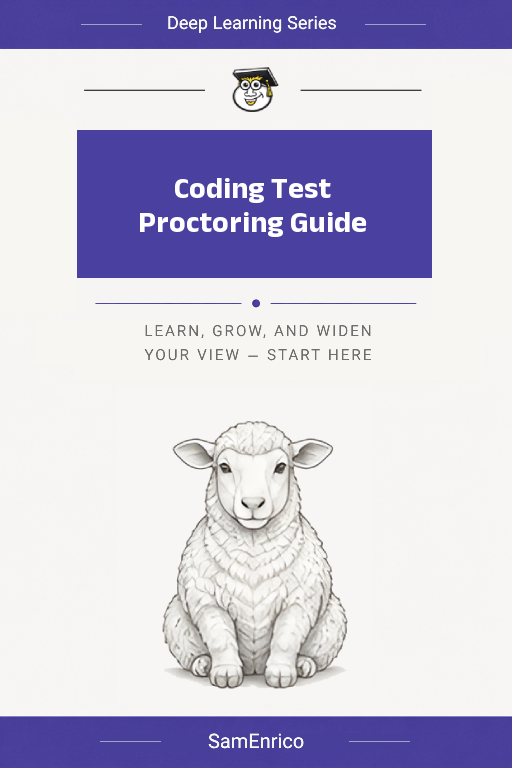
Coding Test Proctoring Guide eBook
Complete coding assessments during online proctore
Complete coding assessments during online proctored exams with in browser IDE and screen recording awareness.
Formats
Free sample
Chapter 1: The 5 Eyes...--–- I watched my own proctoring footage for three hours, and what I saw made me physically ill. Not because I had cheated—I hadn't. Not because I had failed—I had passed. What made me sick was watching myself transform from a competent software engineer into a fidgeting, eye-darting, sweat-beaded suspect over the course of seventy-two minutes. The recording showed a man who looked guilty as sin.
And that man was me.The problem was not my coding ability. I had solved the same problem in Visual Studio Code the night before in eleven minutes flat, using elegant recursion and a memoization pattern I had perfected over a decade of professional work. But under the gaze of the proctoring software—under the five invisible layers of observation I had not even known existed—I wrote like a novice. I second-guessed every loop. I typed console.log eighteen times.
I stared blankly at the input parser for ninety seconds because I could not remember whether Python's input() stripped newlines by default.This chapter is not about coding. It is about surveillance—specifically, the five distinct ways modern proctoring systems watch you, how each layer thinks, and why your honest behaviors trigger false flags more often than actual cheating. By the end of this chapter, you will understand the invisible architecture that turned me from a senior engineer into a suspect. More importantly, you will learn how to stop performing like a guilty person when you are innocent.The Five Layers of Digital Observation Before we discuss tactics, you need a map of the battlefield. Most candidates assume proctoring is a single thing: a camera watching them.
This assumption is dangerous because it leads to the wrong countermeasures. You cannot outsmart something you do not understand.Modern online proctoring is not one system. It is five systems operating in parallel, each with its own logic, its own failure modes, and its own triggers.Layer One: AI Gaze Detection This is the layer most candidates fear, but few understand. Gaze detection does not simply record where you look. It tracks the velocity and pattern of your pupil movements.
The algorithm distinguishes between saccades (rapid, ballistic eye movements) and smooth pursuit (tracking a moving object). Why does this matter? Because reading your own code produces a different gaze pattern than reading a second screen or a hidden phone.The algorithm logs three gaze metrics: fixation duration (how long your eyes rest on a single point), scan path (the sequence of where you look), and pupil dilation (which correlates with cognitive load and, controversially, deception). When my proctoring footage was analyzed, the AI flagged a 1.4-second fixation on the upper-left corner of my screen followed by a rapid downward saccade. To the algorithm, this looked like glancing at pre-written notes.
In reality, I was checking the timer.Layer Two: Microphone Ambient Noise Analysis Your microphone is always on. Always. Even during the "check-in" phase before the exam officially starts. Even during breaks. The software does not just listen for speech—it analyzes ambient noise patterns, keyboard acoustics, and vocal frequency.Here is what triggers flags at this layer: whispering (frequency range 180-250 Hz, which the AI distinguishes from normal speech), muttering repeated error messages (which sounds like reading from an external source), and irregular breathing patterns (which can indicate a hidden earpiece or anxiety so severe that the system flags you for "behavioral instability").
The microphone also detects typing cadence. If your typing rhythm suddenly changes—for example, if you pause for forty-five seconds and then type a perfect block of code with zero hesitation—the system notes the anomaly.Layer Three: Screen Recording Algorithms This is the most misunderstood layer. Candidates think screen recording captures everything. It does not. It captures changes.
The algorithm runs a pixel-difference engine that logs every region of the screen that changes between frames. This is computationally efficient, but it creates blind spots. If you open a second browser window behind the proctoring overlay, and that window does not update its pixels, the recording may not capture it.What the screen recording does capture reliably: every tab switch (even micro-switches under 0.5 seconds, which the system logs as "context shifts"), cursor movement speed and dwell time (lingering on empty space for more than two seconds triggers a "suspicious inactivity" flag), and scrolling patterns (non-linear scrolling—up, down, up—suggests searching for something).Layer Four: Browser Lockdown This layer is the most aggressive and the most brittle. The lockdown script injects itself into your browser's runtime, disabling right-click, copy-paste, keyboard shortcuts, extensions, and developer tools. It also monitors the browser's process tree for any debugging or inspection tools.What most candidates do not realize is that browser lockdown has a critical vulnerability: it cannot distinguish between a legitimate system process and a malicious one if both run at the same privilege level.
This is not an invitation to cheat—it is an invitation to understand that the lockdown will fail in unpredictable ways. It may disable your password manager. It may block your accessibility tools. It may, as happened to one candidate I interviewed, interpret a legitimate Windows update notification as a "potential screen-sharing attempt."Layer Five: Live Human Review This is the layer that saves innocent candidates and condemns the guilty—but only if you understand how it operates. Human reviewers do not watch your exam live.
They watch flagged segments. The AI flags 2-5% of all exam time as "suspicious." A human then reviews those segments, usually at 2x or 4x speed, and makes a final determination.Here is the critical insight: human reviewers are not looking for proof of cheating. They are looking for patterns that match their training examples. Their training consists of thousands of clips of actual cheaters—candidates looking down at phones, whispering to hidden collaborators, switching tabs to documentation. If your behavior matches those patterns, even innocently, you are at risk.Myth Versus Reality: What the Proctor Actually Sees The gap between candidate belief and system reality is where most failures happen.
Let me correct five dangerous myths.Myth 1: A human is watching you at all times.False. In a typical proctored exam, a human watches approximately 2-4 minutes of your footage total, usually in 15-30 second bursts. The rest of the time, you are watched by algorithms that have no understanding of context, fatigue, or anxiety.Myth 2: Proctors see your every keystroke.False. The system records keystrokes, but reviewers rarely examine them unless flagged by other layers. Keystroke analysis is computationally expensive, so most platforms sample it or use it only for behavioral biometrics (more on that in Chapter 12).Myth 3: Looking away from the screen always triggers a flag.Not exactly.
The system distinguishes between duration and frequency. A single long look away (over 3 seconds) is less suspicious than multiple short looks away (under 1 second each) separated by rapid typing. The pattern suggests copying from an external source.Myth 4: You can talk to yourself without consequences.False. Microphone analysis flags sustained vocalization that is not directed at the proctor. The algorithm cannot distinguish between "thinking out loud" and "reading from a hidden earpiece." Both produce similar acoustic…
This is the end of the free sample. Get the eBook to keep going. Buy now
About this book
Details
- Author
- Messina Krystle
- Publisher
- SamEnrico
- Language
- English
- Genre
- Non-Fiction, Student's Shortcut, Coding Test, Programming Exam
- Released
- 2026-06-01
- Pages (approx.)
- 129
- Available as
- eBook, Audiobook

Read better in the ZLOADR app
Your eBooks on your phone or tablet. Sign in with your SamEnrico account and start reading.
More by Messina Krystle
 Bariatric Vitamin Supplementation WorkbookMessina Krystle$11.99
 Police Sting Operation FailMessina Krystle$11.99
 LBO Exit Strategy DatabaseMessina Krystle$11.99
 FODMAP Reintroduction Phase WorkbookMessina Krystle$11.99
 Parental Addiction and Al AnonMessina Krystle$11.99
 The Phantom of Necker Island: Richard Branson’s Untold Survival SagaMessina Krystle$11.99
 The Queen Who Stole the Crown: How a Princess Outmaneuvered the KingmakersMessina Krystle$11.99
 Distribution Center ManagerMessina Krystle$11.99
 How to Become a ButtermakerMessina Krystle$11.99
 Equifax Business Credit GuideMessina Krystle$12.99
 Understanding Castro–gago–pombo–novo SyndromeMessina Krystle$17.99