
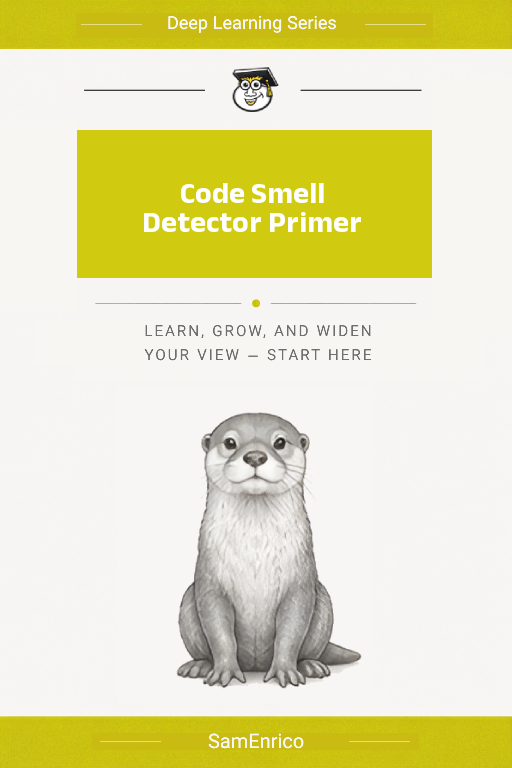
Code Smell Detector Primer eBook
Identify anti-patterns, duplicate code, and overly
by Dobson Jenni
Identify anti-patterns, duplicate code, and overly complex methods using AI-powered static analysis. Includes severity rating, refactoring suggestions, and complexity trend tracking.
Formats
Free sample
Chapter 1: The Million-Dollar Mess--The bug took three weeks to find. Not because it was subtle in the way that race conditions or memory leaks are subtle, but because no one could figure out which file contained the actual logic. The symptom was simple: every Friday afternoon, the invoice system doubled customer charges. The cause, once discovered, was mortifying. Three different developers had independently implemented the same discount calculation in three different places. Two of them had bugs. One of them was correct but unused. The accounting team had been manually refunding overcharged customers for eleven months.When the post-mortem finally arrived, the engineering manager said something that should frighten anyone who has ever written code for a living: "We knew the code was bad. We just didn't know where the bad code was."That manager was not incompetent. She was not lazy. She was running a team of seventeen engineers on a codebase that had grown, over seven years, to nearly 800,000 lines of Java and Kotlin. They had linters. They had code review. They had a style guide. What they did not have was a way to answer a simple question: which parts of our code are quietly destroying our productivity?This book exists because that question is now answerable. Not through heroic effort, not through expensive consultants, not through a multi-year rewrite. Through a combination of classical software engineering wisdom and artificial intelligence that has become, in the last thirty-six months, accessible to any team with a modest budget and a willingness to learn.Before we build that answer, however, we must understand the problem. And the problem, despite decades of hand-wringing about "technical debt," is not what most developers think it is.The Arithmetic of Bad Code Let us begin with a thought experiment. You are presented with two codebases. Codebase A is a masterpiece of clean, idiomatic design. Every function does one thing. Every class has a single responsibility. Names are chosen with the care of a poet. Codebase B is a nightmare. Methods stretch to five hundred lines. Variables are named x, y, tmp, and foo. The same logic appears in seventeen places with minor variations.Which codebase is more expensive to maintain?The obvious answer—Codebase B—is correct, but incomplete. The more interesting question is how much more expensive? Not "more expensive in theory" or "more expensive according to some academic paper," but more expensive for your team, on your schedule, with your deadlines.In 2020, a team of researchers at the University of Zurich analyzed the maintenance costs of fifty open-source projects over a combined total of 187 developer-years. Their findings, published in the journal Empirical Software Engineering, were striking: the 20 percent of files with the highest complexity metrics accounted for 78 percent of bug fix time and 81 percent of feature implementation delays. In other words, bad code is not evenly distributed. It clusters. It metastasizes. And it extracts a compound interest that most organizations never bother to calculate.Consider the arithmetic. A typical senior developer earns 150,000peryear.Addingbenefits,overhead,andthecostofcontextswitching,aconservativefully−loadedcostis150,000 per year. Adding benefits, overhead, and the cost of context switching, a conservative fully-loaded cost is 150,000peryear.Addingbenefits,overhead,andthecostofcontextswitching,aconservativefully−loadedcostis250,000 annually, or approximately 125perhour.Nowimaginethatdeveloperspendsjustonehourperdaywrestlingwithcodethatisunnecessarilycomplex—understandingwhatitdoes,tracingthroughduplicatelogic,orfixingbugscausedbyhiddencoupling.Thatis125 per hour. Now imagine that developer spends just one hour per day wrestling with code that is unnecessarily complex—understanding what it does, tracing through duplicate logic, or fixing bugs caused by hidden coupling. That is 125perhour.Nowimaginethatdeveloperspendsjustonehourperdaywrestlingwithcodethatisunnecessarilycomplex—understandingwhatitdoes,tracingthroughduplicatelogic,orfixingbugscausedbyhiddencoupling.Thatis125 per day, 625perweek,625 per week, 625perweek,32,500 per year. For one developer. On a team of ten, that is 325,000annually.Onateamoffifty,morethan325,000 annually. On a team of fifty, more than 325,000annually.Onateamoffifty,morethan1.6 million.Those numbers are not hypothetical. They are the median results from the University of Zurich study. The actual range was worse.But here is where the story takes an uncomfortable turn. Traditional static analysis tools—linters, formatters, and rule-based checkers—miss most of this cost. They will catch a missing semicolon. They will flag an unused import. They will complain about a line exceeding eighty characters. What they will not do is look at two functions, see that they do the same thing, and ask why neither has been extracted into a shared utility. They will not notice that a class has quietly accumulated seven different responsibilities because each one seemed reasonable at the time. They will not observe that a method that was simple twelve months ago has become a sprawling monstrosity because every bug fix added another conditional branch.These are not failures of tooling. These are failures of category. Traditional static analysis operates on syntax. The costliest problems in software engineering operate on semantics. Syntax tells you what the code says. Semantics tells you what the code means. And the gap between saying and meaning is where technical debt hides.The Semantic Gap Imagine you are reading a novel written in a language you barely understand. You can identify the nouns. You can identify the verbs. You can parse the sentences grammatically. But you cannot tell whether the protagonist is being ironic, whether the narrator is reliable, or whether the author is foreshadowing a betrayal. You have syntax. You do not have semantics.This is precisely the situation of traditional linters. They are grammarians, not literary critics. They enforce rules about sentence structure but have no theory of meaning. Consider the following two code snippets:python Copy Download# Snippet A
def calculate_discount(price, customer_type): if customer_type == "regular": return price * 0.95 elif customer_type == "premium": return price * 0.90 elif customer_type == "vip": return price * 0.85 else: return price
# Snippet B def get_final_price(base, tier): discounts = {"standard": 0.95, "gold": 0.90, "platinum": 0.85} return base * discounts.get(tier, 1.0)A traditional linter will pass both snippets without complaint. Neither has syntax errors. Neither exceeds line length limits. Neither uses a forbidden language feature. And yet these two snippets are semantic duplicates—they do exactly the same thing, but in different ways, using different names, with different structures. A developer who changes the discount logic in Snippet A but forgets to change it in Snippet B has introduced a bug that no linter will catch. A developer who reads Snippet A and assumes Snippet B behaves differently has fallen into a trap that no style guide can prevent.This is the semantic gap. It is the space between what the code says and what the code does. And it is where technical debt accumulates most rapidly because it is invisible to the tools that most teams rely upon.Artificial intelligence—specifically, large language models trained on billions of lines of code—closes this gap. Not perfectly. Not without caveats. But for the first time, we have tools that can look at Snippet A and Snippet B and ask: "Are these the same?" They can examine a four-hundred-line method and say: "This contains seven distinct logical operations that should be extracted." They can scan a codebase and identify that a class named User Manager is actually handling authentication, logging, email delivery, and database connection pooling.The difference between traditional static analysis and AI-powered analysis is not incremental. It is categorical. It is the difference between a spell checker and an editor. Between a thermometer and a…
This is the end of the free sample. Get the eBook to keep going. Buy now
About this book
Details
- Author
- Dobson Jenni
- Publisher
- SamEnrico
- Language
- English
- Genre
- Non-Fiction, AI Operator, Quality Assurance, Code Guide
- Released
- 2026-06-02
- Pages (approx.)
- 141
- Available as
- eBook, Audiobook

Read better in the ZLOADR app
Your eBooks on your phone or tablet. Sign in with your SamEnrico account and start reading.
More by Dobson Jenni
 US Inflation Reduction Act ImpactDobson Jenni$12.99
 The Vagus Nerve Stimulation GuideDobson Jenni$11.99
 Event Planner Deadline Stress WorkbookDobson Jenni$11.99
 Parental Resentment Healing CourseDobson Jenni$11.99
 Recovering Gamblers Debt Repayment PlanDobson Jenni$11.99
 Body Language for Cruise StaffDobson Jenni$11.99
 The Jade Serpent's Bargain: A Dragon's Debt in Ancient ChinaDobson Jenni$11.99
 Book ArtistDobson Jenni$11.99US Inflation Reduction Act ImpactDobson Jenni$12.99
 Understanding Lamellar Recessive IchthyosisDobson Jenni$17.99
 How to Start a Bakery Moulders Business (Beginners Guide)Dobson Jenni$11.99