
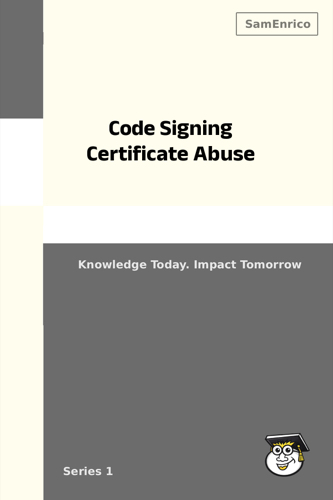
Non-FictionAnnual CheckupSoftware Supply Chain
Code Signing Certificate Abuse eBook
Review stolen certificate usage to bypass security
Review stolen certificate usage to bypass security controls.
Formats
Free sample
Chapter 1: The Broken Padlock...–- On a Tuesday morning in March 2021, the head of information security at a Fortune 500 manufacturing firm received an alert that would fundamentally change how he thought about digital trust. The alert was not a screaming red dashboard warning or a frantic call from the SOC. It was a quiet, almost polite notification from the company's endpoint detection system: "A signed binary with valid certificate attempted to access the domain controller's LSASS process memory." The binary was signed. The certificate chain was perfect. The timestamp showed it was issued by a trusted Certificate Authority eighteen months earlier.
The only problem was that no one in the organization had ever seen the binary before, and no one had authorized the certificate that signed it. That certificate belonged to a subsidiary that had been divested three years ago. Its private key should have been destroyed. Instead, it had been used to sign malware that had lived inside the company's network for fourteen months, pushing "updates" to critical manufacturing systems while masquerading as legitimate software maintenance. The damage totaled forty-seven million dollars.
The signature was real. The trust was a lie.This is not a hypothetical scenario. It is a composite drawn from multiple real-world breaches that share a common, terrifying thread: the exploitation of digital signatures as weapons rather than shields. The security industry has spent decades teaching users and systems to trust signed code. Click the green padlock.
Run the signed executable. Allow the driver with the valid certificate. And attackers have spent those same decades learning one simple truth: trust is the easiest vulnerability to exploit because it requires the victim to lower their own defenses. When a binary is signed with a stolen but cryptographically valid certificate, every security control that relies on signature verification—application whitelisting, driver integrity checks, update mechanisms, even some antivirus products—opens the door and says, "Welcome, trusted friend."The Illusion of Cryptographic Safety The fundamental problem is not a technical flaw in public key infrastructure itself. Asymmetric cryptography, when implemented correctly, does exactly what it promises: it provides mathematical proof that a specific private key signed a specific message.
The problem is that human beings and organizations have conflated "this signature is mathematically valid" with "this software is safe to run." These are not the same thing. A stolen private key produces signatures that are just as mathematically valid as the legitimate owner's signatures. The certificate does not know it has been stolen. The timestamp server does not know the signer's intent. The operating system's trust store does not know that the company whose name appears on the certificate went out of business six months ago and its keys were sold on a dark web forum.Consider the anatomy of a typical code-signing certificate.
It contains a public key, an identity (the name of the organization or individual), a validity period (typically one to three years), and a digital signature from a Certificate Authority attesting that the CA verified that identity before issuing the certificate. When a user downloads a signed executable, Windows checks that the certificate chains up to a trusted root CA, that the certificate has not expired, and that the signature over the binary matches. If all these checks pass, Windows displays "Digital signature found" and, depending on policy, may run the binary without further prompting. Nowhere in this process does Windows check whether the private key was stolen. Nowhere does it check whether the organization named on the certificate still exists.
Nowhere does it check whether the binary's behavior matches what that organization normally signs. The only thing the signature proves is that someone, somewhere, at some point in time, possessed a private key. That is all.The Explosion of Certificate Theft The theft of code-signing certificates has shifted from a rare, sophisticated nation-state tactic to a commodity capability available to any ransomware group with a few thousand dollars and a Telegram account. Several factors have driven this democratization. First, the proliferation of certificates themselves.
Every software company, every hardware vendor, every large enterprise IT department, and many smaller organizations now possess at least one code-signing certificate. Many possess dozens, scattered across build servers, developer workstations, hardware security modules, and cloud CI/CD pipelines. Each certificate represents a potential attack surface. Second, the tools for extracting certificates have become free, reliable, and automated. A tool like certipy can, with a single command and domain user credentials, locate and back up every certificate in an Active Directory Certificate Services deployment.
Mimikatz can extract certificates from memory, from the Windows certificate store, and from the Data Protection API with minimal effort. These are not nation-state tools. They are open-source utilities maintained on Git Hub, documented in blog posts, and integrated into every major penetration testing framework. Third, the market for stolen certificates has matured. Dark web vendors offer not just certificates but also the cloud credentials to access the original signing infrastructure, the email accounts used to request certificates, and even the documentation showing which applications trust which certificates.
An attacker can purchase a stolen EV certificate from a bankrupt software company for fifteen thousand dollars and use it to sign malware that will bypass application whitelisting in every organization that still trusts that company's certificate—which is to say, almost all of them, because almost no one maintains a real-time revocation list.The Consequences of Broken Trust The consequences of certificate theft cascade through an organization's security controls in ways that are often invisible until it is too late. A single stolen certificate can simultaneously bypass multiple layers of defense that are designed to work independently. Application whitelisting (Windows Defender Application Control, App Locker) allows signed binaries from trusted publishers to run without restrictions. Code integrity policies trust signed drivers to load into the kernel. Antivirus and EDR products often assign higher reputation scores to signed binaries, delaying or entirely skipping behavioral analysis.
Update mechanisms trust signed payloads to install with elevated privileges. All of these controls share a common dependency: the assumption that a valid signature implies a trustworthy origin. When that assumption fails, the entire defense-in-depth strategy collapses.The manufacturing firm described at the beginning of this chapter learned this lesson expensively. The stolen certificate was originally issued to a subsidiary that had been acquired and then divested during a corporate restructuring. The divestiture agreement required the subsidiary to destroy its code-signing private keys.
No one verified that this happened. The keys remained on a forgotten build server that was later decommissioned and sold as scrap—but not before the private key was exfiltrated. The attacker who obtained the key did not need to use it immediately. They waited, and they watched. They learned which systems still trusted certificates issued by that subsidiary's CA.
They learned which security controls would accept a signed binary without further review. Then, they signed their malware and deployed it through the company's own software distribution system, which had been configured to trust any binary signed with that subsidiary's key because the subsidiary had once been responsible for maintaining critical manufacturing applications. The attack was not sophisticated in a cryptographic sense. It was sophisticated in its understanding of how…
This is the end of the free sample. Get the eBook to keep going. Buy now
About this book
Details
- Author
- Nicholson Zenobia
- Publisher
- SamEnrico
- Language
- English
- Genre
- Non-Fiction, Annual Checkup, Software Supply Chain
- Released
- 2026-06-09
- Pages (approx.)
- 158
- Available as
- eBook, Audiobook

Read better in the ZLOADR app
Your eBooks on your phone or tablet. Sign in with your SamEnrico account and start reading.
More by Nicholson Zenobia
 TikTok Storytelling FrameworkNicholson Zenobia$11.99
 Alcohol Detox Mobile UnitsNicholson Zenobia$11.99
 The Social Eating Addiction GuideNicholson Zenobia$11.99
 Imposter Syndrome MentorshipNicholson Zenobia$11.99
 The Iron Duke's Arsenal: Wellington's Weapons of WarNicholson Zenobia$11.99
 Content Positioning That Attracts BuyersNicholson Zenobia$11.99
 Understanding Primary Granulocytic SarcomaNicholson Zenobia$17.99
 South Korea Export Eco Label GuideNicholson Zenobia$12.99
 Search Console Job PostingsNicholson Zenobia$12.99
 How to Become a Composing-room MachinistNicholson Zenobia$11.99
You may also like
 Hong Kong Handover 1997Dunn Johnnie$11.99
 Zumba For Postnatal Recovery CourseNeal Christian$11.99
 Zumba for BeginnersLadner Nikia$11.99
 YouTube Comment Mining GuideHumes Pandora$12.99
 Worry Box MeditationCarlin Rudy$11.99
 Workplace Stress MeditationNguyen Lynn$11.99
 Workplace Stress and Sleep RepairHawley Ivory$11.99
 Workplace Perfectionism CureDelaney Jeffry$11.99
 Workplace Injustice Anger GuideWallen Isabelle$11.99
 Work Addiction and Burnout LinkGreenwood Ester$11.99
 Women in Yoga and WellnessBeattie Galina$11.99
 Women in Stand Up ComedyChun Evangeline$11.99