
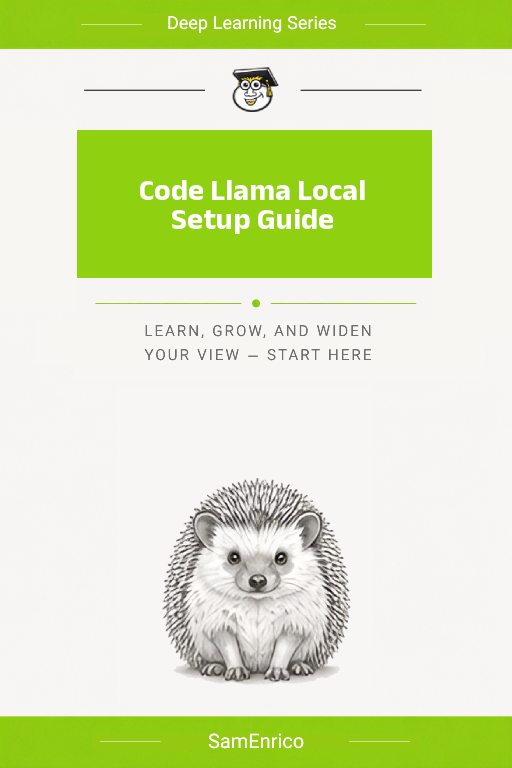
Code Llama Local Setup Guide eBook
Run open-source code generation models locally for
Run open-source code generation models locally for private development.
Formats
Free sample
Chapter 1: The Hardware Reality Check--The first mistake most developers make when diving into local AI is also the most expensive. They hear about a powerful 70-billion parameter model, they download it with eager anticipation, they run the command to start it up, and then they stare at an error message that says something like "CUDA out of memory" or "failed to allocate 20 Gi B of VRAM." Their expensive gaming laptop with 8 gigabytes of video memory—the same machine that runs Cyberpunk 2077 at high settings—has just been humbled by a text generator.You are about to avoid that mistake entirely. By the time you finish this chapter, you will know exactly what hardware you need, which model fits your machine, and whether you should upgrade, downsize your expectations, or proceed happily with what you already own. More importantly, you will understand why a 7-billion parameter model running on modest hardware will often outperform a 70-billion parameter model that is thrashing between RAM and swap because it does not fit in your GPU.Let us be brutally honest about what running a local coding AI actually requires. The marketing materials from model creators often list "minimum requirements" that are technically accurate but practically useless.
They will tell you that a 7 billion parameter model needs 4 gigabytes of VRAM, and they are not lying—if you are willing to accept glacial generation speeds, frequent crashes, and a context window the size of a text message. This chapter gives you the real numbers, the ones that actually work for a production-ready development assistant.The One-Sentence Takeaway Before we dive into tables and benchmarks, here is the single most important sentence in this entire book: Run the smallest model that reliably completes your tasks, not the largest model your machine can technically load. A 7 billion parameter model that responds in 200 milliseconds and fits comfortably in your GPU will feel like magic. A 34 billion parameter model that takes thirty seconds per response because it is swapping to system RAM will feel like a punishment. Speed and responsiveness are features.
Do not trade them for raw parameter count.Understanding the Numbers: What Do 7B, 13B, 34B, and 70B Actually Mean?When you see a model labeled "Code Llama 7B" or "Qwen-Coder 34B," the number refers to the quantity of parameters—the internal weights and connections that the model learned during training. Think of parameters as the model's memory and knowledge capacity. A 7 billion parameter model has learned approximately seven billion numerical values that represent patterns in code, syntax rules, debugging strategies, and programming conventions. A 34 billion parameter model has learned nearly five times as many patterns.More parameters generally mean more knowledge, better reasoning, and fewer mistakes. However, more parameters also mean exponentially more computation during inference (when you ask the model a question) and significantly more memory required to hold those parameters in RAM or VRAM.
A 70 billion parameter model does not simply require ten times the memory of a 7 billion parameter model—the relationship is not perfectly linear, but it is close enough for practical purposes.Here is the critical insight that most online guides get wrong: The relationship between parameter count and performance for coding tasks is not linear. A 34 billion parameter model is not five times better at generating Python functions than a 7 billion parameter model. In many cases, the improvement is modest—perhaps twenty to thirty percent better on complex refactoring tasks, and nearly identical on simple code completion. However, a 34 billion parameter model requires approximately five times the VRAM and runs roughly four times slower. You are paying a massive cost in hardware and speed for a relatively small gain in capability.This is why the recommendation throughout this book is to start with 7 billion parameters.
Only upgrade to a larger model if you consistently find that the 7B model produces incorrect or incomplete code for your specific use cases. For most developers—writing Python, Java Script, Go, Rust, or Java—the 7B model is sufficient for daily work.The Honest Hardware Requirements Table The following table shows real-world requirements for running Code Llama models at usable speeds. "Usable" means response times under two seconds for simple prompts and under ten seconds for complex prompts with large context windows. These numbers assume you are using 4-bit quantization, which we will cover in detail in Chapter 5, but for now understand that quantization is the secret sauce that makes large models run on modest hardware.Model Size Minimum VRAM (Usable)Recommended VRAM (Fast)System RAMStorage Best For7B4 GB6-8 GB8 GB8 GBAutocomplete, simple functions, explanation13B8 GB10-12 GB16 GB12 GBComplex functions, moderate refactoring34B16 GB20-24 GB32 GB20 GBCross-file refactoring, architecture design70B32 GB40-48 GB64 GB40 GBEnterprise codebases, complex agents If your GPU has less than the "Minimum VRAM" column, you can still run the model, but you will need to offload some layers to system RAM, which slows generation significantly. A 7B model on a 2 GB GPU with most layers offloaded to CPU might take thirty seconds per response—too slow for interactive use.
You are better off using a smaller model that fits entirely in your GPU.GPU Brand Compatibility: What Works Where?Not all graphics cards are created equal for AI workloads, and the differences can be frustrating. Here is the straightforward compatibility guide.NVIDIA GPUs work on every operating system—Windows, Linux, and mac OS (though mac OS NVIDIA support ended years ago, so only older Macs have NVIDIA chips). NVIDIA dominates the AI space because CUDA, their parallel computing platform, is the standard that most AI software targets. If you are buying hardware specifically for local AI, buy NVIDIA. A used RTX 3060 with 12 GB of VRAM can be found for under 250one Bayandwillrun13Bmodelscomfortably.Anew RTX4060Tiwith16GBcostsaround250 on e Bay and will run 13B models comfortably.
A new RTX 4060 Ti with 16 GB costs around 250one Bayandwillrun13Bmodelscomfortably.Anew RTX4060Tiwith16GBcostsaround400 and runs 34B models acceptably.AMD GPUs work well on Linux with ROCm, AMD's answer to CUDA. On Windows, AMD support is improving but remains inconsistent. Many users report success with recent AMD cards on Windows using Direct ML, but you should expect more troubleshooting and fewer one-click solutions. If you already own an AMD card, try it before buying new hardware. If you are buying new hardware for AI, choose NVIDIA unless you are committed to Linux.Intel GPUs are experimental for AI workloads.
The Arc series can run models through Open VINO and Py Torch with Intel extensions, but you will be in a small community of early adopters. Documentation is sparse, and performance is unpredictable. Do not buy an Intel GPU specifically for this book's purposes.Apple Silicon Macs (M1, M2, M3) are a special case. They use unified memory, meaning the GPU and CPU share the same RAM pool. An M2 Mac with 16 GB of unified memory can run a 13B model reasonably well, and a 32 GB model can run 34B models slowly.
However, Apple's Metal Performance Shaders are not as optimized as NVIDIA's CUDA, so you will get roughly half the tokens per second compared to an NVIDIA GPU with equivalent memory. The trade-off is convenience—you are already…
This is the end of the free sample. Get the eBook to keep going. Buy now
About this book
Details
- Author
- Martindale Drucilla
- Publisher
- SamEnrico
- Language
- English
- Genre
- Non-Fiction, AI Operator
- Released
- 2026-06-01
- Pages (approx.)
- 129
- Available as
- eBook, Audiobook

Read better in the ZLOADR app
Your eBooks on your phone or tablet. Sign in with your SamEnrico account and start reading.
More by Martindale Drucilla
 Breaking Opioid Dependency GuideMartindale Drucilla$11.99
 Imposter PTSD HypervigilanceMartindale Drucilla$11.99
 Rwandan Church SurvivorMartindale Drucilla$11.99
 LTC Insurance For Couples GuideMartindale Drucilla$11.99
 Gift Buying StrategyMartindale Drucilla$11.99
 All Nighters Memory DamageMartindale Drucilla$11.99
 The Sack of Rome 1527Martindale Drucilla$11.99
 Ceremonial Feast Leadership GuideMartindale Drucilla$11.99
 First Responder PTSD PreventionMartindale Drucilla$11.99
 The Last Letter: Agatha Christie’s Vanishing ActMartindale Drucilla$11.99
 The Iron Duke’s Gambit: Wellington’s Masterstroke at SalamancaMartindale Drucilla$11.99
 Echoes from the Dawn: Africa’s Cosmic Pioneers and the Birth of the UniverseMartindale Drucilla$11.99
You may also like
 AI Presentation WorkbookSommers Tonda$11.99
 PowerPoint Copilot MasteryConway Lanita$11.99
 Branded AI DecksWindham Loni$11.99
 AI Presentation CourseGrooms Olin$11.99
 AI Presentation CertificationBlank Dolly$11.99
 AI Deck Version ControlMedley Lorina$11.99
 AI Deck Update AutomationFraser Tresa$11.99
 AI Deck Myths DebunkedCrittenden Romelia$11.99
 AI Deck Customization GuideDove Hannelore$11.99
 AI Bullet to Slide ConverterKohn Eloisa$11.99
 AI Deck Notes CreatorBarela Sunday$11.99
 AI Deck Outline GeneratorAshmore Morgan$11.99