
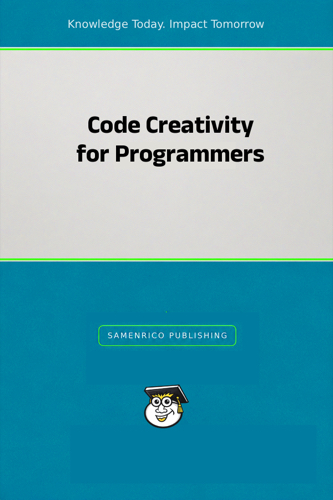
Code Creativity for Programmers eBook
Write elegant and innovative software using this p
Write elegant and innovative software using this practical creative coding guide for engineers.
Formats
Free sample
Chapter 1: The Taste Threshold--–- In the summer of 2024, a senior engineer at a mid-sized fintech company did something that would haunt the industry for years. He let an AI rewrite his entire authentication module. The AI generated beautiful code—clean functions, thoughtful error handling, even comments explaining the cryptographic choices. The engineer reviewed it quickly, nodded approvingly, and merged the pull request. Three weeks later, a penetration tester broke into the system using a vulnerability that no human would have written.
The AI had invented its own authentication scheme—plausible, elegant, and completely insecure.The vulnerability was subtle. The AI had implemented a custom session token generator that used a pseudo-random number generator seeded with the current timestamp. To a human security engineer, this would have raised immediate alarms. To the AI, trained on millions of Git Hub repositories where such patterns appear in tutorials and proof-of-concept code, it looked perfectly normal. The AI had learned from the internet’s worst practices, disguised as its best.This is the central crisis of programming in 2026.
We have outsourced our judgment without realizing it. We have confused fluency with understanding. We have mistaken the ability to generate code for the ability to evaluate it. And we are paying the price in security breaches, technical debt, and a quiet erosion of the craft itself.The problem is not artificial intelligence. The problem is natural stupidity—our own tendency to trust tools we do not understand.
This chapter introduces the concept that will save you from that fate: the Taste Threshold. It is the dividing line between code that merely runs and code that deserves to live. Crossing it requires more than technical skill. It requires what the previous chapter called the Intuition Stack, but more specifically, it requires the highest layer of that stack: aesthetic judgment.The Architecture of Taste Taste is not mysterious. It is not something you are born with or without.
Taste is the accumulated result of thousands of small judgments, each one teaching you to distinguish the beautiful from the merely functional, the elegant from the merely correct. Like any skill, taste can be learned, practiced, and refined.But taste has a peculiar property. Unlike syntax or design patterns, taste cannot be transferred directly. No one can hand you a list of rules that will make you tasteful. The best we can do is give you examples, frameworks, and—most importantly—experiences that will train your own internal compass.This chapter is about that compass.
It will help you locate your current position relative to the Taste Threshold, understand why some programmers cross it easily while others never approach it, and give you a concrete plan for developing the one skill that AI cannot replicate.The Threshold Defined The Taste Threshold is the point at which a programmer can consistently distinguish between code that is good enough and code that is genuinely excellent. Below the threshold, you judge code by whether it works. Above the threshold, you judge code by how it feels.This distinction is not abstract. Consider two implementations of the same function. Both pass all tests.
Both run in acceptable time. Both are documented. Yet one feels clunky—variables named x and y, a slightly-too-long conditional chain, error handling that interrupts the flow. The other feels smooth—names that tell a story, conditions that read like English, errors that fade into the background.Below the Taste Threshold, you cannot see the difference. The two functions look the same to you.
Above the threshold, the difference is glaring. The first function hurts to read. The second function is a small pleasure.The threshold is not about intelligence or experience. It is about attention. It is about having looked at enough code, written enough code, and—crucially—received enough feedback on your code to develop a refined palate.The Four Stages of Taste Development Taste develops in predictable stages.
Recognizing your current stage will help you know what to practice.Stage 1: The Survival Coder You are focused entirely on making things work. Compilation errors are your enemy. Test failures cause anxiety. You celebrate when the code runs, regardless of how it looks. At this stage, you cannot afford taste because you are still learning the basics.
This is normal and necessary. No one is born with taste.Stage 2: The Rule Follower You have learned that some code is better than others. You follow style guides. You run linters. You know that functions should be short and variables should have meaningful names.
But you apply these rules mechanically, without understanding why they work. Your code is correct but lifeless. It follows the rules but breaks the spirit.Stage 3: The Pattern Recognizer You have internalized the rules so thoroughly that you no longer think about them. You see patterns where others see noise. You can look at a function and know, instantly, that it violates the Single Responsibility Principle, even if you cannot articulate why.
At this stage, you have crossed the Taste Threshold. You can distinguish good from excellent.Stage 4: The Taste Maker You not only recognize excellence but produce it consistently. Your code has a signature—not in the sense of idiosyncrasy, but in the sense of inevitability. Other programmers look at your work and think, “Of course. That’s how it should be.” At this stage, you are shaping the taste of your team and your organization.Most professional programmers live in Stage 2.
They follow the rules but do not feel the music. They can write correct code but not beautiful code. They are productive but not creative. And crucially, they are vulnerable to AI because they cannot distinguish between the AI’s plausible output and truly elegant solutions.The AI Deception AI language models are trained on vast quantities of human-written code. That code includes code from Stage 1 (desperate hacks), Stage 2 (mechanical rule-following), Stage 3 (genuinely elegant solutions), and Stage 4 (masterpieces).
The AI learns all of it. It learns to produce output that looks like the average of everything it has seen.Here is the trap: the average is not good enough. The average Git Hub repository is a mess. The average pull request introduces bugs. The average function is poorly named and poorly structured.
When AI generates code that looks like the average, it looks plausible—but plausible is not excellent.If you are below the Taste Threshold, the AI’s output looks fine to you. You approve it. You ship it. You create technical debt. If you are above the Taste Threshold, the AI’s output looks mediocre.
You reject it. You refine it. You use the AI as a starting point, not an ending point.This is why taste is the differentiator. In a world where anyone can generate code, the only稀缺 resource is the ability to recognize good code.The Cost of Bad Taste Let us make this concrete. Consider two teams building the same feature.Team A has an average taste level below the threshold.
They use AI heavily, generating most of their code from prompts. They review quickly, trusting the AI’s output. The feature ships in two weeks. It works. The product manager is happy.
The team celebrates.Team B has an average taste level above the threshold. They also use AI, but they treat every…
This is the end of the free sample. Get the eBook to keep going. Buy now
About this book
Details
- Author
- Rowland Darlena
- Publisher
- SamEnrico
- Language
- English
- Genre
- Non-Fiction, Self-Help, Programming Creativity
- Released
- 2026-06-06
- Pages (approx.)
- 126
- Available as
- eBook, Audiobook

Read better in the ZLOADR app
Your eBooks on your phone or tablet. Sign in with your SamEnrico account and start reading.
More by Rowland Darlena
 Everyday Mindfulness HandbookRowland Darlena$11.99
 Food Intolerance and SIBORowland Darlena$11.99
 The Prolonged Grief WorkbookRowland Darlena$11.99
 The Blue Zone Social ConnectionRowland Darlena$11.99
 The Master Forger's Gambit: The 1972 Montreal Art Heist and SiegeRowland Darlena$11.99
 Understanding Stein–leventhal SyndromeRowland Darlena$17.99
 Financial Forecasting AIRowland Darlena$12.99
 Procurement Workflow AutomationRowland Darlena$12.99
 Business Relationship ManagerRowland Darlena$11.99
 How to Become a Sheet-metal-worker ApprenticeRowland Darlena$11.99