
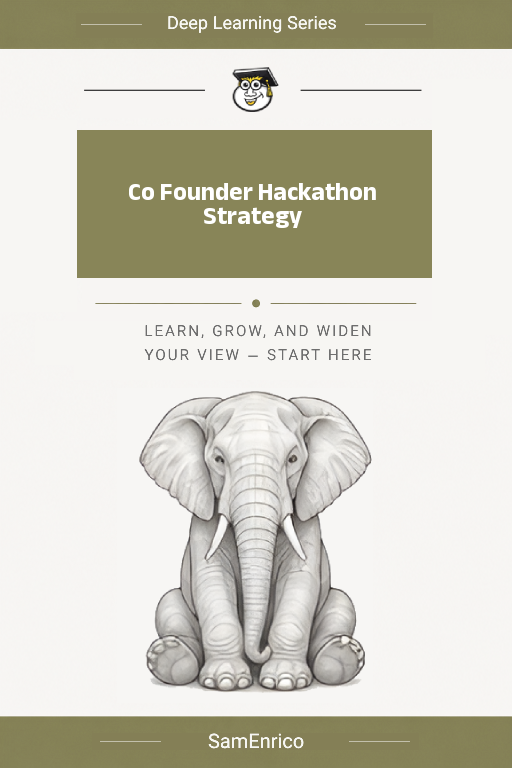
Non-FictionFirst 30 DaysHackathons
Co Founder Hackathon Strategy eBook
Meet potential co-founders by participating in onl
by Pope Leslie
Meet potential co-founders by participating in online and in-person hackathons.
Formats
Free sample
Chapter 1: The Coffee Lie--–- The coffee shop was buzzing with the sound of wasted potential. Across a tiny round table, two aspiring founders nodded enthusiastically at each other’s pitch decks. They had matching logos, matching fundraising targets, and matching delusions. Neither had ever written a line of code together. Neither had ever argued about an API at 3 AM.
Neither had ever stared at a broken demo with four hours left on a timer and felt the cold sweat of real partnership pressure. But they were convinced they had found their co-founder. Three months later, they weren’t speaking. The startup never launched. The coffee chats continued with new faces, new logos, new delusions.This scene repeats itself thousands of times every year.
Aspiring founders treat co-founder search like a dating app—swipe right on a promising Linked In profile, schedule a coffee chat, share some vague aspirations about “changing the world,” and call it vetting. They mistake rapport for reliability. They confuse enthusiasm for execution. And they almost always fail.This chapter dismantles the most dangerous myth in early-stage startups: that you can find your co-founder through conversation alone. Drawing from Eric Ries’s The Lean Startup, we extend the “get out of the building” mandate to co-founder search.
You cannot test a partnership hypothesis over oat milk lattes. You must test it through action. A 48-hour hackathon compresses months of vetting into a single weekend, revealing what coffee chats never will: how someone handles ambiguity, sleep deprivation, technical trade-offs, ego, and delivery.By the end of this chapter, you will never go on a “founder coffee date” again. You will understand why action is the only valid test of partnership. And you will be ready to enter the 30-day co-founder trial that begins with a hackathon.The $100 Billion Coffee Chat Let’s start with a confession.
I have sat through more than two hundred co-founder coffee chats. I have watched brilliant engineers nod politely at non-technical founders who couldn’t articulate a problem statement. I have watched non-technical founders shrink when an engineer asked, “What will you actually do while I build?” I have watched both parties leave those coffee shops feeling validated—and utterly wrong.The problem is not that coffee chats are useless. The problem is that they measure the wrong thing entirely. A coffee chat measures charisma, confidence, and conversational chemistry.
None of these predict partnership success. Startups do not fail because co-founders couldn’t hold a pleasant conversation. Startups fail because co-founders cannot disagree productively, cannot scope ruthlessly, cannot deliver under pressure, and cannot recover from failure.Let me give you a concrete example. In 2019, I watched two founders meet at a prestigious accelerator’s networking event. They had effortless chemistry.
They laughed at each other’s jokes. They finished each other’s sentences. They signed a co-founder agreement within two weeks. Eight months later, they dissolved the company in a bitter dispute over equity and work ethic. The charming conversationalist turned out to be a ghost when real work appeared.
The enthusiastic listener turned out to be incapable of making a single decision without consensus.Meanwhile, across town, two strangers met at a climate tech hackathon. They had never spoken before. Their first interaction was a tense debate about whether to use a relational or non-relational database. By hour twelve, they had stopped being polite and started being honest. By hour thirty, they had their first real argument about scope.
By the end of the weekend, they had a working prototype—and a clear sense of how the other person fought, fixed, and finished. That team is now a profitable company with twelve employees.The coffee chat couple raised more money. The hackathon couple built more value. This pattern is not an accident.Why Conversation Is a Terrible Vet To understand why coffee chats fail, we have to understand what they actually measure. Conversation measures presentation self—the version of ourselves we curate when we have time to prepare, when we are well-rested, when we are not under threat.
Partnership requires pressure self—the version of ourselves that emerges when the demo crashes, when the investor says no, when the co-founder makes a mistake that costs us the weekend.You cannot access pressure self through conversation. Pressure self only appears in three conditions: ambiguity (no clear right answer), constraint (limited time or resources), and consequence (real stakes for failure). Coffee chats have none of these. A hackathon has all three.Let me break this down by the specific traits coffee chats cannot measure:First, ambiguity tolerance. In a coffee chat, every question has a safe, rehearsed answer.
“What’s your biggest weakness?” The founder smiles and says, “I care too much.” In a hackathon, ambiguity is constant. The API documentation is wrong. The judge’s feedback is contradictory. The team has two hours to decide between two equally plausible technical directions. You watch how someone thinks when the answer is not obvious.
Do they freeze? Do they over-optimize? Do they make a decision and move on? These patterns predict how they will behave when your startup hits its first crisis.Second, delivery under constraint. Coffee chats have no constraints.
You can talk for an hour without producing anything. Hackathons have extreme constraints. You have forty-eight hours to go from nothing to something demonstrable. You watch how someone prioritizes when everything feels urgent. Do they build the magic or the login page?
Do they fake what can be faked or insist on perfection? Do they ship something ugly that works or something beautiful that crashes? Delivery under constraint is the single best predictor of startup velocity.Third, ego regulation. In a coffee chat, ego is invisible. Everyone is on their best behavior.
In a hackathon, ego is unavoidable. Someone’s code gets rewritten. Someone’s design gets rejected. Someone’s brilliant idea gets cut for time. You watch how someone handles being wrong, being overruled, or being ignored.
Do they get defensive? Do they learn? Do they pivot with grace or resist with resentment? Ego regulation determines whether your startup will have productive conflict or destructive drama.Fourth, recovery from failure. Coffee chats have no failure.
Everything is hypothetical. Hackathons have constant, humiliating failure. The build breaks. The demo fails. The judges dismiss your project as “interesting but not viable.” You watch how someone responds to the word “no.” Do they blame the judges?
Do they blame the API? Do they say, “That was useful feedback,” and iterate? Or do they spiral, shut down, or lash out? Recovery from failure is the difference between a startup that learns and a startup that collapses.Fifth, follow-through. This is the killer.
Coffee chats measure nothing about follow-through because nothing follows from a coffee chat except another coffee chat. Hackathons produce a concrete artifact—a prototype, a demo, a shared experience. You then watch what someone does after the event. Do they ghost? Do they send a half-hearted “great working with you” message and disappear?
Do they show up the next day with fixes, improvements, and questions? Follow-through after the hackathon is the ultimate test of partnership potential. And you cannot fake it.The Idea-Stage Loneliness Trap…
This is the end of the free sample. Get the eBook to keep going. Buy now
About this book
Details
- Author
- Pope Leslie
- Publisher
- SamEnrico
- Language
- English
- Genre
- Non-Fiction, First 30 Days, Hackathons
- Released
- 2026-06-01
- Pages (approx.)
- 148
- Available as
- eBook, Audiobook

Read better in the ZLOADR app
Your eBooks on your phone or tablet. Sign in with your SamEnrico account and start reading.
More by Pope Leslie
 Negotiation Role Play ScenariosPope Leslie$11.99
 Child Loss Music TherapyPope Leslie$11.99
 Sober Parenting During RecoveryPope Leslie$11.99
 Financial Guilt ResolutionPope Leslie$11.99
 The Phonetic Number MemoryPope Leslie$11.99
 Partner HIIT MotivationPope Leslie$11.99
 Legacy Through MusicPope Leslie$11.99
 Divorce and Travel AlonePope Leslie$11.99
 Wolf vs. Fox: The Battle of Fort William Henry and the Fates of EmpiresPope Leslie$11.99
 The Wall That Stood: The Ming Dynasty's Last Stand at the Great WallPope Leslie$11.99
 How to Produce Motorcycle Bags and PanniersPope Leslie$11.99
 Generative AI Whitepaper GuidePope Leslie$12.99
You may also like
 Hong Kong Handover 1997Dunn Johnnie$11.99
 Zumba For Postnatal Recovery CourseNeal Christian$11.99
 Zumba for BeginnersLadner Nikia$11.99
 YouTube Comment Mining GuideHumes Pandora$12.99
 Worry Box MeditationCarlin Rudy$11.99
 Workplace Stress MeditationNguyen Lynn$11.99
 Workplace Stress and Sleep RepairHawley Ivory$11.99
 Workplace Perfectionism CureDelaney Jeffry$11.99
 Workplace Injustice Anger GuideWallen Isabelle$11.99
 Work Addiction and Burnout LinkGreenwood Ester$11.99
 Women in Yoga and WellnessBeattie Galina$11.99
 Women in Stand Up ComedyChun Evangeline$11.99